The story in brief
Learn how camera angles and their emotional meaning shape power, vulnerability, intimacy, and tension, with framing advice and AI image and video prompts.
Inside this story
A support guide for AI cinematic creators
Table of contents
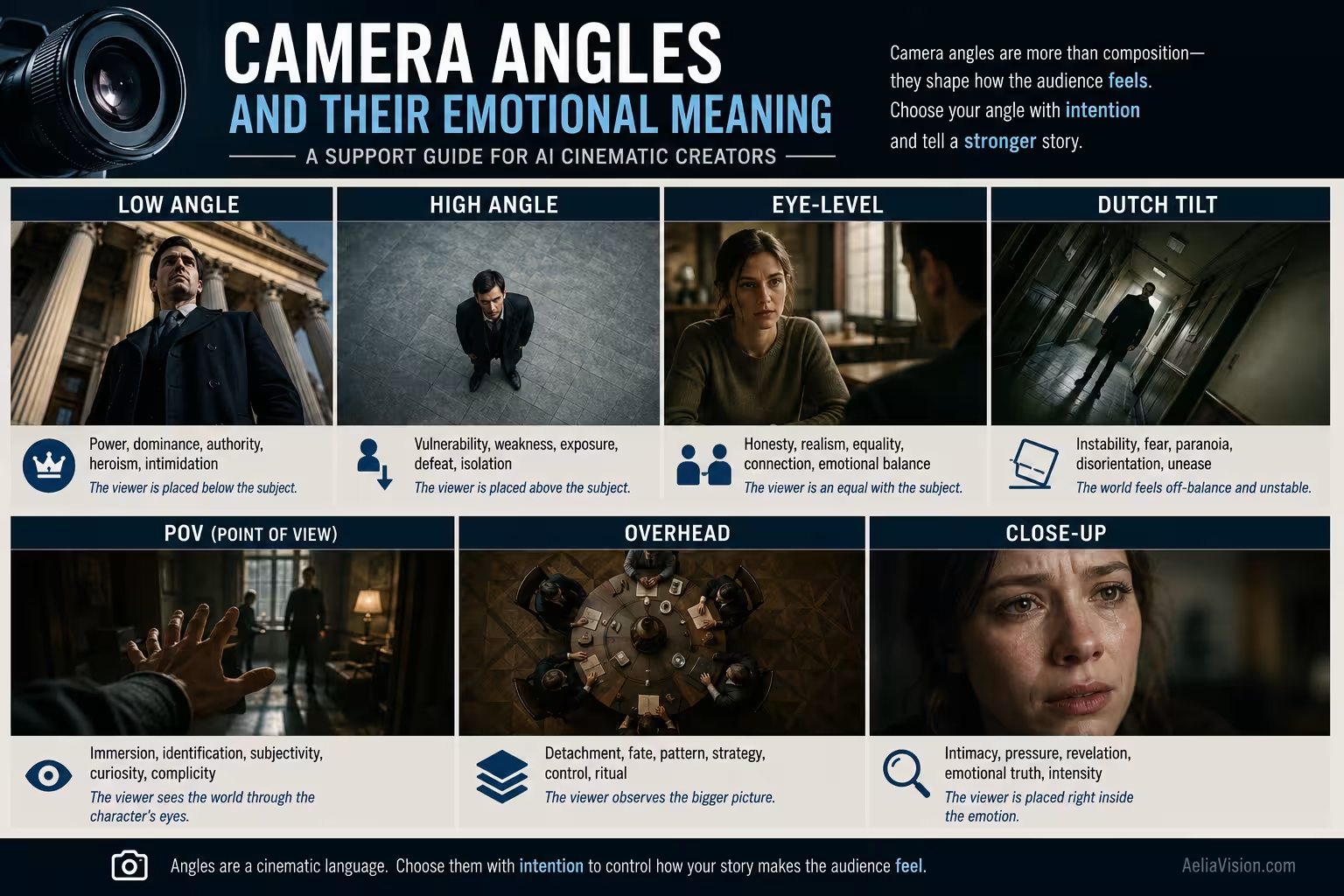
Camera angle is one of the fastest ways to change the emotional meaning of an image. Before the audience fully understands the dialogue, costume, color palette, or story context, the camera has already placed them in a psychological relationship with the subject. The viewer may feel beneath a powerful figure, above a vulnerable character, beside someone as an equal, inside a character’s point of view, or pressed close to a face at the exact moment emotion breaks through.
That is the real power of camera angles. A camera angle is not only where the camera is placed. It is where the audience is emotionally positioned.
For AI cinematic creators, the problem shows up quickly. AI tools can generate beautiful frames very quickly, but they often default to attractive, generic compositions unless you tell them how the camera should relate to the subject. If you only write “cinematic portrait” or “dramatic shot,” the AI may create something polished, but it will not necessarily understand power, vulnerability, intimacy, fear, instability, or subjectivity.
Stronger cinematic images and videos come from prompting camera angles with emotional intention. Instead of asking, “What angle looks cool?” ask, “What should this angle make the audience feel?”
This guide explains the emotional meaning of the most important cinematic camera angles: low angle, high angle, eye-level, Dutch tilt, POV, overhead, and close-up angles. Each section includes practical use cases, common mistakes, and prompt examples for AI image and video generation.
Why camera angles matter
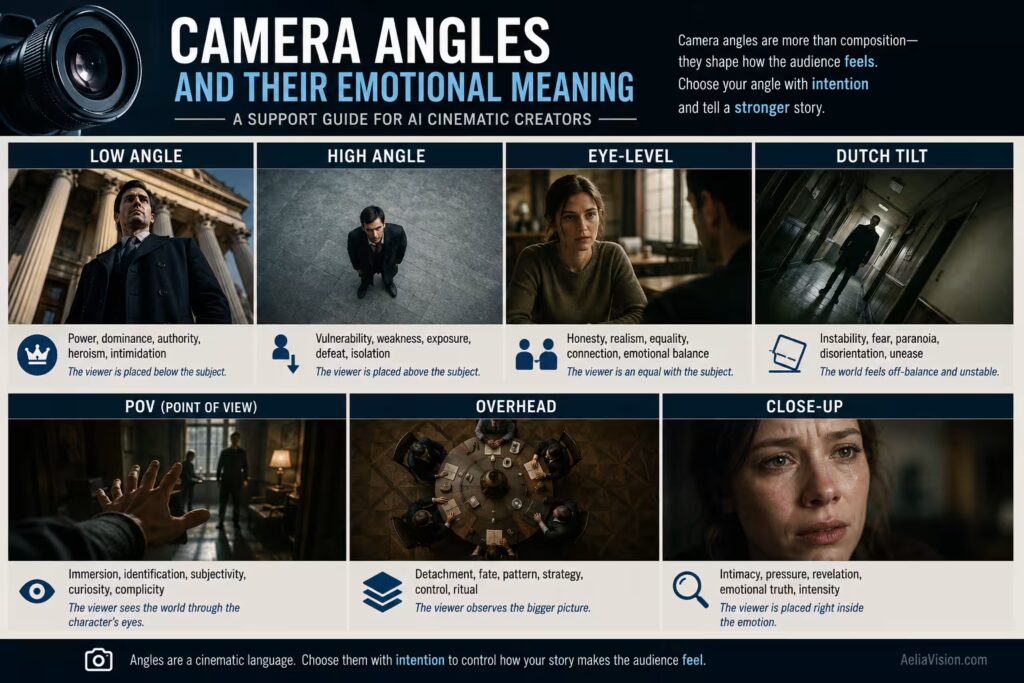
Camera angles shape meaning because they define the viewer’s position in relation to the subject. A character filmed from below feels different from a character filmed from above. A face filmed at eye level feels different from a face filmed at a tilted angle. A scene shown from a character’s point of view feels different from a scene shown from a detached overhead perspective.
The subject may be the same, but the emotional reading changes.
Imagine a ruler standing in a palace. If the camera is low, the ruler may feel powerful, threatening, or mythic. If the camera is high, the same ruler may feel exposed, defeated, or small inside the architecture. If the camera is eye-level, the ruler may feel human and approachable. If the camera is tilted, the palace may feel unstable or morally corrupted. If the camera is overhead, the ruler becomes part of a larger political system or ritual.
The angle changes the meaning.
Camera angles can communicate power, weakness, fear, authority, intimacy, distance, suspicion, instability, subjectivity, emotional pressure, detachment, and control. This is why angle choice should never be random. Every camera angle should answer a story question: Who has power? Who is vulnerable? Should the viewer feel close or distant? Should the world feel stable or unstable? Should the audience observe the scene, or experience it from inside a character’s mind?
When you answer those questions, camera angles become cinematic language.
Quick reference: camera angles and emotional meaning
Use this table as a starting point, not as a fixed rulebook. Camera meaning always depends on story context, lens choice, blocking, lighting, and movement.
| Camera Angle | Emotional Meaning | Best Used For |
|---|---|---|
| Low Angle | Power, dominance, threat, myth, authority | Heroes, villains, rulers, monsters, institutional force |
| High Angle | Vulnerability, weakness, exposure, defeat | Isolation, shame, social pressure, emotional collapse |
| Eye-Level | Honesty, realism, equality, human connection | Dialogue, drama, grounded realism, emotional neutrality |
| Dutch Tilt | Instability, fear, paranoia, disorientation | Horror, thrillers, madness, moral imbalance |
| POV | Identification, immersion, subjectivity, complicity | Suspense, discovery, fear, action, voyeurism |
| Overhead | Detachment, fate, pattern, strategy, control | Rituals, crime scenes, battles, choreography, systems |
| Close-Up Angle | Intimacy, pressure, revelation, emotional truth | Confession, realization, grief, fear, decision moments |
Low angle
What is a low angle?
A low angle places the camera below the subject’s eyeline, looking upward. The lower the camera goes, the more the subject can appear visually dominant, powerful, threatening, or monumental. A subtle low angle may simply give a character authority, while an extreme low angle can make the viewer feel physically small beneath the subject.
Emotional meaning of a low angle
A low angle is most often used to communicate power. It can make a hero feel legendary, a villain feel dangerous, a king feel untouchable, or a building feel oppressive. The audience is visually placed beneath the subject, which creates an immediate power imbalance.
This angle is useful when the story moment is about a character taking control, a villain entering the scene, a hero becoming larger than life, a ruler asserting authority, a monster looming over someone, or an institution feeling overwhelming. For example, if a queen steps onto a balcony before thousands of soldiers, a low angle can make her body rise against the sky and turn her into a symbol of command.
Blocking and lens considerations
Low angles work best when the subject’s posture supports the power. The character may stand taller than others, look slightly above the lens, occupy the center of the frame, block another character’s path, or be placed against strong vertical architecture. A clear silhouette also helps because it gives the body a monumental shape.
Be careful with faces. If the camera is too low, the chin, nostrils, or neck may become distracting. In AI images, extreme low angles can also cause warped anatomy, stretched limbs, or distorted architecture.
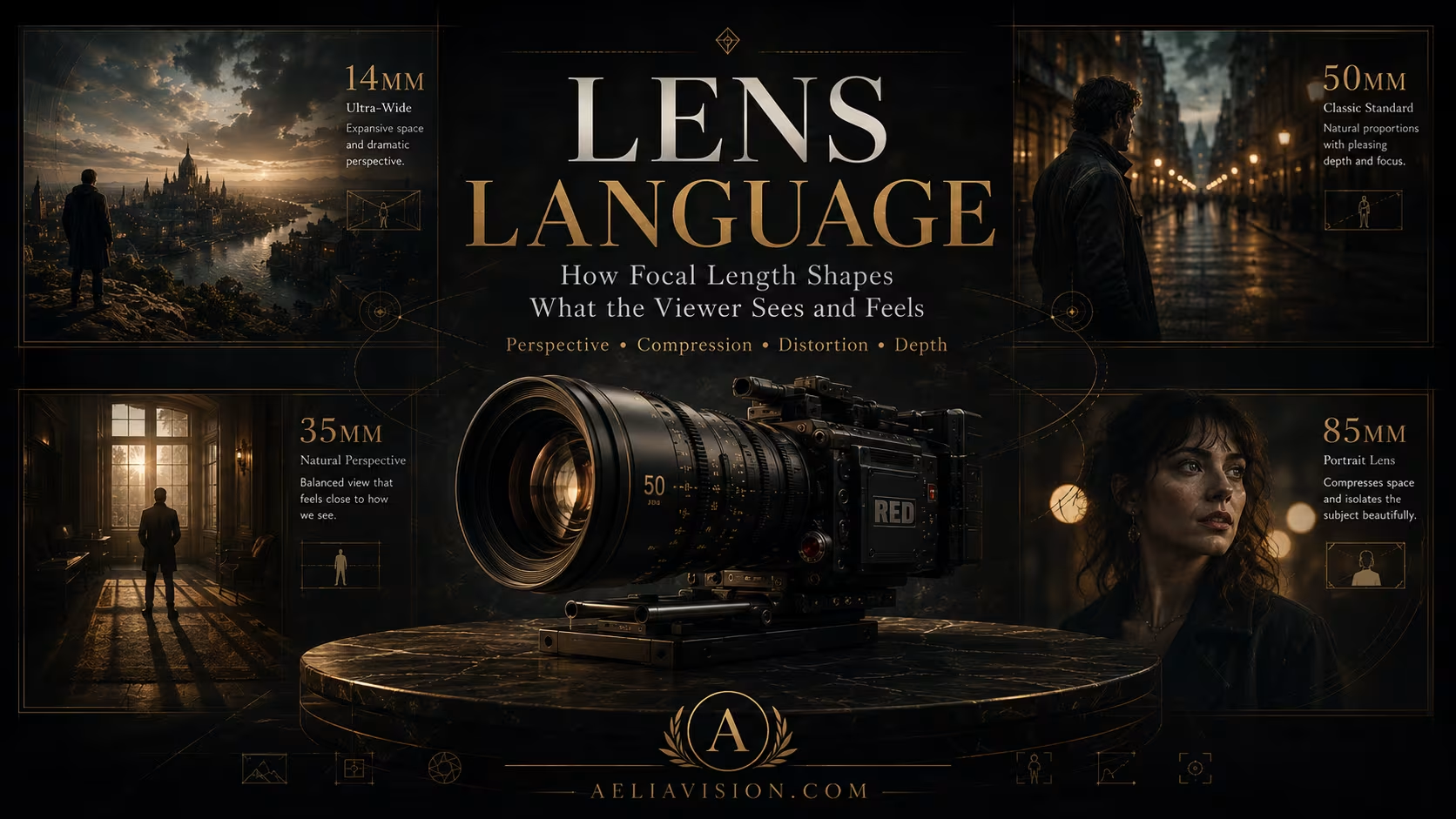
Lens choice changes the feeling of the low angle. A 24mm or 28mm lens can exaggerate vertical lines and make bodies, buildings, and environments feel massive. A 50mm or 85mm lens keeps the power cue but feels more controlled and less distorted. Use wider lenses for myth, threat, scale, or environmental force. Use longer lenses for controlled authority, elegance, or formal power.
AI still image prompt example
Prompt:
Cinematic low-angle medium shot of a powerful queen standing at the top of ancient stone steps, camera below eyeline, 35mm lens, strong vertical architecture behind her, dark royal cloak falling heavily, sunrise backlight creating a sharp heroic silhouette, soldiers blurred below in the foreground, controlled authority, realistic fabric texture, natural shadows, epic but grounded realism.
Negative prompt:
No fisheye distortion, no warped hands, no extra fingers, no floating fabric, no cartoon armor, no exaggerated lens flare, no tilted horizon.
AI video prompt example
Prompt:
5-second slow dolly-in from a low angle toward a ruler stepping onto a throne platform. Camera remains below eyeline, slight tilt-up as the ruler stops at center frame. The movement should feel controlled and authoritative. Preserve face identity, costume, lighting direction, and architecture. No random camera orbit, no shaky movement, no warping, no changing background geometry.
High angle
What is a high angle?
A high angle places the camera above the subject, looking downward. It visually reduces the subject within the frame, making them appear smaller, weaker, exposed, watched, judged, or overwhelmed by the environment.
Emotional meaning of a high angle
A high angle often communicates vulnerability. The audience is placed above the subject, which can make the viewer feel like they are observing someone who has lost control. This angle is useful for moments of defeat, shame, isolation, surveillance, social pressure, emotional collapse, or public exposure.
For example, a boxer sitting alone in the ring after losing the final round will feel more vulnerable if seen from above. The ring becomes large and empty around him, while his body feels smaller inside the space.
Blocking and lens considerations
High angles work best when the subject’s body language supports vulnerability. The character may look downward, sit, kneel, collapse their shoulders, occupy a low position in the frame, or be surrounded by empty space. They may also be separated from others or watched by people above or around them.
Avoid making the angle too extreme unless you specifically want an overhead effect. A high angle still keeps an emotional relationship with the subject. An overhead shot turns the subject into a more graphic element inside a visual pattern.
A 35mm to 65mm lens often works well for a clean high-angle shot. A wider lens can make the environment feel larger and more oppressive, while a longer lens can make vulnerability feel quieter, more controlled, or more observational.
AI still image prompt example
Prompt:
Cinematic high-angle wide shot of a young man sitting alone on a courtroom bench after hearing the verdict, camera above eyeline looking down, 50mm lens, polished floor and tall doors surrounding him, large empty space emphasizing vulnerability, cool daylight from high windows, restrained color palette, realistic posture, quiet emotional defeat.
Negative prompt:
No top-down overhead view, no fisheye distortion, no exaggerated sadness, no glam lighting, no crowded background, no warped perspective.
AI video prompt example
Prompt:
6-second slow crane down into a high-angle view of a defeated boxer sitting alone in the corner of the ring. The crowd fades into soft background movement while the boxer remains still. Camera should feel observational and quiet, not dramatic or flashy. Preserve body position, ring geometry, lighting, and scale. No spinning camera, no sudden zoom, no face warping.
Eye-level angle
What is an eye-level angle?
An eye-level angle places the camera roughly at the subject’s eye height. It is one of the most natural and human camera positions. Unlike low and high angles, eye-level does not strongly push power or weakness. Instead, it often creates honesty, balance, realism, and emotional access.
Emotional meaning of an eye-level angle
Eye-level framing says, “We are with this person.” It does not force the viewer to look up or down at the subject, which makes it ideal for grounded human scenes. It often communicates equality, honesty, realism, emotional clarity, natural intimacy, and observational truth.
Use eye-level framing when the story moment is about dialogue, moral ambiguity, quiet drama, honest emotional exchange, everyday life, or human truth without exaggeration. If two siblings sit across a kitchen table after years of silence, an eye-level angle allows the performance to carry the emotion without making the frame feel manipulative.
Blocking and lens considerations
Eye-level shots depend heavily on eyelines. If two characters are speaking, their eyelines must feel consistent. If one character looks camera-left, the other should usually look camera-right in the matching shot. When eyelines are wrong, the scene feels false even if the image itself looks beautiful.
Because eye-level framing is less dramatic by itself, composition, lighting, and performance become even more important. The subject may face another character honestly, avoid eye contact for emotional tension, sit or stand naturally, or be framed in a balanced medium shot with readable facial expression and body language.
A 35mm, 40mm, 50mm, or 65mm lens often works well. A 35mm lens keeps some environment visible, a 50mm lens feels natural and focused, and an 85mm lens can make eye-level framing feel more intimate and isolated.
AI still image prompt example
Prompt:
Cinematic eye-level medium two-shot of two adult brothers sitting across a modest kitchen table at dusk, 50mm lens, natural human perspective, soft window light mixed with a warm practical lamp, quiet emotional honesty, balanced composition, hands visible on the table, realistic skin texture, restrained color palette, no melodrama.
Negative prompt:
No low angle, no high angle, no Dutch tilt, no exaggerated bokeh, no misaligned eyelines, no glamour retouching, no artificial lens flare.
AI video prompt example
Prompt:
7-second locked-off eye-level conversation shot between a doctor and a patient in a quiet office. Camera remains still at seated eye height. Both characters maintain natural eyelines and subtle body language. Lighting is soft and realistic. No dramatic push-in, no camera shake, no jumpy reframing, no eyeline mismatch.
Dutch tilt
What is a Dutch tilt?
A Dutch tilt, also called a canted angle, tilts the camera so the horizon line is not level. Instead of keeping the world stable, the frame becomes diagonal. This immediately creates visual discomfort.
Emotional meaning of a Dutch tilt
A Dutch tilt often communicates instability, fear, paranoia, disorientation, madness, moral imbalance, danger, or psychological unease. The angle tells the viewer that something is not stable.
Because it is so noticeable, it must be used carefully. A Dutch tilt becomes powerful when the story world or the character’s inner state has become unstable. It becomes cheap when it is used only to make a shot look stylish.
Use a Dutch tilt when a character loses control, discovers something suspicious, enters a corrupted space, experiences panic, or feels reality shift. For example, if a detective enters a hotel hallway and realizes every door has the same number, a Dutch tilt can make the space feel psychologically wrong.
Blocking and lens considerations
Dutch tilt works best when the environment has strong lines that reveal the tilt. Hallways, door frames, windows, staircases, street lamps, floor tiles, walls, architecture, and long shadows all help the audience feel the imbalance.
Avoid using a Dutch tilt in an empty frame with no visual reference. The audience needs a horizon, wall, or vertical line to understand that the world is off-balance.
A 24mm to 50mm lens is often effective. Wide lenses can make the tilt feel more intense, while normal lenses keep it controlled and readable. Avoid combining extreme wide distortion with extreme tilt unless the scene is intentionally surreal or expressionistic.
AI still image prompt example
Prompt:
Cinematic Dutch-angle medium-wide shot of a detective standing in a narrow hotel corridor at night, 35mm lens, tilted horizon, repeating doors and diagonal shadows creating visual unease, flickering wall lights, rain reflection on the floor, suspicious body posture, noir thriller atmosphere, restrained color palette.
Negative prompt:
No level horizon, no comedy tone, no fisheye distortion, no over-neon colors, no messy clutter, no exaggerated tilt that makes the scene unreadable.
AI video prompt example
Prompt:
5-second slow diagonal tracking shot through a slightly canted hospital corridor. The camera maintains a subtle Dutch tilt while moving forward slowly. Fluorescent lights flicker softly. The mood is psychological unease, not action. Preserve corridor geometry and horizon tilt. No spinning camera, no extreme blur, no chaotic handheld movement, no focus hunting.
POV angle
What is a POV shot?
A POV shot shows the scene from a character’s viewpoint or near-viewpoint. The audience sees what the character sees. It can feel fully subjective, like looking through the character’s eyes, or near-subjective, where the camera stands close to the character’s perspective.
Emotional meaning of POV
POV changes the audience from observer to participant. Instead of watching someone enter a room, the viewer feels like they are entering the room. This makes POV powerful for identification, immersion, suspense, fear, curiosity, voyeurism, and complicity.
Use POV when the story moment is about discovery, hiding, being chased, opening a door, searching a crowd, seeing through someone’s eyes, or making the audience complicit in looking. For example, if a character slowly opens a motel room door and we see their hand reach forward from their own point of view, the audience becomes the character.
Blocking and lens considerations
POV requires clear setup. The audience must understand whose POV it is, where the character is standing, what they are looking at, and how other characters respond to the viewer’s position. If another character looks directly at the lens, it should feel like they are looking at the POV character.
In AI, POV often fails because the model creates a third-person shot instead. To prevent this, mention visible body parts and camera height. Phrases like “one hand visible at the bottom of frame,” “camera at standing human eye height,” “breathing-level handheld sway,” or “subject across the room looking toward camera” can help the model understand the intended perspective.
A 24mm to 50mm lens usually feels most natural. A 24mm lens can feel immersive and physical, a 35mm lens feels human and balanced, and a 50mm lens feels focused and less distorted.
AI still image prompt example
Prompt:
Cinematic near-subjective POV shot from a person standing in a dark apartment doorway, 35mm lens, one trembling hand visible near the bottom of frame, a suspicious man across the room turning toward the camera, motivated warm lamp light, deep shadows in the corners, realistic room scale, suspenseful atmosphere, grounded human perspective.
Negative prompt:
No third-person view, no floating camera, no extra hands, no distorted fingers, no drone angle, no symmetrical studio lighting, no game HUD, no text overlay.
AI video prompt example
Prompt:
6-second handheld POV shot walking slowly through a crowded train platform, camera at human eye height, subtle breathing sway, scanning faces to find one specific person. A hand briefly enters the lower frame holding a folded photo. Movement should feel human and suspenseful. No rollercoaster motion, no hyperactive whip pans, no exposure flicker, no extra fingers, no third-person cutaway.
Overhead angle
What is an overhead angle?
An overhead angle places the camera directly or almost directly above the subject, looking down. Unlike a normal high angle, an overhead shot often removes personal intimacy and turns the scene into geometry.
People become shapes. Movement becomes pattern. The room becomes a map.
Emotional meaning of overhead shots
Overhead angles often communicate detachment, fate, strategy, control, pattern, choreography, ritual, surveillance, emotional distance, or system-level thinking. The overhead angle tells the viewer, “We are not inside the character’s emotion. We are seeing the larger design.”
Use overhead framing when the story moment is about a crime scene, ritual, battle plan, dance pattern, group formation, evidence table, chess-like power structure, or movement choreography. It is also useful when a character feels trapped inside a larger system.
Blocking and lens considerations
Overhead shots must be designed graphically. From above, faces are usually less important than shape, spacing, and movement. Think in circles, lines, diagonals, triangles, clusters, empty space, symmetry, and repetition.
If the subject blends into the floor, the shot fails. Use costume contrast, light pools, strong shadows, or clear object placement to separate the subject from the background.
A 24mm to 50mm lens can work depending on the space. A wider lens shows more geography but can warp edges. A 35mm or 50mm overhead shot may feel cleaner and more controlled.
AI still image prompt example
Prompt:
Cinematic overhead shot directly above a detective’s evidence table, 35mm lens equivalent, photographs, maps, notes, and red thread arranged in precise visual geometry, hands entering frame from different sides, warm desk lamp creating pools of light, dark surrounding room, procedural thriller mood, clear graphic composition.
Negative prompt:
No steep high-angle view, no messy clutter, no unreadable objects, no random shadows, no warped hands, no tilted perspective, no extra text artifacts.
AI video prompt example
Prompt:
5-second locked overhead shot of dancers crossing and separating into precise geometric patterns on a rain-dark street. Camera remains directly above, no tilt. Movement forms clean circles and diagonals. Reflections on pavement enhance the pattern. No wobbling drone motion, no perspective drift, no chaotic blocking, no smearing motion artifacts.
Close-up angle
What is a close-up angle?
A close-up frames a face, object, or detail so it dominates the image. Close-up is not only a shot size. It is also an emotional angle because it changes the viewer’s psychological distance from the subject.
The audience is no longer observing the scene from outside. They are brought close enough to read thought, breath, tension, moisture, skin texture, eye movement, and micro-expression.
Emotional meaning of close-ups
Close-ups often communicate intimacy, pressure, revelation, confession, fear, grief, love, suspicion, decision, emotional truth, or psychological exposure. A close-up tells the audience, “This feeling matters.”
Use close-ups when the story moment is about a character realizing the truth, confessing, making a decision, discovering a betrayal, hiding an emotion, noticing a symbolic object, or experiencing a final emotional shift. For example, if a woman hears that her brother betrayed her and says nothing, the close-up allows the audience to see the emotional break through her eyes.
Blocking and lens considerations
Close-ups need less physical movement and more emotional precision. Small details matter: eye movement, breath, blink timing, jaw tension, tearline, chin position, a slight head turn, a hand touching the face, looking away, or looking into the light.
Do not use a close-up only because you want beauty. A close-up must be earned by story.
An 85mm lens is classic for emotional close-ups because it compresses the face gently and separates the background. A 50mm close-up feels more immediate and human, while a 35mm close-up feels invasive and physically close. Use longer lenses for elegance and isolation. Use shorter lenses for pressure, discomfort, or subjective intensity.
AI still image prompt example
Prompt:
Cinematic close-up of a young woman realizing she has been betrayed, 85mm portrait lens, eyes wet but controlled, soft side light from camera-left, controlled negative fill on the shadow side, background dissolved into warm darkness, natural skin texture, visible pores and tearline, restrained expression between anger and disbelief, realistic emotional performance.
Negative prompt:
No beauty-filter skin, no plastic face, no exaggerated crying, no warped eyes, no extra eyelashes, no over-sharpening, no distracting background, no excessive bokeh swirls.
AI video prompt example
Prompt:
5-second very slow push-in to a close-up of a suspect deciding whether to confess. The camera movement is almost imperceptible. The subject stays still except for breathing and a small eye movement in the final second. Soft side light, natural skin texture, sharp focus on eyes. No rapid zoom, no face warping, no handheld jitter, no overacted crying, no focus hunting.
How to choose the right camera angle
Choosing the right angle begins with emotional intention. Do not choose the angle first. Choose the feeling first.
If the subject should feel powerful, use a low angle, central framing, or larger scale. If the subject should feel vulnerable, use a high angle, empty space, or smaller scale. If the moment should feel honest and human, use eye-level framing. If the world should feel unstable, use a Dutch tilt. If the viewer should feel inside the character’s experience, use POV. If the scene should feel like a system, map, ritual, or pattern, use overhead. If the audience must read emotion directly, use a close-up.
A practical decision formula is:
| Step | Question |
|---|---|
| Emotion | What should the audience feel? |
| Viewer Position | Where should the audience feel placed? |
| Camera Angle | Which angle expresses that relationship? |
| Lens | Should space feel wide, natural, compressed, intimate, or distorted? |
| Blocking | Who has power, who is vulnerable, and where are they placed? |
| Lighting | What emotional tone supports the angle? |
| Movement | Should the camera remain still, push in, pull back, track, or sway? |
For example, if the emotion is fear and the viewer should feel trapped with the character, a POV angle with a 35mm lens may work well. The blocking could include a trembling hand reaching toward a dark door, the lighting could come from a dim hallway practical, and the movement could be a slow handheld approach.
A strong prompt might be:
Handheld POV shot from a frightened character approaching a dark apartment door, 35mm lens, one trembling hand visible at bottom frame, dim hallway practical light, slow breathing sway, suspenseful realism, no third-person view.
This is more cinematic than simply writing:
scary cinematic hallway.
Common mistakes when using camera angles
Using the angle as decoration
A low angle does not automatically make a shot cinematic. A Dutch tilt does not automatically create tension. A close-up does not automatically create emotion. The angle must match the story beat.
Confusing high angle with overhead
A high angle still keeps emotional relation to the subject. An overhead angle turns the scene into geometry. Use a high angle for vulnerability, and use overhead for pattern, fate, strategy, or detachment.
Overusing Dutch tilt
Dutch tilt is powerful because it is noticeable. If used too often, it becomes cheap. Use it only when the world or character is emotionally unstable.
Forgetting lens behavior
A low angle with a 24mm lens feels different from a low angle with an 85mm lens. A close-up with a 35mm lens feels different from a close-up with an 85mm lens. Always pair angle with lens.
Ignoring eyelines
Eyelines tell the viewer where emotion is directed. If eyelines are wrong, the scene feels false. In AI prompts, include direction clearly: looking camera-left, looking toward the person off-screen, near-lens eyeline, avoiding eye contact, gaze downward, or subject looks directly into camera.
Adding movement without purpose
A camera move should strengthen the angle. A low angle with a slow push-in can increase dominance. A high angle with a pull-back can increase isolation. A Dutch tilt with spinning camera may become too much. A close-up with a tiny push-in can intensify a decision.
Letting AI change the angle during video
AI video may drift from one angle to another unless instructed. Use continuity constraints such as “maintain low angle throughout,” “preserve camera height,” “no sudden zoom,” “no camera orbit,” “no tilt change,” “keep subject centered,” and “preserve eyeline direction.”
Angle prompt templates for AI creators
| Angle | Prompt Template |
|---|---|
| Low Angle | Cinematic low-angle [shot size] of [subject], camera below eyeline, [lens] lens, [blocking/power detail], [lighting source], [environment supports dominance], [emotion], realistic textures, controlled composition. Negative: no fisheye distortion, no warped anatomy, no tilted horizon unless specified. |
| High Angle | Cinematic high-angle [shot size] of [subject], camera above eyeline looking down, [lens] lens, subject visually diminished within [environment], [negative space detail], [lighting source], [emotion]. Negative: no extreme overhead unless specified, no distorted proportions, no clutter. |
| Eye-Level | Cinematic eye-level [shot size] of [subject or characters], camera at natural human height, [lens] lens, honest emotional framing, clean eyelines, [lighting source], grounded realism. Negative: no low angle, no high angle, no Dutch tilt, no exaggerated stylization. |
| Dutch Tilt | Cinematic Dutch-angle [shot size] of [subject], subtle canted horizon, [lens] lens, diagonal architecture or shadows, [emotion of instability], [lighting source], controlled tension. Negative: no extreme tilt, no comedy tone, no fisheye distortion, no spinning motion. |
| POV | Cinematic POV shot from [character] perspective, camera at [eye height/body position], [lens] lens, [visible hand/body detail if needed], [subject/object being seen], [lighting source], subjective emotional tension. Negative: no third-person view, no floating camera, no extra hands, no game HUD. |
| Overhead | Cinematic overhead shot directly above [scene], [lens] equivalent, bodies and objects arranged in clear geometric composition, [pattern or system], [lighting pools or contrast], detached emotional perspective. Negative: no steep high angle, no tilted perspective, no messy clutter, no unclear limbs. |
| Close-Up | Cinematic close-up of [subject/detail], [lens] lens, sharp focus on [eyes/object], [micro-expression or detail], [lighting source], shallow depth of field, emotional revelation, natural texture. Negative: no plastic skin, no warped eyes, no overacting, no distracting background. |
Practice exercise: learn angles through comparison
A powerful way to train camera-angle literacy is to generate the same scene seven times, changing only the angle. Use the same character, location, clothing, lighting, and emotional context.
Scene:
A young detective discovers a hidden letter inside an abandoned office.
Generate the scene as a low angle, high angle, eye-level angle, Dutch tilt, POV, overhead, and close-up. Then compare the results. Which version feels powerful? Which feels vulnerable? Which feels most realistic? Which feels unstable? Which feels subjective? Which feels detached? Which feels emotionally intense?
This exercise teaches that camera angle is not cosmetic. It changes the meaning of the scene.
Final lesson
Camera angles are emotional positions.
A low angle places the viewer beneath power. A high angle places the viewer above vulnerability. An eye-level angle places the viewer beside a human being. A Dutch tilt places the viewer inside instability. A POV angle places the viewer inside someone’s experience. An overhead angle places the viewer above the system. A close-up places the viewer against emotion itself.
For AI cinematic creators, the key lesson is simple: do not prompt angles randomly. Prompt the relationship. Define who has power, who is vulnerable, who is watching, who is trapped, who is unstable, and who owns the emotional moment. Then choose the angle that makes that feeling visible.
A cinematic camera angle does more than show where the camera is.
It is where the audience feels from.
Continue reading
Further insights from the Journal
Have a story in mind?
Bring your next project into focus.
Tell us what you are creating and what you want the audience to feel.