The story in brief
Fashion ads need more than attractive clothes and a good location. This guide explains how to build a clear point of view, direct talent, control fabric and movement, shape light, and finish a fashion film for real campaign use.
Inside this story
excerpt: “Fashion ads need more than attractive clothes and a good location. This guide explains how to build a clear point of view, direct talent, control fabric and movement, shape light, and finish a fashion film for real campaign use.”
A fashion ad has to do two jobs at once. It has to make clothes, accessories, or beauty products desirable, and it has to make the viewer feel that the brand belongs to a particular world. The first job is tangible. Does the coat have shape? Can the audience see the drape of the trousers, the surface of the bag, the way a shoe lands? The second is harder to describe, but it decides whether the work feels like a campaign or a sequence of nice images.
A strong fashion film does not treat the garment as an object that happens to be in frame. Cut, fit, texture, scale, and movement drive the frame. A formal dress needs a different camera distance from a technical jacket. A delicate knit may need soft, patient light that shows fibers without making it look fragile. A streetwear collection can handle an aggressive rhythm, but only if the energy comes from a real attitude rather than a bundle of borrowed visual tricks.
There is no universal fashion-ad formula. Some campaigns sell intimacy and tactility. Others sell status, absurdity, athletic power, restraint, or a small moment of escape. What matters is that the decisions agree with each other. Casting, styling, location, lensing, music, pace, and typography should feel as though they came from the same brief. When they do not, a fashion film can still be expensive and technically polished, yet feel anonymous.
This guide covers the practical work behind fashion ads, from the first conversation with a client through final exports. It focuses on choices that help the clothes read, protect the brand idea, and give the post-production team material they can actually use.
Begin with the brand’s point of view
Most fashion briefs arrive with broad language: elevated, youthful, disruptive, timeless, sensual, inclusive, effortless. Those words may be useful starting points, but they cannot direct a shoot by themselves. Ask for evidence. Which garment, image, location, person, or cultural reference makes the desired feeling concrete? What should the viewer understand after ten seconds that they could not understand from a product grid?
Turn the brief into a short creative statement. It should include the collection’s visible truth, the intended emotional temperature, and one clear boundary. For example: “This summer collection is light, social, and a little unruly. The clothes should move in bright afternoon air, but the film must never feel like a resort catalog.” The boundary prevents the team from sliding toward the easiest version of the idea.
Then identify the campaign’s hierarchy. In a launch film, the collection may be the lead and the model’s character supports it. In a fragrance or luxury accessory film, the person may carry most of the story while the product appears as a precise visual punctuation. In a lookbook motion piece, the job may simply be to show every silhouette accurately and memorably. These are different productions. They need different coverage plans.
It helps to decide what the audience should notice first, second, and last. A good order might be silhouette, attitude, material, then the brand mark. If the main idea is tailoring, a close shot of a face is not automatically useful. If the main idea is a performer inhabiting a new identity, a perfectly lit detail of a cuff may be less useful than a gesture that gives the character a life.
Avoid trying to prove every brand value in one short film. Sustainability, craft, global reach, technical innovation, confidence, and romance may all be true, but a thirty-second piece cannot carry them with equal force. Choose the promise that the imagery can prove. The rest can live in stills, copy, product pages, or another chapter of the campaign.
Research references like a director, not a collector
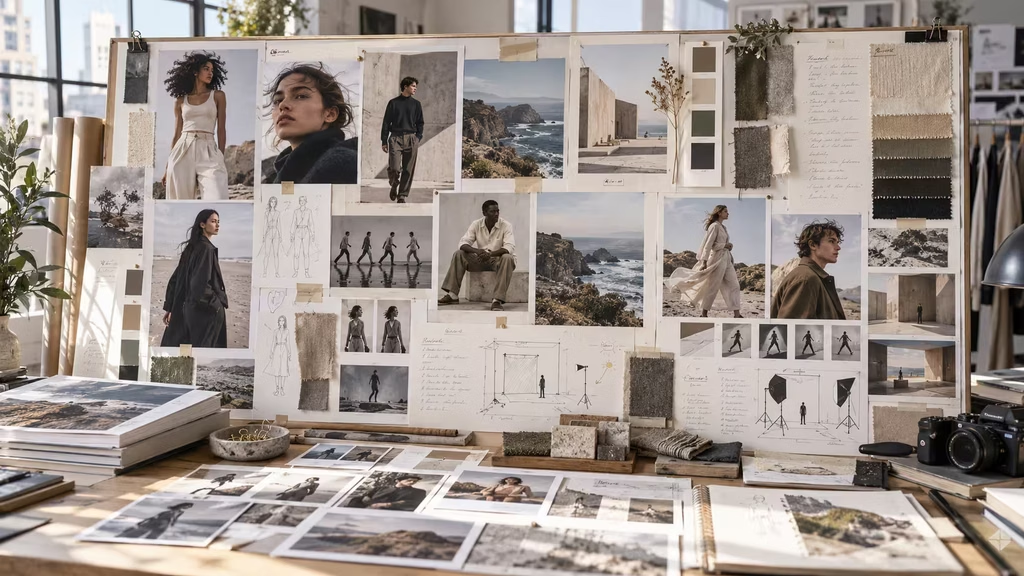
A reference board is not a pile of pictures with the same color palette. It is a record of decisions. When an image works, ask why. Is the camera held at waist height? Is the model moving toward or across the lens? Does the frame rely on hard morning sun, a broad window, green fluorescent practicals, or a carefully shaped studio source? Does the clothing read because of the pose, the background contrast, or the focal length?
Separate references into useful groups. One board can cover casting and faces. Another can cover silhouette and styling. A third can cover camera movement, light, texture, and framing. If every reference serves every purpose, people will select their favorite image for different reasons and the plan will become confused. Notes are more valuable than a hundred unlabelled screenshots.
Look beyond fashion campaigns. Documentary photography may offer a better answer for imperfect movement. Dance rehearsal footage may show how fabric behaves when a body turns. Architecture can suggest a location’s geometry. A family photo album can suggest an emotional distance or a flash-lit honesty that a polished editorial shoot lacks. Borrow the underlying idea, not the surface decoration.
Build a short list of rules from the references. The camera might remain at human height and never look down at the talent. The collection might be shown mostly in motion, with brief clean poses for the product read. Direct flash may appear only at the emotional peak. The palette may stay neutral so one saturated garment becomes a signal. Such rules make the shoot easier to run because every department can test a suggestion against them.
The board also needs a list of things to avoid. Perhaps the brand has already used endless slow motion. Perhaps a location risks making a new collection look like a travel campaign. Perhaps exaggerated poses will fight the client’s wish for everyday confidence. Saying no early saves time, money, and polite arguments on set.
Cast people who can carry the clothes
Casting is often treated as a search for the right face. A face matters, but fashion film asks more of a person than a still image does. They need a relationship to movement, camera proximity, and clothing. Someone can look excellent in a test portrait and become guarded when asked to walk, turn, sit, laugh, dance, or repeat a gesture for twenty takes.
Start with the character rather than a demographic label. Is this person self-possessed, awkward, restless, formal, funny, intimate, detached, or openly performative? The answer shapes casting, but it also shapes how you direct them. A campaign about quiet confidence will not benefit from asking every cast member to project the same glossy self-assurance.
Test movement during casting. Ask people to walk toward camera, away from camera, and across frame in a simple outfit. See how they react when a camera moves close. Ask for a small action such as adjusting a sleeve, putting on a coat, or stopping at a mark and holding their body still. The footage does not need to be beautiful. You are looking for ease, rhythm, and an ability to take direction without losing presence.
Consider the clothes as physical constraints. A long skirt changes a walk. Narrow tailoring changes how a person sits. A heavy boot changes the cadence of a step. Tall hats, large bags, slippery shoes, and layered outerwear can make a basic move difficult. Include the stylist in movement tests when possible. The best performer cannot sell a garment if the fit, footwear, or alterations make them uncomfortable.
Respect is practical production work. Give cast members a private changing area, clear expectations about coverage, an agreed approach to intimacy, and enough time to eat and reset. State whether the work includes social crops, global usage, motion retouching, or a long day in weather. People who understand the conditions can give an informed yes. A tense or exhausted set shows up in the footage.
Styling for the camera, not only the rail
Clothes change under lens and light. A garment that looks perfect on a hanger can flatten against a similar-toned wall, turn transparent in backlight, or gather in an unflattering way when the talent sits. Camera tests are not a luxury. They reveal whether a hem needs shortening, a jacket needs tape, a shirt needs a different underlayer, or a color needs to move to another look.
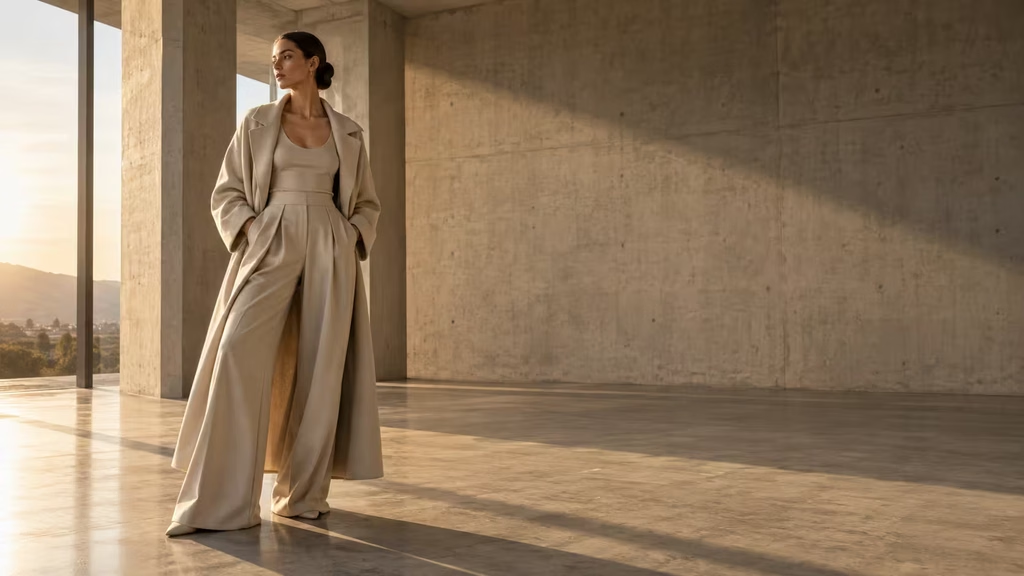
Build each look around a clear silhouette. The viewer may not read every seam in a fast edit, but they will register proportion. Define what makes the look distinct: a wide shoulder, narrow waist, long leg line, cropped body, layered volume, or sharp boot. Then choose camera positions that make that shape legible. A low wide lens might enlarge a coat’s structure. A longer lens may make a flowing dress feel graphic and contained.
Keep a continuity record for every look. Photograph front, back, each side, and meaningful details before the day begins. Record jewelry, belts, cuff positions, bag strap length, socks, and any deliberate imperfections. If a jacket is meant to hang open in one setup and closed in another, make that a chosen story beat rather than an accidental reset error.
Fabric needs special attention. Satin can turn into a bright untextured sheet if the source is too broad or frontal. Black wool can collapse into darkness unless edge separation is planned. Fine stripes and tight checks can create moire. Sequins can become uncontrolled sparkle. Use the intended camera, frame rate, and light to test problem materials before principal photography. A quick test can stop a whole collection from becoming a post-production repair job.
Styling also shapes time. A pristine look may feel distant. A slightly loosened tie, a folded sleeve, a coat caught by wind, or a shoe scuffed through use can make a person feel present. The distinction is deliberate wear, not untidiness. Decide whether the campaign wants the clothes to appear newly composed, lived in, or somewhere between those states.
Choose locations that add pressure, scale, or intimacy
Location is one of the fastest ways to explain a fashion campaign, and one of the fastest ways to reduce it to a cliché. An industrial warehouse does not automatically create edge. A clean modern house does not automatically create luxury. A street does not automatically create authenticity. The location needs to have a useful relationship with the collection.
Look for practical visual properties. Consider the scale of the rooms, the ceiling height, available daylight, reflections, wall color, surfaces underfoot, sound, power, holding space, access, and the way backgrounds will fall out at different focal lengths. A dramatic building can be a poor fashion location if every wall is visually loud or there is nowhere to place a full-length frame.
Architecture can direct movement. Long corridors give a walk a destination. A staircase gives vertical rhythm. A doorway creates a natural entrance and exit. A small room can create proximity and pressure. Open ground can make a lone figure feel exposed or free, depending on lensing and blocking. Map these opportunities in the scout rather than discovering them while the crew waits.
Do not use a location only as an attractive backdrop. Put the cast in relation to it. A person leaning against a wall, crossing a lobby, stepping off a bus, waiting at a doorway, or moving through a crowd gives the clothes a reason to behave. Even an abstract studio set benefits from a physical task: climb, turn, sit, balance, pull a curtain, carry an object, or meet another person’s gaze.
If the film depends on public space, plan for unpredictability. Pedestrians, traffic, noise, weather, security, permits, and changing light can all affect the schedule. Make a version of the idea that survives a smaller footprint. Sometimes the better result comes from accepting a real interruption rather than trying to control every background detail, but that choice must suit the brand and be cleared with the production team.
Light for shape, skin, and material
Fashion lighting has to work on bodies and garments at the same time. A beauty light can make skin look smooth while erasing the texture of a jacket. A hard side light can make tailoring look strong while creating a face that feels too severe for the campaign. Start with the collection’s visual need, then balance it with the cast and the desired emotional distance.
Daylight is useful because it gives fabric an honest response, but it is rarely neutral. Window light can be soft and directional, while open shade can make colors cool and flatten the scene. Direct sun can turn a simple walk into a graphic event. Learn what the available light does at each key location and time. Do not promise golden-hour softness in a narrow alley that receives hard sun for ten minutes.
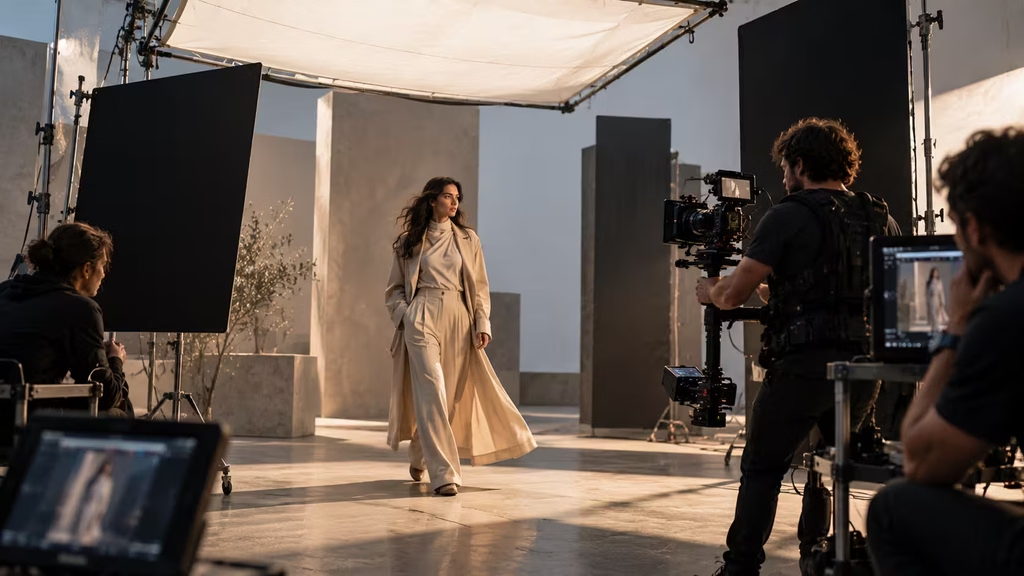
In studio work, build a base that lets the clothes breathe. Large sources can give skin a gentle falloff and reveal a garment’s broad surface. Negative fill helps define the body and keeps pale clothing from blending into a pale environment. Hard accents can sharpen a shoulder, a heel, a bag edge, or a glossy leather surface. Control is more useful than sheer brightness.
Watch the relationship between garment and background. A white outfit against a pale wall may need a subtle shadow or a darker edge in the frame. A black dress against black can be elegant if the light reveals enough contour. Bright colors may need a quieter environment, while neutral tailoring may need a stronger color field behind it. The goal is not to isolate every item like ecommerce photography. The goal is to let viewers understand the form.
Skin tone deserves a real conversation before the shoot. Ask makeup, wardrobe, and camera departments how the planned palette will respond to each cast member. Test the grade direction early. A fashionable cool look that drains warmth and detail from the people wearing the collection is not a successful look. The campaign should not require the cast to disappear in order for the colors to feel current.
Frame the body with intention
Lens choice is a style decision before it is a technical one. A wide lens close to the body can make a walk feel immediate, unstable, or physical. A longer lens can make a model feel observed from a distance and turn a busy location into soft color. A normal focal length can hold a person in a believable relationship to their surroundings. Test the same look across a few focal lengths before deciding.
Full-body frames matter because fashion is worn. A campaign can live on portraits and details, but if the viewer never sees how a garment sits on a moving body, the film loses useful information. Shoot enough clean full-length coverage for the edit, especially when the collection includes strong silhouette changes. The camera can still be expressive. It just needs to give the clothes their moment.
Avoid framing a person into awkward visual fragments unless that fragmentation says something. Cropping at joints can make a carefully styled figure look accidental. Extreme close work can be beautiful when it shows makeup, jewelry, hands, seams, or a specific attitude. It becomes empty when it is used to hide that the outfit has not been considered in the whole frame.
Camera height carries meaning. Shooting from below can make a cast member look monumental, confrontational, or playful. Shooting from above can create fragility, surveillance, or graphic flatness. A level camera can feel intimate because it meets the person as another body in the room. Keep the chosen height consistent enough that the campaign has a visual grammar, then break it only when the moment earns it.
Every camera move should reveal a new relationship. A lateral track can let a coat move through space. A slow push can bring the viewer into a private moment. A circling move can show construction and create energy, but it can also make clothes swirl into visual noise. Watch the move with styling, hair, and light in place. A technically smooth shot is not necessarily a useful fashion shot.
Direct movement rather than poses
Still-fashion posing and fashion-film movement are related but not identical. A pose gives the camera a finished shape. Movement gives the editor material, reveals the garment, and lets a person feel alive. The most effective direction often starts with a simple action and a clear emotional instruction: walk as if you are late but refuse to hurry, enter like you know the room is watching, wait for someone who may not arrive, or keep moving after the music stops.
Give talent room to find their own rhythm. If every elbow, eye line, and hand position is dictated, the work can stiffen. If there is no direction, the result can become generic improvised posing. The balance comes from setting a task, demonstrating the camera’s path, and then adjusting small details. Ask for slower turns, more weight in the heel, less performance in the face, or a pause before the exit.
Repetition is normal. A clean walk may require several passes because wardrobe, focus, hair, and timing all need to align. Keep the notes specific and respectful. “That was good, again” tells a performer nothing. “Keep the first three steps, then delay the glance until you pass the light” gives them a playable adjustment.
For group scenes, block the relationships before chasing coverage. Decide who leads, who follows, where attention goes, and whether the group feels connected or separate. Fashion casts often need to look natural together before they need to look friendly. A slight mismatch of rhythm can be more interesting than synchronized movement if it supports the campaign’s mood.
Dance can help a collection move, but do not use it as a replacement for concept. Choreography should show what the garment can do or expose an emotional quality that ordinary walking cannot. A rigid suit might look surprising in loose, expansive movement. A fluid dress might need a simple turn rather than a complex routine. Work with a choreographer early if the movement is central, especially when the schedule includes multiple looks and resets.
Plan coverage for the edit you need
A fashion ad often needs one hero film plus vertical cuts, six-second assets, social loops, still frames, retailer crops, and behind-the-scenes material. Those needs should shape the shot list before the shoot, not after a final landscape edit has been approved. Protect center framing where vertical crops matter. Capture clean poses for thumbnails. Hold hero images long enough for copy and platform variations.
Build coverage in layers. First capture the proof: full looks, product details, clear faces when needed, and stable hero frames. Then capture the expressive material: movement, passing reflections, compressed close-ups, environmental textures, and imperfect transitions. The second layer gives the edit personality, but it cannot replace the first layer.
Record longer takes than the final runtime suggests. Editors need handles for speed changes, music adjustments, typography, and transitions. A beautiful move that begins and ends too abruptly can become unusable. Ask the operator and talent to hold before and after the active action. Those quiet seconds are often where an edit finds its rhythm.
Make a practical shot log. Note look number, location, lens, movement, best take, sound issues, styling changes, and any client comments. When a campaign has a large wardrobe count, this record prevents a missed product detail from being discovered after the set has been cleared. It also helps post-production find the exact take that had the best clothing shape.
Plan clean plates and reference frames. Photograph the final styling, capture empty backgrounds when useful, and record color charts or gray references for complicated mixed light. If visual effects may remove a stand, extend a wall, clean a reflection, or change a screen, tell the team before the camera rolls. Post work is much easier when the plate was photographed for it.
Edit around rhythm and recognition
Fashion editing can be fast, slow, or nearly still. The right pace comes from the campaign, the platform, and the material captured. Do not cut simply because the music has a beat. Let the edit respond to a turn, a glance, a garment settling after motion, or a shift in the relationship between people.
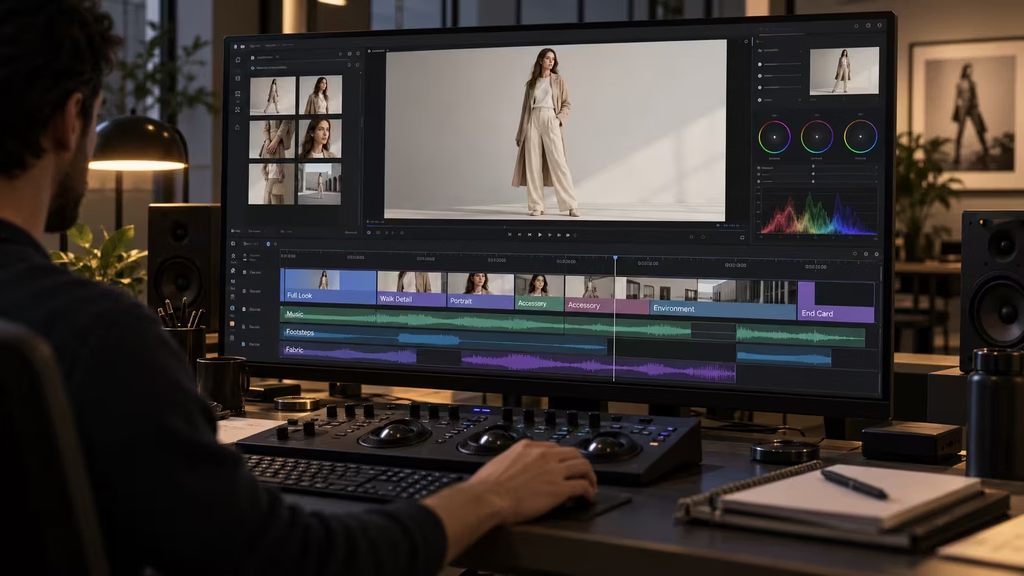
Begin by building a silent assembly. Without music, sound effects, or transitions, the pictures have to communicate silhouette, character, and sequence. If they do not, a strong track will only make the weakness harder to notice until late in the process. Find the moments that make each look distinct and give them enough duration to register.
Then use music as a partner rather than a metronome. A driving track can support a quick campaign, but cutting every shot on the beat often feels like an edit template. Let a movement lead into the next shot. Use a musical break to hold a face or a full look. If the music will need territory-specific replacements, make sure the visual structure still works without its exact accents.
Protect recognition. A viewer needs enough time to understand that a new garment, model, product, or location has entered the film. Rapid montage can create excitement, but it can also turn a collection into a blur of attractive fragments. If a piece is commercially important, give it at least one clear frame where the fit and context can be read.
Transitions should have a reason. A match cut can connect a bag curve to an architectural line. A whip can carry a person from one place to another. A sudden cut can create a welcome change of energy. Constant blur, flash, and speed-ramp effects can make a film feel dated quickly. Most campaigns gain more from confident selection than from added treatment.
Sound turns pictures into a physical world
Sound is easy to leave until the end because fashion images can look complete without it. Yet even a minimal fashion ad benefits from a world around the clothes. Footsteps establish weight and surface. Fabric movement gives a coat, skirt, or technical shell a physical presence. A zipper, heel, bag clasp, door, train, or passing car can place the character in a real environment.
Record location sound when possible, even if it will not be used directly. It provides texture and reference for the sound team. Clean production dialogue may not matter in a nonverbal spot, but room tone, street beds, and practical sounds often help the final mix feel less assembled.
Foley is particularly useful for wardrobe. A microphone placed near fabric can capture details that disappear on set. Record different weights of cloth, leather, metal hardware, shoe soles, and bags. Match the sound to the garment’s scale. A light nylon jacket should not sound like heavy canvas, and a thin heel should not land with the force of a work boot.
Use voice only when it adds a point of view. A line of dialogue, a spoken text, or a voiceover can give a campaign intimacy, humor, or tension. It can also explain too much. Test the film without the words. If the copy mostly narrates what the audience already sees, cut it down. Fashion work usually benefits from language that leaves room for the image.
Music should be cleared for every intended use and format. Build alternate edits or score options early if timing is likely to change. The best music cue in an offline may be unavailable, unaffordable, or unsuitable for certain regions. A campaign with a solid visual rhythm can survive that problem. A campaign built only around a particular chorus cannot.
Grade for the collection, not a passing trend
Color finishing should make the collection more legible and the campaign more cohesive. Start with accurate exposure and a stable white point. Then compare shots of each major look. The same red dress cannot drift from orange to magenta merely because the location changed. A leather bag needs to remain recognizably its own color even when the grade gives the overall film a mood.
A grade can create distance or closeness. Cool shadows and crisp contrast may make a collection feel urban or technical. Softer contrast and warmer skin may make it feel personal. Strong saturation may serve a playful youth campaign, while muted color may suit tailoring or minimal design. The choice should come from the brief and tests, not from a preset applied late in the process.
Protect skin tone and texture. Fashion retouching can quietly turn people into plastic if skin is softened too far or color separations are pushed without restraint. Preserve pores, movement, and variation. A cast member should look like themselves under good light, not a generic approximation of a face.
Watch black detail, especially for outerwear and formal collections. A rich black garment needs some separation at the shoulder, sleeve, lapel, and hem. Crushing every dark tone may look dramatic on a grading display and become unreadable on a phone. Review on the devices and platforms that matter to the campaign.
Texture treatments need the same discipline. Grain, bloom, halation, diffusion, and lens imperfections can unite a film, but they can also obscure the clothes. Judge them at final resolution after compression tests. A barely visible effect in a high-quality master may become murky in a social export.
Build delivery into the production plan
The final master is rarely the only deliverable. Ask for a delivery matrix early. It should list aspect ratios, runtimes, frame rates, codecs, audio requirements, title languages, legal copy, platform safe areas, retailer specifications, and whether separate versions are needed for paid media. This list protects both the creative and the budget.
A 16:9 hero film may need 9:16, 4:5, 1:1, and 1:1 cutdowns. Plan for these formats while composing the original coverage. Keep faces, products, and important graphics within safe crop regions. Capture alternate takes when a wide composition cannot survive a vertical crop. A late request to make every landscape shot vertical usually produces cramped, compromised work.
Design the end card as a flexible system. A lockup that works on a dark landscape frame may fail on a pale vertical version. Give the brand mark and any campaign line enough contrast and space. Check legal copy at the actual display size. If text is too small to read on a phone, it is not functioning as information.
Keep the post-production archive orderly. Save camera originals, project files, audio, graphics, fonts, grade stills, VFX plates, final masters, captions, and a document of approved versions. Name assets consistently. A campaign often returns months later for a new region, a new retailer, or a re-edit. An organized archive turns that request into a small job rather than a forensic search.
Common problems in fashion ads
The most common problem is a beautiful mood with no product read. A film can have strong casting, locations, and music, then fail because the viewer cannot see how the clothes fit or what is being sold. Solve this with intentional full looks and detail coverage, not a last-minute product montage.
Another problem is style without specificity. Handheld camera, flash frames, slow motion, and a fashion track can imitate the outside of a campaign without revealing anything about this collection. Return to the product truth. If the film could promote any other brand with a logo swap, it needs a more precise point of view.
Over-direction can flatten the cast. Fashion talent often needs a frame and a task, then room to work. Give notes that change behavior rather than asking for vague energy. Under-direction creates the opposite problem: a long day of default walks and disconnected poses. The director’s job is to keep the performance connected to the campaign’s character.
Poor coordination between departments also causes visible issues. Hair can cover a collar that the stylist intended to show. A camera angle can hide a bag. A lighting change can remove the texture the art department built. Use short checks before each setup. Everyone does not need to discuss every frame, but the relevant departments should see the monitor when the hero image is found.
Finally, do not mistake production scale for campaign quality. A large crew, an expensive location, and a complex rig can all help, but they cannot supply the central idea. A smaller production with clear casting, careful styling, a decisive camera language, and time to refine a few strong setups often creates more memorable work.
Finish with a frame that can hold attention
The final shot has practical and emotional work to do. It may carry a logo, collection name, release date, retail message, or a brief pause before a loop restarts. Give it enough time. A final frame cut too quickly feels like an unfinished thought, while a held image with a clear product and purposeful space gives the audience somewhere to land.
Review the film without sound, then with sound, then on the actual devices and platforms where it will run. Check the clothing read, skin tones, title legibility, black detail, crop safety, compression, and the rhythm of the first two seconds. Those first seconds matter because many viewers will decide whether to keep watching before the hero garment has been fully revealed.
A successful fashion ad makes a distinct proposition. It tells viewers how the brand sees bodies, clothes, places, and time. The production can be glossy, raw, intimate, graphic, funny, or severe. The style is less important than the agreement between all the decisions. When styling, casting, camera, light, sound, and edit speak the same visual language, the clothes stop looking like costumes placed in front of a camera. They become part of a world the audience can recognize and want to enter.
Continue reading
Further insights from the Journal
Have a story in mind?
Bring your next project into focus.
Tell us what you are creating and what you want the audience to feel.