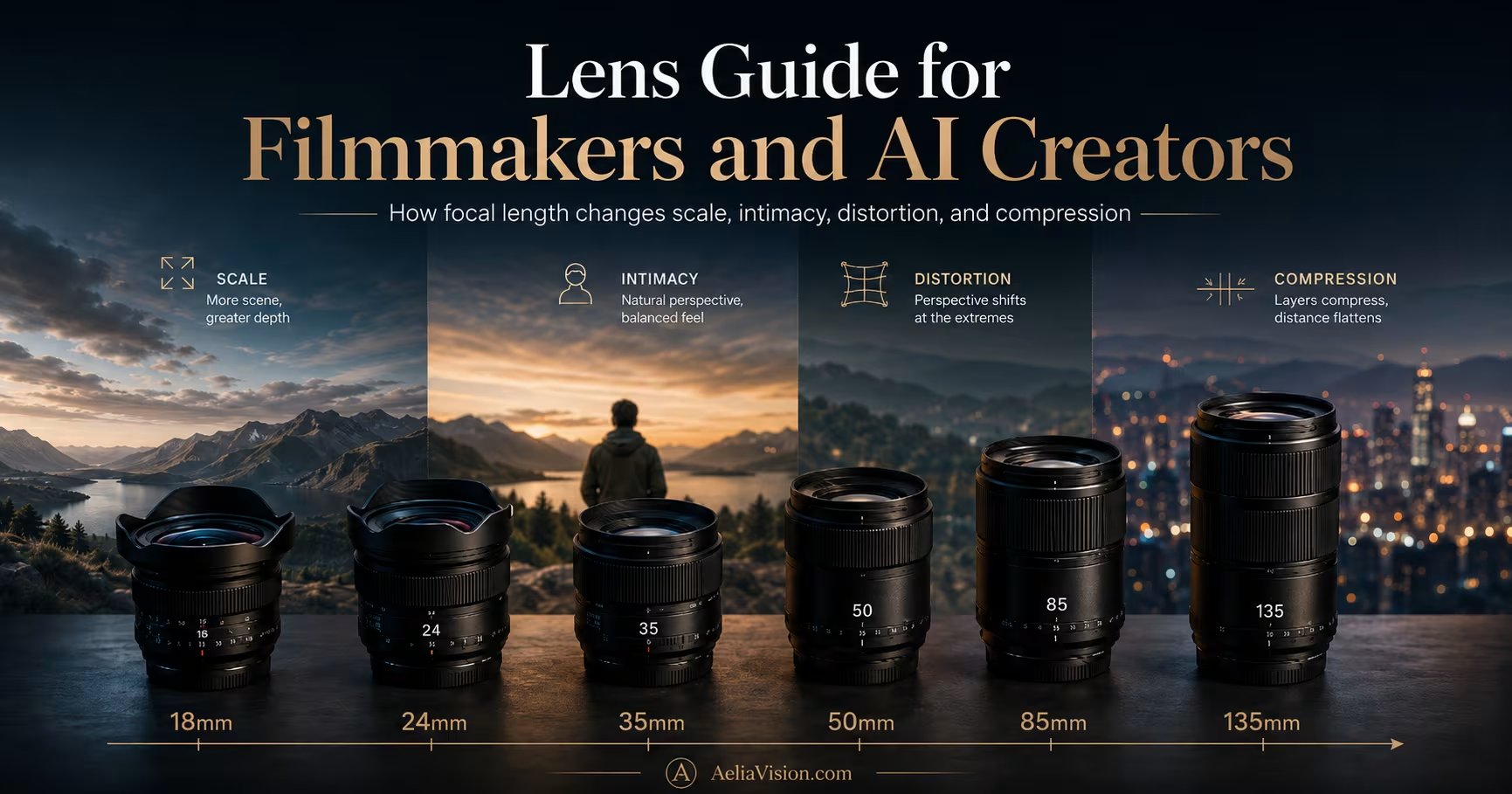
The story in brief
Use this lens guide for filmmakers and AI creators to choose focal lengths for scale, intimacy, distortion, compression, depth of field, and cinematic emotion.
Inside this story
How focal length changes scale, intimacy, distortion, compression, and cinematic emotion
Table of contents
Lens choice is not a technical detail you add after the creative decisions are finished. It is one of the main ways a filmmaker shapes how the audience experiences space, faces, movement, emotion, and scale. A lens does not simply decide whether the image looks “wide” or “zoomed in.” It changes how much of the world fits into the frame, how close the camera needs to be to the subject, how large the background feels, how intimate a face becomes, and how physically believable the scene appears.
For AI cinematic creators, lens language helps solve a specific problem. AI tools can create visually impressive images, but they often misunderstand perspective, depth, distortion, and spatial relationships unless the prompt gives clear optical direction. If you only write “cinematic portrait” or “wide shot,” the result may look polished, but it may not communicate the right emotional distance or spatial logic.
A stronger prompt names the focal length, camera distance, subject relationship, depth of field, and optical feeling. Instead of asking, “What lens looks cinematic?” ask, “What should this lens make the audience feel?”
This guide explains focal lengths for filmmakers and AI creators, including ultra-wide, wide, normal, short telephoto, medium telephoto, and long telephoto lenses. It also explains how lens choice affects scale, intimacy, distortion, compression, depth, realism, and AI prompt writing.
Why lens choice matters
Lens choice changes the emotional geometry of a shot. A face filmed close with an 18mm lens feels completely different from the same face filmed from farther away with an 85mm lens. A mountain behind a character feels distant with a wide lens, but huge and compressed with a telephoto lens. A hallway can feel spacious, claustrophobic, threatening, or calm depending on the focal length and camera position.
This is why lens choice should never be random. A lens should answer a story question. Should the audience feel physically inside the scene? Should the subject feel isolated from the world? Should the background feel massive and close? Should the face feel intimate, flattering, distorted, or pressured? Should the environment dominate the character? Should the camera feel objective or subjective?
A wide lens often makes the viewer feel close to the action. A normal lens often feels grounded and human. A short telephoto lens often feels intimate and flattering. A long lens often feels distant, compressed, watchful, or emotionally isolated.
The lens changes the relationship between viewer, subject, and world.
The core principle: lenses change framing, camera position changes perspective
One of the most important lessons in cinematography is that focal length and camera position work together. A lens changes field of view, which means how much of the world the camera can see. A 16mm lens sees a lot of the world. A 100mm lens sees a much narrower part of it.
However, perspective is controlled by camera position. If you want the same face to fill the frame with a 24mm lens, you must move the camera very close to the face. That closeness exaggerates near features, such as the nose, hands, or foreground objects. The background appears smaller and farther away.
If you want the same face to fill the frame with an 85mm or 135mm lens, you must move the camera farther back. That distance reduces the difference between near and far objects. The face appears flatter and more flattering, while the background appears larger and closer.
This is where “wide exaggeration” and “telephoto compression” come from. The lens gives you field of view. The camera position gives you perspective. Together, they create the emotional feeling of the image.
Quick reference: focal lengths and cinematic meaning
The table below uses full-frame focal length references. If you are working with Super 35, APS-C, Micro Four Thirds, or another format, think in equivalent field of view rather than copying the number exactly.
| Focal Range | Visual Feeling | Emotional Effect | Best Used For |
|---|---|---|---|
| 14-24mm | Ultra-wide, expansive, exaggerated | Immersion, urgency, scale, pressure, distortion | Tight interiors, action, horror, architecture, vehicles, epic environments |
| 24-35mm | Wide but controlled | Energy, realism, movement, environmental presence | Walk-and-talks, masters, handheld, gimbal shots, environmental portraits |
| 35-50mm | Natural, balanced, restrained | Honesty, realism, human connection | Dialogue, medium shots, grounded drama, natural coverage |
| 50-85mm | Intimate, selective, flattering | Emotional closeness, beauty, isolation | Portraits, medium close-ups, interviews, dramatic singles |
| 85-135mm | Compressed, elegant, isolated | Distance, romance, psychological separation | Close-ups, fashion, long-lens drama, product beauty, city backgrounds |
| 135mm+ | Long-lens, distant, strongly compressed | Surveillance, observation, abstraction, loneliness | Sports, wildlife, distant subjects, compressed landscapes, secret observation |
This table is only a starting point. The final meaning depends on camera distance, blocking, lighting, movement, aperture, format, and story context.
Ultra-wide lenses: 14-24mm
What ultra-wide lenses do
Ultra-wide lenses see a very large part of the world. They exaggerate depth, stretch space, increase foreground dominance, and make camera movement feel faster. They are powerful because they allow the camera to move very close to a subject while still showing the environment.
This range is not automatically “epic.” Its real power is proximity. The camera can stand inside the action instead of observing it from a distance. An ultra-wide lens can make a hallway feel endless, a room feel unstable, a battlefield feel huge, or a car interior feel physically intense. It can also make a face look distorted if the camera is placed too close.
Emotional meaning
Ultra-wide lenses often create immersion, pressure, danger, scale, exposure, and kinetic energy. They can make the audience feel physically present in the scene. In horror, they can make a room feel strange and distorted. In action, they can make movement feel fast and immediate. In fantasy, they can make architecture and landscapes feel monumental.
Best uses
Use ultra-wide lenses when the scene needs strong physical space. They work well for cramped interiors, vehicle interiors, corridors, action scenes, chase scenes, fantasy halls, large architecture, environmental establishing shots, and subjective fear.
They are also useful when the environment is part of the emotion. If the character is overwhelmed by a palace, city, desert, prison, or battlefield, an ultra-wide lens can make the world dominate them.
Common mistakes
The biggest mistake is placing the lens too close to a face without intention. This can stretch facial features and make the image feel accidental instead of cinematic. AI tools may also exaggerate this problem by warping hands, faces, walls, or architecture.
When using ultra-wide prompts, ask for rectilinear perspective if you want straight lines, and add negative constraints against fisheye distortion unless that is the intended look.
AI still image prompt example
Prompt:
Cinematic ultra-wide 18mm full-frame rectilinear lens shot inside a narrow rain-soaked alley at night, camera very close to the foreground wall, strong depth leading toward a lone detective in the distance, wet pavement reflecting neon practical lights, dramatic foreground parallax, immersive spatial tension, realistic architecture, grounded cinematic realism.
Negative prompt:
No fisheye bulge, no bent buildings, no warped face, no stretched hands at frame edge, no floating objects, no impossible perspective, no cartoon distortion.
AI video prompt example
Prompt:
5-second handheld run through a narrow market alley at dusk, 20mm full-frame lens, chest-height camera, strong foreground motion, deep spatial parallax, urgent documentary energy, realistic motion blur, subject remains readable, lighting stays consistent, no rubbery textures, no geometry warping, no sudden zoom.
Wide lenses: 24-35mm
What wide lenses do
The 24-35mm range is one of the most useful storytelling zones in modern cinematic language. It still shows the environment, but it is more controlled than ultra-wide. It feels alive, present, and physical without always looking distorted.
Wide lenses in this range are excellent for scenes where the character and environment both matter. They allow the audience to stay close to the subject while still understanding the world around them. This is why 24mm, 28mm, 32mm, and 35mm lenses are so useful for walk-and-talk scenes, handheld movement, environmental portraits, and blocking-heavy masters.
Emotional meaning
Wide lenses often create presence, immediacy, energy, realism, and environmental connection. They are less extreme than ultra-wide lenses, but they still make the viewer feel close to the world.
A 28mm lens can make a character feel surrounded by their environment. A 35mm lens can feel grounded and cinematic without calling too much attention to itself.
Best uses
Use wide lenses when the scene needs both human presence and spatial context. They are strong for street scenes, kitchens, offices, markets, newsrooms, battlefields, small rooms, and naturalistic movement. They are also useful for AI prompts because they usually produce a cinematic perspective without pushing the model into extreme distortion.
Common mistakes
The most common mistake is moving too close to the face and expecting it to look like a portrait lens. A 24mm or 28mm close-up can feel intense and subjective, but it may also exaggerate facial features.
Use this range when you want character plus environment. For flattering portraits, move toward 50mm, 65mm, or 85mm.
AI still image prompt example
Prompt:
Environmental portrait of a chef in a busy restaurant kitchen, 32mm full-frame lens, camera at conversational distance, natural wide perspective, visible workspace context, soft steam in the background, warm practical lights, realistic skin tones, stainless steel reflections, grounded editorial cinematography.
Negative prompt:
No exaggerated facial distortion, no fisheye look, no bent horizon, no fake ultra-wide edge stretch, no floating props, no messy unreadable background.
AI video prompt example
Prompt:
7-second walk-and-talk dialogue shot in a busy newsroom, 28mm full-frame lens, smooth gimbal movement, camera walking backward at human pace, balanced environmental context, mild subject-background separation, natural blocking, clean eyelines, no sudden camera orbit, no warped faces, no inconsistent depth planes.
Normal lenses: 35-50mm
What normal lenses do
The 35-50mm range is the language of restraint. It often feels natural, balanced, and human. These lenses do not strongly exaggerate space like wide lenses, and they do not compress the background as much as telephoto lenses.
Because of that, normal lenses often disappear into the story. They let performance, blocking, lighting, and composition do the emotional work. A 40mm or 50mm lens is often a strong default for grounded cinematic realism because it feels controlled without feeling stylized.
Emotional meaning
Normal lenses often communicate honesty, realism, balance, emotional clarity, and human connection. They are useful when you do not want the audience thinking about the lens. Instead, you want them to focus on the character, dialogue, and story.
This makes the 35-50mm range ideal for drama, dialogue, interviews, over-the-shoulder shots, medium coverage, and realistic scenes.
Best uses
Use normal lenses when the scene needs natural perspective. They work well for conversations, quiet emotional exchanges, family drama, workplace scenes, grounded realism, and morally complex moments where you do not want the camera to strongly judge the subject.
For AI creators, this is also one of the safest lens ranges. If a prompt is becoming too distorted or too artificial, switching to a 40mm or 50mm spherical lens can often make the result feel more believable.
Common mistakes
The biggest mistake is assuming normal lenses are boring. They are only boring when blocking, lighting, and composition are weak. A normal lens can be extremely cinematic if the scene has strong emotional design.
Another mistake is using “50mm” without describing distance or shot size. A 50mm close-up, medium shot, and wide shot all feel different.
AI still image prompt example
Prompt:
Moody cafe conversation between two old friends, 40mm full-frame spherical lens, seated eye-level framing, natural perspective, gentle falloff, warm practical lamp in the background, restrained cinematic composition, realistic skin texture, quiet emotional tension, grounded drama.
Negative prompt:
No fisheye traits, no telephoto compression, no exaggerated bokeh, no plastic skin, no melted background, no excessive bloom, no artificial glamour lighting.
AI video prompt example
Prompt:
6-second slow push-in on a seated character during a confession scene, 50mm full-frame spherical lens, stable dolly movement, naturalistic perspective, soft background separation, realistic focus behavior, subtle breathing, no rapid zoom, no warped face, no focus hunting, no background melting.
Short telephoto lenses: 50-85mm
What short telephoto lenses do
The 50-85mm range is where intimacy begins. These lenses are more selective than normal lenses. They reduce environmental distraction, separate the subject from the background, and tend to make faces look more flattering because the camera can move farther back for the same framing.
This range is common for portraits, medium close-ups, interviews, beauty shots, emotional singles, and dramatic character moments. A 65mm lens can feel intimate but still natural, while an 85mm lens creates stronger isolation and a more polished portrait feeling.
Emotional meaning
Short telephoto lenses often communicate intimacy, emotional focus, elegance, beauty, isolation, and controlled drama. They are useful when the story is less about the environment and more about the person.
The audience feels close to the character, but not physically invasive. This makes the range excellent for emotional close-ups, restrained romance, confession scenes, and moments of inner conflict.
Best uses
Use short telephoto lenses for portraits, interviews, emotional singles, medium close-ups, beauty work, performance-focused scenes, and moments where the background should become secondary.
This range is also very useful for AI because it helps avoid facial distortion while giving the image a clean cinematic subject separation.
Common mistakes
The most common mistake is overusing this range for everything. If every shot is isolated and shallow, the world can disappear. The scene may become visually pretty but geographically unclear.
Use short telephoto when emotional focus matters. Use wider lenses when environment and blocking matter.
AI still image prompt example
Prompt:
Intimate portrait of a young musician standing beside a rain-streaked window, 65mm full-frame lens, flattering facial geometry, shallow depth of field, smooth circular bokeh, emotionally isolated subject, soft side light, natural skin texture, refined cinematic color, quiet introspective mood.
Negative prompt:
No distorted nose or ears, no waxy skin, no over-blurred shoulders, no fake halo edges, no mismatched eyes, no excessive beauty filter, no warped teeth.
AI video prompt example
Prompt:
5-second medium close-up of a singer on stage before the first note, 75mm full-frame lens, subtle handheld float, flattering compression, selective focus, warm practical highlights blooming softly in the background, subject remains sharp, natural breathing, no face warping, no focus hunting, no exaggerated bokeh swirls.
Medium telephoto lenses: 85-135mm
What medium telephoto lenses do
The 85-135mm range creates stronger compression, cleaner backgrounds, and more elegant isolation. Background lights appear larger and closer. City skylines, mountains, crowds, and interiors can feel layered and dense.
This range allows a face to fill the frame without the camera being physically close to the actor. That creates emotional distance and elegance at the same time. It is a powerful range for close-ups, fashion, music videos, long-lens drama, romantic separation, product beauty, and stylized emotional isolation.
Emotional meaning
Medium telephoto lenses often communicate elegance, romance, watchfulness, psychological distance, emotional isolation, and compressed pressure. The subject can feel separated from the world, even when the background is visually rich.
A 100mm lens can make a rooftop close-up feel dramatic and polished. A 135mm lens can make a ballroom feel compressed, romantic, and emotionally selective.
Best uses
Use this range for close-ups, dramatic portraits, romantic scenes, fashion work, emotional isolation, city-light backgrounds, product shots, and scenes where the background should feel visually close but emotionally distant.
This is also a useful range when you want the subject to feel watched from a distance.
Common mistakes
The biggest mistake is losing geography. Telephoto lenses compress space, which can make a scene beautiful but spatially unclear. If the audience needs to understand blocking, action direction, or environment layout, include wider shots before or after the telephoto shot.
In AI, this range can also produce unrealistically huge backgrounds or overly blurred edges. Use negative prompts to protect believable scale and focus.
AI still image prompt example
Prompt:
Stylized dramatic close-up of a woman on a rooftop at blue hour, 100mm full-frame lens, layered city lights behind her, elegant telephoto compression, isolated expression, soft wind in hair, rich contrast, cinematic color separation, realistic skin texture, background lights large but believable.
Negative prompt:
No flat cutout edges, no impossible background scale, no fake blur smear, no duplicated city lights, no plastic skin, no overcompressed surreal background unless intentional.
AI video prompt example
Prompt:
6-second slow lateral slider move on a couple across a crowded ballroom, 135mm full-frame lens, compressed background, selective focus, graceful romantic separation, warm chandelier bokeh, elegant camera movement, preserve subject scale and background geometry, no focus jumps, no smear blur, no duplicated lights.
Long telephoto lenses: 135mm+
What long telephoto lenses do
At 135mm and beyond, the lens becomes observational. It narrows the world, compresses distant planes, magnifies the background, and creates a strong sense of watching from far away.
This range can make a city feel dense, a mountain feel enormous behind a small character, or a person feel secretly observed across a street. It is common in sports, wildlife, surveillance-style shots, long-lens landscapes, and distant emotional observation.
Emotional meaning
Long telephoto lenses often communicate distance, surveillance, loneliness, abstraction, pressure, and graphic compression. The viewer does not feel physically close to the subject. Instead, the viewer feels like they are watching from far away.
This can be emotionally powerful. A character walking alone across a desert road with a huge compressed mountain behind them can feel mythic, lonely, and visually sculptural.
Best uses
Use long telephoto lenses for surveillance, distant observation, compressed landscapes, sports, wildlife, secret watching, heat-haze city shots, and stylized isolation. They are also useful when the background itself is emotionally important and should feel larger, closer, or heavier.
Common mistakes
Long lenses are harder to control. Camera shake becomes more visible, focus becomes more sensitive, and atmospheric haze can affect clarity. In action scenes, long lenses can flatten geography and make movement harder to understand.
In AI, long lens prompts may create impossible background scale or melted subject edges. You must ask for controlled compression and believable atmospheric perspective.
AI still image prompt example
Prompt:
Distant runner on an empty desert road, 200mm full-frame lens, huge compressed mountain backdrop, atmospheric haze, extreme but believable background magnification, graphic long-lens framing, restrained color palette, lonely cinematic mood, realistic heat shimmer.
Negative prompt:
No miniature-model look, no impossible mountain scale, no melted subject edges, no synthetic haze bands, no unstable geometry, no fake cutout foreground.
AI video prompt example
Prompt:
7-second surveillance-like long-lens shot across a city block, 200mm full-frame lens on tripod, compressed urban layers, subtle heat shimmer, distant observational mood, subject walking through traffic far away, controlled camera movement, no handheld shake, no unstable geometry, no melted cars, no impossible background scale.
Lens choice and intimacy
Lens choice strongly affects intimacy, but not always in the way beginners expect. A wide lens can feel intimate because the camera must be physically close to the subject. However, that intimacy can feel invasive, anxious, or subjective. A close 24mm shot can make the viewer feel inside someone’s personal space.
A short telephoto lens creates a different kind of intimacy. The camera stands farther back, the face looks more natural, and the background softens. This creates emotional privacy rather than physical invasion. A long telephoto lens can show a close image of a person while still feeling emotionally distant. The audience sees the subject clearly, but the camera feels like it is watching from far away.
Intimacy depends on more than how large the face is in frame. Camera distance, perspective, lens compression, and emotional context all shape it.
| Lens Type | Intimacy Style |
|---|---|
| Wide lens close to subject | Physical, immersive, invasive |
| Normal lens | Human, balanced, conversational |
| Short telephoto | Emotional, flattering, private |
| Long telephoto | Distant, observational, isolated |
Lens choice and distortion
Distortion is one of the most misunderstood lens concepts. There are two major types to understand: perspective distortion and optical distortion.
Perspective distortion comes from camera distance. If the camera is very close to a face, near features become larger than far features. This is why noses, hands, and foreground objects look exaggerated with close wide-angle framing.
Optical distortion comes from the lens design itself. Some lenses bend straight lines, especially near the edges of the frame. Fisheye lenses do this intentionally. Rectilinear wide lenses try to keep straight lines straight.
For cinematic AI prompting, you must be specific. If you want a wide lens without curved architecture, say “rectilinear wide-angle lens” or “straight architectural lines.” If you want a surreal fisheye feeling, say so directly.
Prompt example: controlled wide lens
Prompt:
18mm full-frame rectilinear lens, wide interior shot of a modern gallery, straight architectural lines, deep foreground-to-background perspective, realistic spatial depth, no fisheye bending.
Prompt example: intentional distortion
Prompt:
16mm fisheye-inspired close shot of a paranoid character in a tiny bathroom, exaggerated curved walls, distorted personal space, psychological panic, surreal thriller mood.
Lens choice and compression
Compression is the feeling that background and foreground elements are closer together. This usually happens when the camera moves farther away and uses a longer lens to keep the subject the same size in frame.
Telephoto compression can make a city skyline feel close behind a person. It can make mountains feel massive. It can make crowds look denser. It can also make a character feel trapped inside visual layers.
Compression is useful when you want the background to feel emotionally heavy.
Prompt example: telephoto compression
Prompt:
100mm full-frame lens, character standing on a rooftop at dusk, camera positioned farther back for portrait compression, city skyline appears large and close behind the subject, layered atmospheric depth, elegant cinematic isolation.
Negative prompt:
No impossible background scale, no flat cutout edges, no fake miniature look, no melted city lights, no excessive background blur.
Lens choice and scale
Lens choice can make the same environment feel completely different. An ultra-wide lens can make a palace hall feel enormous because it stretches foreground and background distance. A normal lens can make the same hall feel human and realistic. A telephoto lens can compress the hall, making columns, people, and background details stack together.
Use wide lenses when you want the audience to feel scale from inside the space. Use long lenses when you want scale to feel compressed, dense, and graphic.
For example, imagine a lone warrior before a mountain. With a 20mm lens close to the warrior, the foreground rocks feel huge, the warrior feels physically present, and the mountain feels far away. With a 200mm lens far from the warrior, the mountain feels enormous and close, swallowing the frame behind them.
Both are cinematic. They communicate different kinds of scale.
Lens choice and depth of field
Depth of field is the range of distance that appears acceptably sharp. Lens choice affects depth of field, but it works together with aperture, camera distance, subject distance, and sensor size.
A wide lens often keeps more of the scene readable, especially when focused farther away. This is useful for action, geography, and environmental storytelling. A telephoto lens often makes it easier to isolate the subject with a soft background, which is useful for portraits, emotional close-ups, and beauty shots.
But do not reduce lens choice to “wide equals deep focus” and “long equals blurry background.” The real result depends on framing and distance.
For AI prompts, describe the depth behavior directly:
- deep focus with foreground and background readable
- shallow depth of field with soft background separation
- subject sharply focused, background gently compressed
- foreground blurred, subject sharp, background layered
- realistic focus falloff, no excessive fake blur
Spherical vs anamorphic lens look
Spherical lens look
Spherical lenses are the standard lens type for most photography and cinematography. They usually feel cleaner, more neutral, and more geometrically straightforward than anamorphic lenses.
A spherical lens look is useful for grounded realism, natural drama, documentary-inspired scenes, clean product visuals, and scenes where you do not want the lens to call too much attention to itself.
AI prompt phrase:
40mm spherical lens, natural perspective, clean geometry, grounded cinematic realism, subtle bokeh, no exaggerated lens flare.
Anamorphic lens look
Anamorphic lenses create a more stylized widescreen feeling. They are often associated with oval bokeh, horizontal flares, edge falloff, focus breathing, and a more authored cinematic image.
Anamorphic is useful for epics, sci-fi, fantasy, romance, music videos, stylized drama, and premium commercial imagery. But anamorphic does not automatically mean cinematic. It should serve the story.
AI prompt phrase:
75mm anamorphic lens, 1.8x squeeze, oval bokeh, subtle warm horizontal flare, organic focus roll-off, cinematic widescreen composition, restrained lens artifacts.
Common mistake
Do not simply write “anamorphic cinematic lens” and expect control. Specify which traits you want: oval bokeh, horizontal flare, wider composition, edge softness, breathing, or warm vintage falloff. Also specify what you do not want, such as excessive flare, warped faces, or chaotic distortion.
Choosing lenses by shot type
Portraits
For portraits, start with 50-85mm if you want intimacy with a little environmental softness. Move to 85-135mm if you want cleaner facial geometry, stronger isolation, and more elegant compression.
For AI portraits, avoid using very wide lenses unless you intentionally want pressure, distortion, or subjective intensity.
Prompt phrase:
85mm full-frame portrait lens, flattering facial compression, soft background separation, natural skin texture, sharp eyes, no plastic skin.
Landscapes
For landscapes, choose the lens based on the kind of scale you want. Use 14-24mm when you want foreground rocks, trees, architecture, or terrain to feel huge and immersive. Use 85mm and beyond when you want mountains, skylines, or atmospheric layers to stack together.
Prompt phrase:
20mm wide-angle landscape, dramatic foreground rocks, deep perspective, huge sky, immersive scale.
Prompt phrase:
200mm telephoto landscape, compressed mountain layers, atmospheric haze, graphic cinematic composition.
Action
For action, 18-35mm often works well because it gives physical energy and readable movement through space. Wider lenses make foreground motion feel fast and immersive. Longer lenses, such as 70-135mm, can be useful for selective action inserts or high-pressure moments, but they can reduce geographic clarity.
Prompt phrase:
24mm handheld action shot, camera close to the performer, strong foreground movement, readable body motion, realistic motion blur.
Product shots
For product shots, lens choice depends on the object size and how close the camera needs to focus. A macro-capable lens is often better than simply choosing a longer lens. A 100mm macro is commonly useful because it allows close framing while preserving shape and working distance.
Prompt phrase:
100mm macro lens product shot of a luxury perfume bottle, realistic glass refraction, controlled highlights, shallow depth of field, clean reflections, premium black-and-gold palette.
VFX and virtual production
For VFX, plates, architecture, and virtual production, low distortion and predictable geometry matter. Wide lenses can be useful, but they should be rectilinear or controlled if the shot needs straight lines.
Prompt phrase:
18mm rectilinear lens, VFX-friendly wide shot, straight architectural lines, low distortion, stable perspective, clean plate-style lighting.
AI prompt library by focal range
| Lens Range | Prompt-Ready Phrase |
|---|---|
| 14-24mm | 18mm full-frame rectilinear lens, camera close to foreground, dramatic parallax, deep spatial perspective, immersive cinematic scale |
| 24-35mm | 32mm full-frame lens, natural wide perspective, visible environment, human presence, mild foreground depth |
| 35-50mm | 40mm spherical lens, natural perspective, grounded cinematic realism, balanced subject and environment |
| 50-85mm | 65mm full-frame lens, flattering facial geometry, shallow depth of field, intimate emotional focus |
| 85-135mm | 100mm full-frame lens, elegant telephoto compression, isolated subject, layered background lights |
| 135mm+ | 200mm full-frame lens, extreme telephoto compression, distant observational mood, atmospheric layers |
AI lens prompt formula
Use this formula when writing cinematic prompts:
| Prompt Element | Purpose |
|---|---|
| Subject | Who or what is in the frame |
| Story Beat | What moment is happening |
| Focal Length | The lens behavior |
| Format | Full-frame, Super 35, anamorphic, etc. |
| Camera Distance | Close, conversational, far back, distant observation |
| Shot Size | Wide, medium, close-up, insert |
| Perspective Effect | Stretch, compression, naturalism, isolation |
| Depth of Field | Deep focus, shallow focus, soft separation |
| Lens Type | Spherical, anamorphic, macro, rectilinear |
| Negative Constraints | What the AI must avoid |
Example
Prompt:
A lonely detective stands on a rooftop after realizing the case is personal, 100mm full-frame lens, camera positioned farther back for portrait compression, medium close-up, city skyline appears large and close behind him, shallow depth of field, spherical lens look, cool blue-hour lighting, realistic skin texture, quiet emotional isolation.
Negative prompt:
No impossible background scale, no melted city lights, no plastic skin, no warped face, no excessive blur, no fake lens flare.
This prompt works because it does not only say “cinematic lens.” It tells the AI how the lens should behave emotionally and spatially.
Common lens mistakes in AI cinematic creation
Using lens numbers without meaning
A focal length should not be decoration. Writing “35mm cinematic” is not enough. Explain why the 35mm lens is being used: natural perspective, environmental context, handheld realism, or grounded drama.
Confusing wide lens with epic scale
Wide lenses can create scale, but they can also distort faces and spaces. Use ultra-wide lenses carefully, especially in portraits.
Overusing 85mm portraits
The 85mm look is beautiful, but if every shot is compressed and isolated, the world disappears. Use wider lenses when blocking and environment matter.
Forgetting camera distance
Lens meaning depends on where the camera is placed. Always describe camera distance: close to the subject, conversational distance, farther back, across the street, or distant observational view.
Ignoring sensor or format
A 50mm lens does not feel the same on every format. For AI prompts, use “full-frame equivalent” or “35mm equivalent field of view” when clarity matters.
Overusing fake bokeh
Background blur is not automatically cinematic. Too much blur can destroy story context. Ask for “natural background separation” or “realistic focus falloff” instead of extreme blur.
Prompting anamorphic without control
Anamorphic should be specific. Mention oval bokeh, horizontal flare, squeeze ratio, edge softness, or organic focus roll-off. Also prevent excessive flare and warped faces.
Practice exercise: same scene, different lenses
A powerful way to learn lens language is to generate the same scene with different focal lengths. Use this base scene:
A young filmmaker stands alone in an abandoned cinema, holding an old camera, looking toward the empty screen.
Generate the scene six times using an 18mm ultra-wide lens, 28mm wide lens, 40mm normal lens, 65mm short telephoto lens, 100mm medium telephoto lens, and 200mm long telephoto lens.
Then compare the emotional differences. The 18mm version may make the cinema feel huge and the character small. The 28mm version may feel immersive and present. The 40mm version may feel grounded and human. The 65mm version may feel intimate. The 100mm version may isolate the character emotionally. The 200mm version may compress the space and make the character feel observed from far away.
This exercise teaches the real power of lenses: the subject may stay the same, but the emotional space changes.
Final lesson
Lens choice is emotional storytelling. A wide lens can pull the audience into the physical space. A normal lens can keep the scene honest and human. A short telephoto lens can create intimacy. A medium telephoto lens can isolate emotion with elegance. A long telephoto lens can make the world feel compressed, distant, watchful, or heavy.
For filmmakers, lenses shape how the audience experiences space. For AI creators, lenses shape how the model understands perspective.
Do not choose focal lengths randomly. Choose them according to story, emotion, distance, scale, and spatial meaning.
A cinematic lens is not only a piece of glass. It is a way of deciding how the audience stands inside the world of the image.
Continue reading
Further insights from the Journal
Have a story in mind?
Bring your next project into focus.
Tell us what you are creating and what you want the audience to feel.