The story in brief
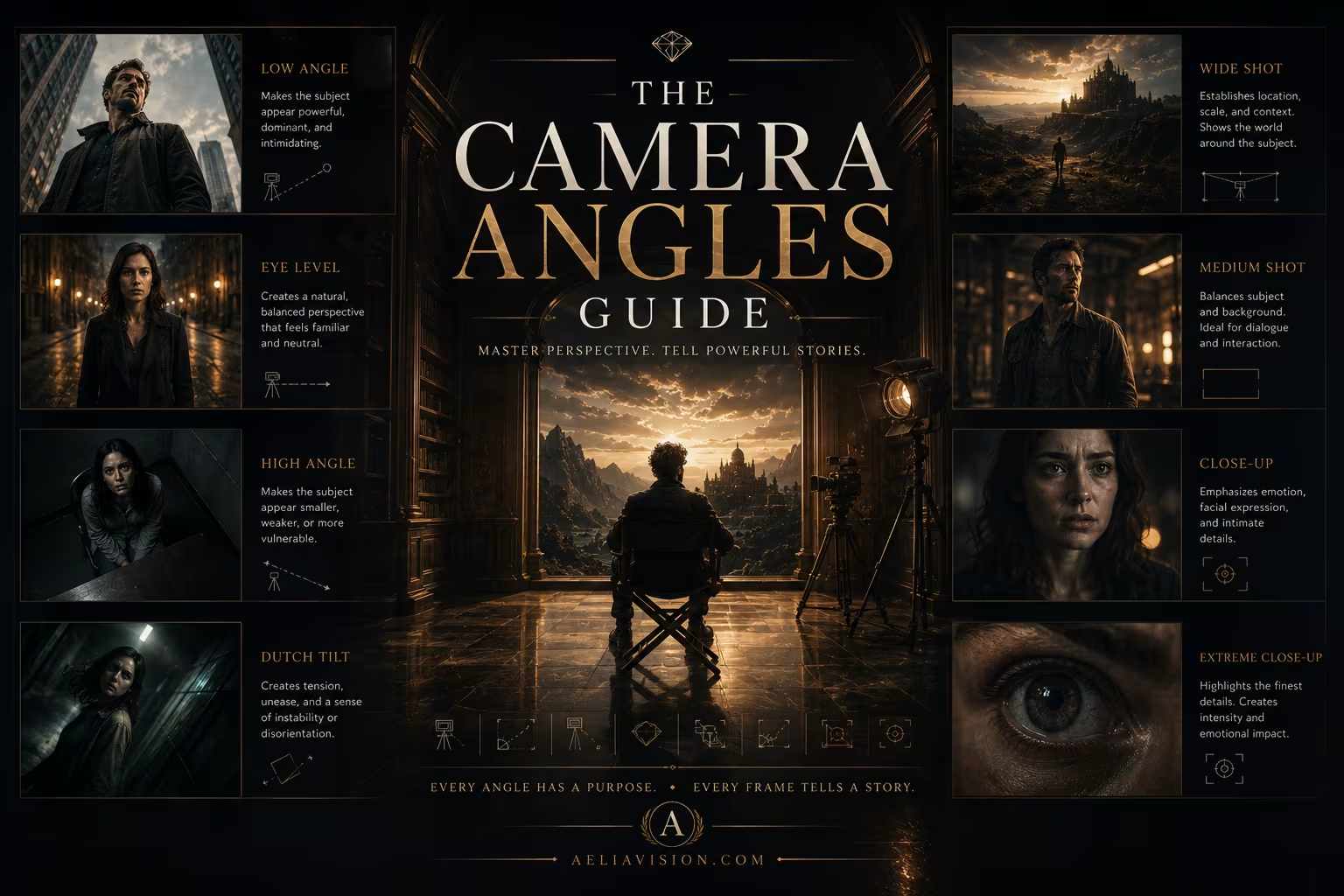
Learn how camera angles shape power, vulnerability, tension, and intimacy, with practical shot choices and prompt language for AI filmmaking.
Inside this story
You point a camera at someone. Where you put it changes everything about what the viewer reads in that moment. A low angle makes them imposing. Eye level makes them relatable. High angle makes them small. The position itself carries meaning before a word is spoken or a frame is graded.
Camera angle is the vertical relationship between the lens and the subject. It’s one of the oldest tools in cinematography, and AI filmmakers need it just as much as anyone holding a real camera. When you write a prompt, the angle you specify shapes the power, vulnerability, intimacy, or distance the viewer feels toward your subject.
This guide covers the practical angles, what each one does emotionally, how to use them in AI generation, and the mistakes that make angle choices feel random instead of intentional.
What camera angles actually control
Table of contents
The angle affects two things: how the viewer sees the subject and how the viewer feels about seeing them that way.
A character shot from below looks physically larger. The viewer has to look up at them. That creates the sensation of power, dominance, or threat. The exact same actor shot from above shrinks. The viewer looks down on them. That reads as weakness, submission, or isolation.
The actor’s performance still matters, but the geometry changes how that performance reads. Lighting and color can reinforce the effect; they cannot make a high angle feel identical to a low one.
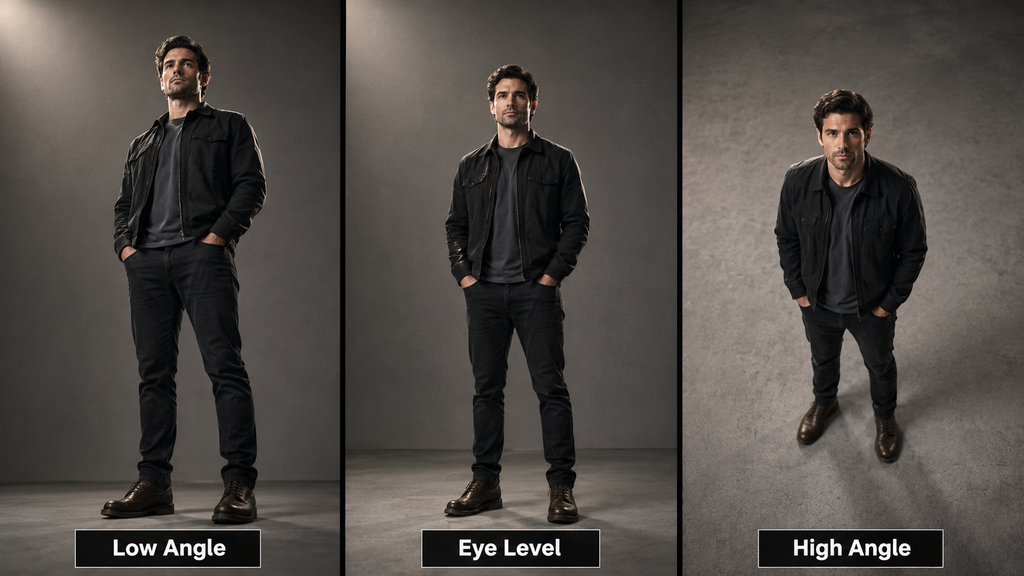
Traditional filmmakers choose angles by moving the camera. AI filmmakers specify them in the prompt. Both are making the same creative decision about how the viewer relates to what they’re seeing.
The standard angles and what they mean
Eye level
The camera sits at the subject’s eye height. The viewer and the subject meet as equals. This is the default for dialogue, interviews, and any scene where you want neutral observation without power dynamics.
Eye level feels honest. It’s the angle humans naturally use when talking to each other face to face. Documentary work lives here. Realism lives here. When you want the viewer to relate to a character without judgment, shoot them at eye level.
In AI prompts, “eye level” or “straight on” gets you this. If you don’t specify an angle, most models default to something close to eye level anyway. But stating it explicitly keeps the model from drifting toward a slight high or low angle that shifts the read.
When to use it: Dialogue between equals, approachable character introductions, documentary-style realism, and moments when power dynamics should feel neutral.
Common mistakes: Using eye level for every shot because it feels safe. Eye level is neutral, which means it adds no emotional weight. If a moment has stakes,a confrontation, a revelation, a threat,staying at eye level wastes the opportunity to make the viewer feel something.
Low angle
The camera sits below the subject’s eye line, pointing up. The subject looms. They occupy more vertical space in the frame. The background often becomes sky or ceiling, emphasizing their separation from the ground and their dominance over the viewer’s perspective.
Low angles make subjects powerful, threatening, heroic, or imposing. A villain shot low feels dangerous. A hero shot low feels larger than life. An authority figure shot low reinforces their control.
The low angle also exposes the underside of the chin and jaw, which can read as unflattering on some faces. That’s intentional when you’re building a villain or a tyrant. It makes them slightly inhuman.
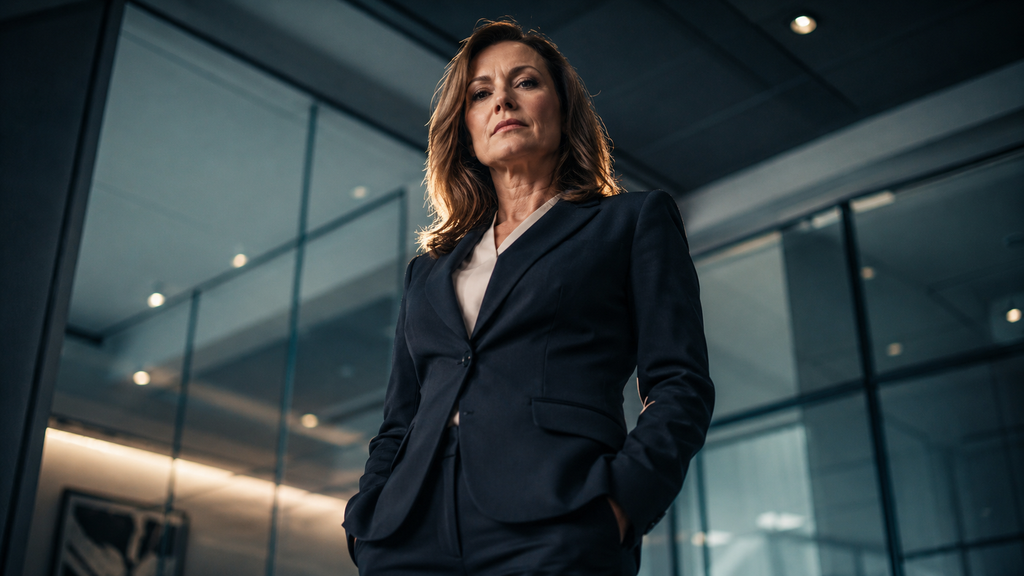
When to use it: Power, authority, menace, triumph, revelation, or architectural scale. Context decides whether the subject reads as heroic or threatening.
In AI prompts: “Low angle,” “camera below subject looking up,” “worm’s eye view” (extreme low), “from ground level.”
Common mistakes: Overusing low angles on protagonists. If every shot makes them look heroic, the technique loses impact. Save the low angle for moments when their power matters to the story.
High angle
The camera sits above the subject, pointing down. The subject shrinks. More floor or ground appears in the frame. The viewer literally looks down on them, which translates emotionally to looking down on their status, safety, or agency.
High angles make subjects vulnerable, weak, trapped, or small. A victim shot high feels helpless. A defeated character shot high looks crushed by the weight of their situation. A child shot high emphasizes their powerlessness compared to adults.
High angles also reveal more of the environment around the subject. That can isolate them,showing them alone in a vast space,or trap them,showing them surrounded with no escape.
When to use it: Vulnerability, fear, defeat, isolation, entrapment, or an emotional low point. The surrounding performance and composition should support that reading.
In AI prompts: “High angle,” “camera above subject looking down,” “bird’s eye view” (extreme high), “overhead shot.”
Common mistakes: Using high angles on protagonists early in the story without a reason. High angles make characters look weak. If your hero isn’t supposed to feel powerless yet, don’t shoot them that way. The angle tells the viewer how to feel before the story does.
Dutch tilt (canted angle)
The camera tilts on its roll axis. The horizon line becomes diagonal. Verticals lean. The frame itself feels unstable.
Dutch tilts create unease, disorientation, chaos, or madness. A thriller uses them when danger is close. A horror film uses them when reality breaks. A fight scene uses them to amplify the sense of things spinning out of control.
The tilt doesn’t need to be extreme. A 10-degree cant is enough to make the viewer feel off-balance. A 30-degree cant reads as extreme either stylized or desperate.
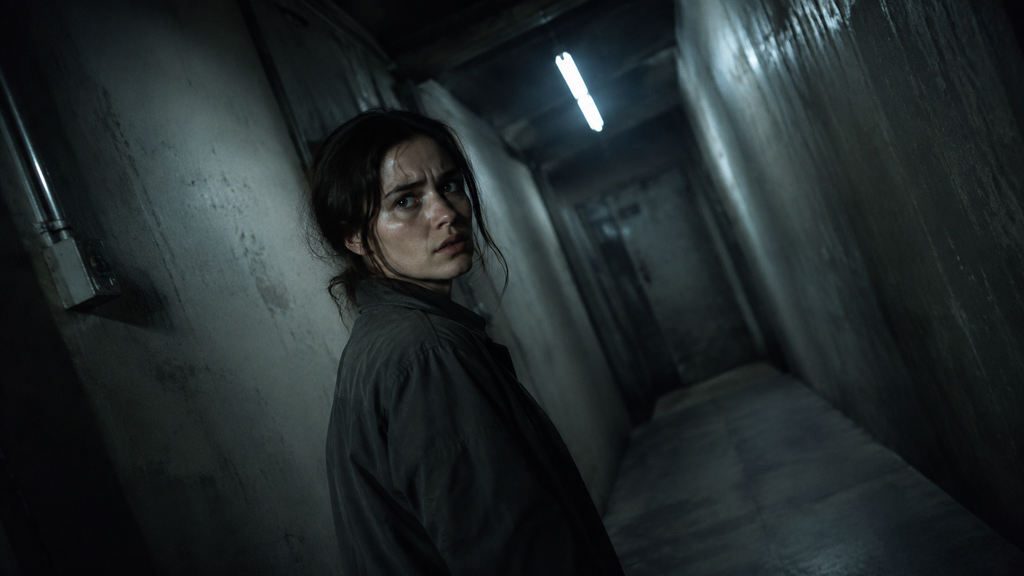
When to use it: Tension, unease, disorientation, psychological instability, action, chaos, or deliberately stylized energy.
In AI prompts: “Dutch angle,” “canted angle,” “tilted frame,” “horizon at 15 degrees” (specify the tilt degree for control).
Common mistakes: Tilting the camera for no reason. A Dutch tilt is a loud signal. If the scene doesn’t have tension or instability, the tilt reads as a mistake or as trying too hard. Use it sparingly. When every shot tilts, none of them land.
Over-the-shoulder (OTS)
The camera sits behind one character’s shoulder, framing a second character in the main portion of the frame. The shoulder and back of the first character anchor the foreground.
Over-the-shoulder shots build conversation. They connect two people in the same space. The viewer sees both participants,one from behind, one facing camera,so the spatial relationship is clear.
OTS coverage is a dependable foundation for dialogue editing. Cutting between one character’s OTS and the reverse angle keeps the geography clear, while clean singles or two-shots can vary the rhythm when the scene calls for them.
When to use it: Two-person dialogue, clear spatial relationships, power shifts within a conversation, and intimate moments that need a grounded perspective.
In AI prompts: “Over the shoulder of [character A] looking at [character B],” “OTS shot,” “from behind [character] shoulder.”
Common mistakes: Not leaving enough shoulder in frame. A true OTS needs the foreground character’s shoulder and head partially visible to anchor the viewer’s perspective. If you frame too tight and lose the shoulder, it becomes a clean single instead of an OTS, and the spatial connection breaks.
POV (point of view)
The camera becomes a character’s eyes. The viewer sees exactly what that character sees, from their eye level, looking in their direction.
POV shots place the viewer inside a character’s experience. A threat approaching in POV feels immediate; a discovery can feel as if the viewer noticed it alongside the character.
POV is powerful but risky. Too much POV can feel gimmicky or disorienting. A few POV shots in a film create intimacy. A whole film shot POV (found footage, body cam) becomes a different grammar with different rules.
When to use it: Direct experience, a character’s discovery, first-person suspense, focused attention, or empathy through a shared perspective.
In AI prompts: “POV shot from [character] perspective,” “first person view,” “looking through [character] eyes,” “handheld POV.”
Common mistakes: Confusing POV with OTS. In POV, the camera represents the character’s viewpoint; an OTS camera sits behind or beside them. A hand or part of the body can still appear in a convincing first-person POV, but another view of the character’s head usually changes the shot’s grammar.
How angles build power dynamics
Power in a scene is often shown through angle contrast. The person with power gets low angles. The person without power gets high angles. When you cut between them, the viewer reads the imbalance immediately.
A courtroom scene might shoot the judge from a low angle and the defendant from a high angle. The geometry alone communicates who controls the room. A police interrogation might shoot the detective from slightly below and the suspect from slightly above. The angles make the dynamic clear before anyone speaks.
When two characters have equal power, you shoot them both at eye level. When the power shifts,one gains the upper hand,you shift the angles. The character who just took control gets their first low angle. The character who just lost it gets their first high angle. The viewer feels the shift through the camera.
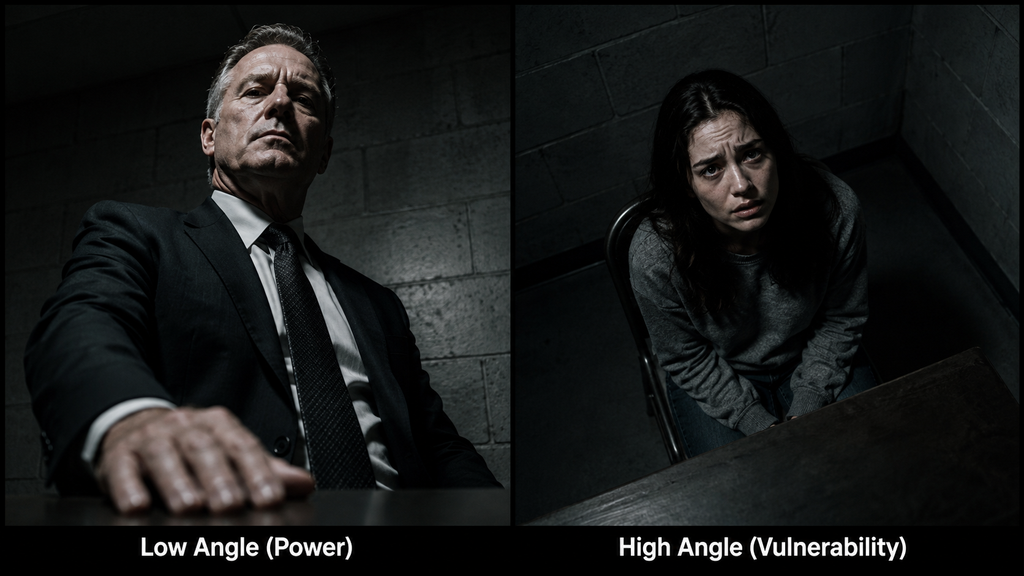
In AI generation, this means thinking in shot pairs. If you’re prompting a scene with two characters where power matters, specify contrasting angles. Don’t let the model default everything to eye level. Make the geometry do the work.
Extreme angles: when standard isn’t enough
Sometimes you need more than a standard low or high. Extreme angles amplify the effect.
Bird’s Eye View: Camera directly overhead, looking straight down. The subject becomes a shape on the floor. This removes their face and their humanity. It shows them as a piece of a larger pattern. Often used for death scenes, isolation, or to show a character as insignificant in a vast system.
Worm’s Eye View: Camera on the ground, looking nearly straight up. The subject towers over everything. Sky or ceiling fills the frame behind them. This makes subjects godlike or monstrous. Use sparingly,it’s a loud effect.
Extreme angles work best as punctuation. Use them once or twice in a film to mark a moment that needs maximum impact. Use them in every shot and they become normal, which defeats the purpose.
In AI prompts: “Bird’s eye view,” “directly overhead,” “top-down shot,” “worm’s eye view,” “extreme low angle from ground.”
Angle progression: how angles build across a scene
Good cinematography doesn’t choose angles shot by shot in isolation. It builds them across a sequence to support the emotional arc.
A character’s introduction might start at eye level,neutral observation. As they take control of a situation, the angles drop lower, giving them more power in the frame. When they lose control, the angles rise, diminishing them. By the end of the scene, the viewer has felt their rise and fall through angle choices alone.
Horror films use angle progression to build dread. A scene might start at normal angles,eye level, comfortable. As the tension rises, the angles creep lower and tilt. By the climax, everything is canted or extreme, and the visual grammar itself has become unstable.
In AI filmmaking, you’re generating shots one at a time, but you need to plan the progression. If shot 1 is eye level, shot 2 is slightly low, and shot 3 is very low, you’re building power. If shot 1 is slightly high and shot 3 is bird’s eye, you’re building isolation or defeat. The progression tells the story the dialogue doesn’t.
Common mistakes when choosing angles
Using eye level for everything
Eye level is safe, but it’s also flat. If every shot in your film is eye level, nothing has stakes. The viewer watches the story happen but never feels positioned toward it. Add lows for moments of power. Add highs for moments of vulnerability. Break the neutrality when the story needs it.
Random dutch tilts
A tilt without tension is a mistake. Dutch angles signal that something is wrong. If the scene is calm, don’t tilt the camera. If the scene is tense, a tilt amplifies that. But sprinkling tilts randomly makes your film look like it doesn’t understand its own grammar.
Mismatched angle in dialogue
In a conversation, if you shoot Character A from a low angle and Character B from eye level, you’ve just told the viewer A has more power than B. If that’s not the story, the angles are lying. Match angles for equal conversations. Contrast them when power is part of the scene.
Forgetting the angle in post
AI filmmakers can fall into the trap of only thinking about angle during generation. Once the image exists, they treat it as fixed. But if you generate a character from the wrong angle, regenerate it. The angle is as important as the lighting or the expression. Don’t keep a high angle shot of a hero moment just because the rest of the image looks good.
Over-rotating angles within a scene
Cutting from a low angle to a high angle to eye level to Dutch angle in rapid succession feels chaotic unless chaos is the point. Pick an angle strategy for the scene and stay consistent. If the scene is about power, use lows and highs deliberately. If it’s about instability, use tilts. Don’t mix all of them unless the story is literally about everything falling apart.
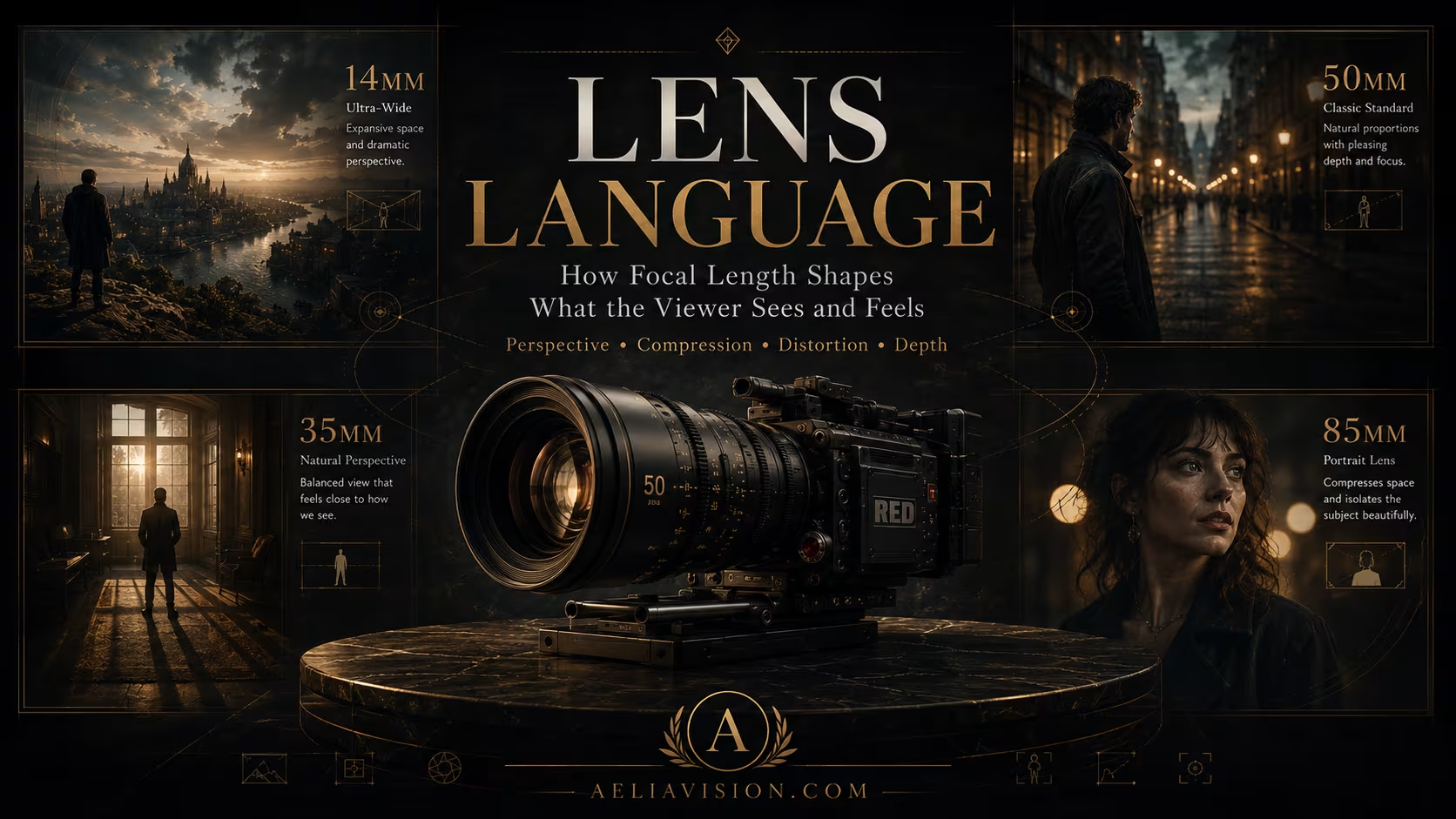
Angle and lens: how they work together
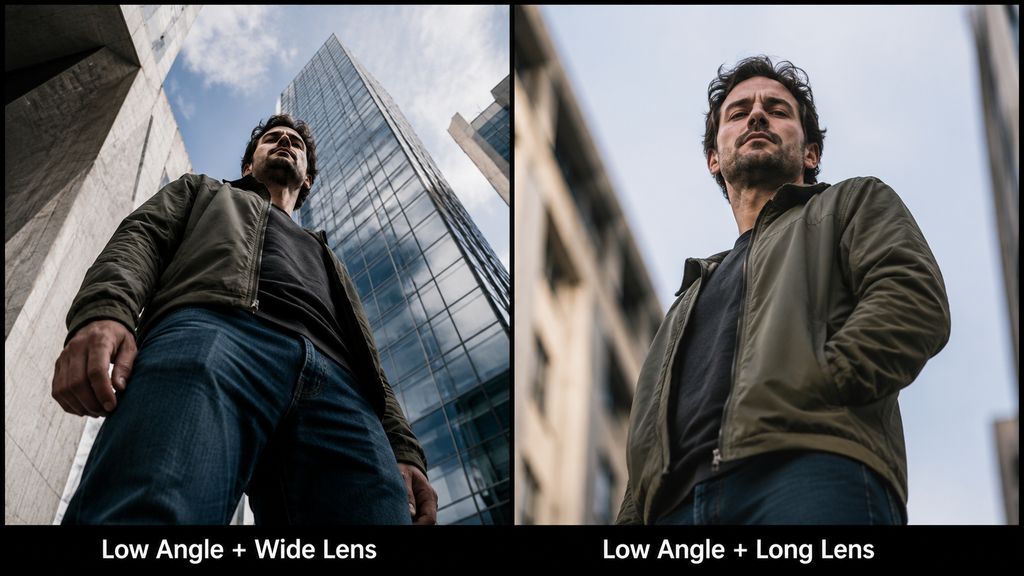
Camera angle and lens choice are partners. A low angle with a wide lens exaggerates height and distorts the subject, making them imposing and slightly monstrous. A low angle with a long lens compresses and flattens, making the subject powerful but more neutral.
A high angle with a wide lens makes a character look tiny and trapped in a big space. A high angle with a long lens isolates them by compressing the background into an undifferentiated blur.
When you prompt for an angle, consider the lens language too. “Low angle, 24mm” gives a different read than “low angle, 85mm.” The combination shapes the emotion.
Angles in different genres
Different genres have angle conventions.
Action films use low angles for heroes and extreme lows for vehicles, mechs, or kaiju. The low angle amplifies scale and power. High angles are saved for victims or defeated enemies.
Horror films use high angles to make victims small and use low angles sparingly,often for the reveal of the monster or threat. Dutch tilts escalate as the horror intensifies.
Dramas stay close to eye level most of the time, using subtle high or low angles to mark emotional shifts rather than constant power plays.
Documentaries often rely on eye level for direct observation, while high, low, or overhead angles can serve a clear editorial purpose.
Commercials use low angles to make products look impressive and high angles to make people look relatable (depending on the message).
Knowing your genre’s conventions lets you either follow them or break them intentionally. Both are valid choices, but breaking them needs a reason.
How to specify angles in AI prompts
Most AI image and video models understand basic angle terminology. These phrases are a useful starting point for a cinematic AI prompt:
For eye level: “Eye level,” “straight on,” “neutral angle,” “camera at subject’s height.”
For low angles: “Low angle,” “camera below subject,” “looking up at subject,” “worm’s eye view” (extreme).
For high angles: “High angle,” “camera above subject,” “looking down at subject,” “bird’s eye view” (extreme).
For Dutch tilts: “Dutch angle,” “canted angle,” “tilted horizon,” “camera tilted 20 degrees” (specify degree for control).
For OTS: “Over the shoulder,” “OTS shot,” “from behind [character] looking at [character].”
For POV: “POV shot,” “first person perspective,” “looking through [character] eyes.”
Start with the standard term. If the model ignores it, add the camera height and viewing direction, such as “low angle, camera two feet off the ground looking up.” Test one change at a time so you can see which wording improves consistency.
Mixing angles and movement
Angles do not have to stay locked. A planned camera movement can start at one angle and end at another.
A push-in that starts at eye level and ends as a low angle makes the subject grow in power as the camera approaches. A crane shot that rises from low to high makes a subject shrink or be swallowed by their environment.
In AI video generation, this is harder to control than in traditional cinematography, but it’s possible if you specify the start and end angle clearly in the motion prompt. “Camera starts low angle and rises to high angle as it pulls back” tells the model to shift the perspective during the move.
Angle changes during movement add another layer of meaning. The change itself tells the viewer something is shifting,power, perspective, or emotional state.
Testing your angle choices
When you’re not sure if an angle is working, ask two questions:
1. What does this angle make the viewer feel about the subject? If the answer doesn’t match what the story needs, change the angle.
2. Is this angle doing work that lighting, composition, or performance can’t do? If the angle adds nothing, default to eye level and let the other elements carry the scene.
Angles are tools. Use them when they add meaning. Don’t use them just to avoid shooting everything flat.
Build angles into your shot workflow
Treat camera angles as part of the project’s visual language. A few explicit rules can keep the framing consistent across a sequence without making every shot look the same.
Write those rules into the shot plan. For example, reserve low angles for moments when the protagonist gains control and high angles for moments of doubt, then note any deliberate exception beside the shot.
In storyboarding, angle is as important as composition. A storyboard panel should show the angle clearly so the final shot matches the intent. Generating shots without a planned angle strategy leaves you with random geometry that doesn’t support the story.
Choose the angle deliberately
Camera angle is a direct way to shape the viewer’s relationship with a subject. The same decision matters on set and in an AI prompt: camera height, tilt, lens, performance, and context work together to create the final reading.
Use low angles for power and dominance. Use high angles for vulnerability and defeat. Use eye level for neutrality and relatability. Use Dutch tilts for instability and chaos. Build angle progressions across scenes to track emotional arcs. Mix angles with lens choice to fine-tune the effect.
Choose the angle deliberately and check it against the story beat. If an AI model defaults to a viewpoint that weakens the scene, revise the prompt or regenerate the shot rather than accepting accidental geometry.
Continue learning
Lens language, camera movement, cinematic visual language, and cinematic AI prompts.
A practical angle checklist
Before generating: note the subject, emotional goal, camera height, viewing direction, lens, and movement. After generating: check whether the angle supports the story beat, matches adjacent shots, and preserves the intended screen direction.
Continue reading
Further insights from the Journal
Have a story in mind?
Bring your next project into focus.
Tell us what you are creating and what you want the audience to feel.