The story in brief
A practical war filmmaking guide for directors and AI creators. Find a human point of view, stage combat clearly, research the world, use sound and editing with restraint, and avoid turning suffering into spectacle.
Inside this story
War is one of cinema’s most powerful subjects and one of its easiest subjects to mishandle. It supplies built-in stakes, uniforms, vehicles, ruined streets, divided loyalties, and the pressure of decisions made too quickly. Those ingredients can make a scene look impressive before it has earned a single feeling. A burning skyline is not a story. A soldier carrying a rifle is not a character. A barrage of cuts, dust, and shouting is not automatically terror.
The films that stay with people usually narrow their attention. They put us beside someone with a limited view of a large event: a medic trying to reach a trapped civilian, a radio operator who has lost contact with her unit, a father hiding a family in a basement, a teenager who thinks enlistment will make him important, an officer whose map has become useless. The conflict remains enormous, but the film gives it a human scale.
That is the central discipline of war filmmaking. Do not begin with battle. Begin with what violence changes for a particular person, family, neighborhood, or unit. Once that is clear, production choices become easier. You know which details the camera should notice, whose fear matters in the sound mix, whether an explosion should be visible, and when the film should refuse a clean resolution.
This guide is for live-action, animation, virtual production, and AI filmmakers. It covers research, story design, visual language, action coverage, prompt writing, sound, editing, and ethical boundaries. The tools may change, but the work remains the same: make deliberate choices, respect the people represented, and keep the audience oriented inside the chaos.
Find the story inside the conflict
A war is a setting, not a plot. It can contain dozens of nations, years of political history, shifting fronts, and millions of individual lives. A short film cannot carry all of that through explanation. It needs a smaller dramatic question that the audience can follow in real time.
Write the premise in terms of a person under pressure. Compare these two starting points:
> A platoon fights through a devastated city during the final days of a war.
> A young translator must choose whether to warn a family that the platoon searching their apartment has mistaken them for informants.
The first describes an arena. The second creates a decision. It establishes a point of view, a time limit, competing obligations, and a civilian presence. It also tells you that the film may belong in corridors, stairwells, and whispered conversations rather than on a broad battlefield.
A useful war-film premise includes five facts. Who is carrying the scene? What do they want before the danger begins? What piece of information or resource is missing? Who pays if they fail? What line will they not cross, or believe they will not cross? That last question gives war stories their moral pressure. Combat becomes dramatic when a character’s practical need collides with their idea of themselves.
Keep the protagonist’s knowledge incomplete. People in combat and occupied places often act on rumor, bad maps, broken radios, memory, and a partial view through smoke. Let the audience experience that limitation. A character may hear armor before seeing it. They may make a choice because a courier never arrives. They may never learn why another unit abandoned a position. This is more truthful than making every person in the story fully informed for the sake of exposition.
Avoid using the conflict as decoration for a generic revenge plot. Revenge can be part of the story, but the war should alter its meaning. A killing in peacetime, a killing during an occupation, and a killing in the last hours before a ceasefire place different demands on the character and the audience. The world should press back on the plot.
Choose a point of view before choosing a side
A point of view is not the same thing as a flag. It is the lens through which the audience receives events. A film may follow soldiers, civilians, journalists, displaced people, resistance members, aid workers, prisoners, or people who support the war and later regret it. Each vantage point changes the story’s available images and its moral blind spots.
Ask whose ordinary life is disrupted. Ask whose labor keeps the place alive when systems collapse. Ask who has the least power over the decisions being made. These questions do not require a film to be politically simple. They prevent a common failure: treating local people as scenery while outsiders get all the choices and emotions.
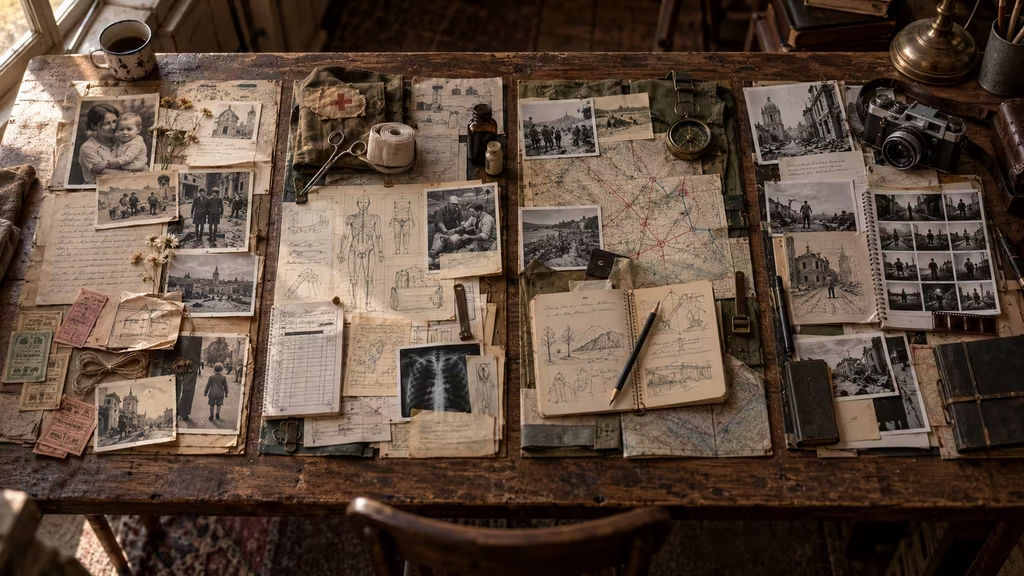
If your story involves a real conflict, research beyond military hardware and major leaders. Read oral histories, diaries, contemporary reporting, museum archives, regional historians, and work by people from the communities shown. Learn how people spoke, what they ate, how they moved through a checkpoint, what work continued, which institutions survived, and what small habits helped them endure. A world becomes believable through these details.
Research also helps you avoid accidental mythology. Uniform colors, insignia, weapons, ranks, slang, dates, and geography matter, especially to viewers with direct knowledge of the conflict. You do not need to turn a drama into a museum exhibit, but basic mistakes break trust quickly. If you compress time, combine locations, or invent a unit, do it consciously and make the fictionalization serve the story.
For fictional wars, establish rules with equal care. What is being fought over? How long has the conflict lasted? What does each side believe it is protecting? Which resources are scarce? How does civilian life continue? What does a child know that an adult does not? You will not explain all of this on screen. You need the answers so the world has weight.
Build characters who existed before the war
The strongest way to avoid cardboard heroes is to give every major character a life that predates the first scene. What job did they have? Who depends on them? What skill is useful now but came from an ordinary past? What do they miss that has nothing to do with strategy? A mechanic may understand how to keep a generator alive. A teacher may know every child in a shelter by name. A cook may have become the person who decides who eats first.
Small behavior carries more weight than a backstory speech. A soldier may fold a letter and put it away when a superior enters. A medic may wash blood from her hands with too little water, then apologize for taking too much. A civilian may insist on bringing keys when leaving a home they know will not survive. These actions suggest history without announcing it.
Do not make one side uniformly noble and the other uniformly monstrous. Atrocities and responsibility should be named honestly when the story requires it, but individuals should remain people rather than props for a message. A humane portrayal does not erase power, ideology, or culpability. It makes the mechanisms of harm more visible. A frightened conscript can still participate in cruelty. A civilian can hold prejudices. A commander can care for a subordinate and issue a terrible order.
Give secondary characters specific wants. The person who hands over ammunition, drives the truck, or opens a door should not exist only to die and motivate the lead. Even brief roles become real when they have a task, a preference, an objection, or a moment of agency. This is particularly important for women, children, elders, and local residents, who are often reduced to evidence of stakes rather than allowed to influence events.
Dialogue should sound like people conserving energy. Under pressure, characters often speak in fragments, practical questions, dark jokes, repeated instructions, and silence. Avoid making everyone explain the theme of the film. Let an argument emerge through what people need: whether to wait, whether to share water, whether to leave someone behind, whether to trust a report.
Treat violence as consequence, not spectacle
Action has a cost in a war film. A bullet changes a body, a plan, a relationship, and the sound of the room. If violence appears only as a clean visual reward, the film begins to celebrate the very thing it claims to condemn.
You do not need graphic imagery to convey harm. Often the aftermath is more disturbing and more useful than the impact. Show a character trying to open a jammed door with shaking hands. Let a survivor stare at a missing chair at a kitchen table. Hold on a medic’s exhausted face after the camera has stayed outside the treatment room. A film can acknowledge injury without turning suffering into a display.
Decide what each violent moment does to the story. It may reveal a character’s training, destroy an illusion of safety, force a moral choice, alter the group’s trust, or create a problem that cannot be solved by more force. If the answer is only that the scene needs more excitement, cut it or rethink it.
The camera’s distance is an ethical choice. A long lens from behind cover can put the audience in a witness position. A close handheld image can trap us inside a character’s sensory confusion. A wide static shot may make people look small against a damaged landscape. None is inherently more respectful. The question is whether the shot asks the audience to understand, observe, or enjoy.
Be especially careful with deaths of civilians and children. Their presence should never be a quick shortcut to seriousness. If the script includes such harm, give the affected people identities, relationships, and consequences. Consider whether the scene needs to be shown directly at all. A missing voice on a radio, an abandoned shoe in a hallway, or a parent’s reaction may say more than an explicit image.
Design a visual language that has a reason
War films often default to desaturated colors, handheld camera movement, smoke, rain, and a wide shutter angle. Those choices can work. Used by habit, they make every conflict look like the same conflict.
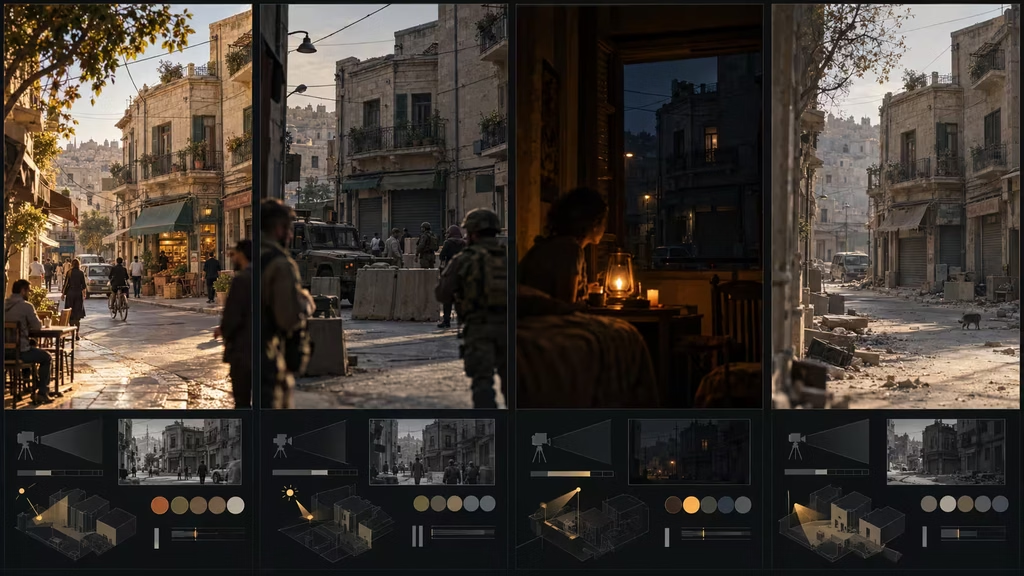
Start with the environment and emotional point of view. A winter campaign might have flat light, brittle surfaces, and long blue shadows. A coastal siege might use bleaching sun, salt haze, crowded alleys, and empty water tanks. An interior story set during blackouts may rely on candles, flashlight spill, and the changing light of a radio dial. Build a visual system from the place rather than from other war movies.
Color can track the erosion of ordinary life. Early scenes might contain domestic colors: a painted door, a school scarf, fruit at a market, laundry in a courtyard. As conflict reaches the characters, those colors may disappear, become dirty, or return briefly in a memory. Do not drain every image to gray on day one. Contrast gives the losses meaning.
Camera movement should reflect what the character can control. A stable tripod frame can make a checkpoint feel impersonal and immovable. A shoulder-mounted camera may work when a character runs through an unfamiliar building. Slow movement can be more frightening than frantic movement if the character is waiting for a sound they cannot identify. Let the movement have a physical motivation.
Use geography to make scenes legible. Before a firefight or escape, show where the exits, windows, cover, civilians, and obstacles are. You do not need an overhead map in every sequence. A few clear establishing details allow the audience to understand why a character chooses a particular route. Chaos feels more intense when viewers know what has been lost.
Lens choice changes emotional distance. Wider focal lengths near a performer make rooms feel unstable and immediate. Longer lenses can compress streets, make escape routes seem impossible, and isolate people from one another. A normal lens may serve conversations where you want the audience to read behavior without a visual trick. Test these choices in relation to the setting, not as a fixed genre recipe.
Stage combat so the audience can follow it
A battle scene needs objectives, space, and changing conditions. Without them, it becomes noise. Before shooting or generating a sequence, write a plain tactical sentence for every beat: the group must cross the street; the medic needs to reach the stairwell; the squad is trying to hold a radio position until evacuation; the family needs to leave before the building is searched.
Then draw the space. Mark cover, sightlines, entrances, stairs, elevation, vehicles, civilians, debris, and areas the characters cannot see. This does not have to become a detailed military diagram. It gives you a practical answer when the action slows down: what has changed in the room?
A clear action sequence often moves through four phases. First, orientation: establish the goal and the layout. Second, disruption: something breaks the expected plan. Third, adaptation: characters make choices with worse options. Fourth, outcome: show what the action cost. The phases can overlap, but the audience should feel the cause and effect.
Keep the number of important actions manageable. If a short sequence includes snipers, drones, artillery, a tank, a collapsing building, a hostage, and a surprise betrayal, none may land. Pick the pressure that serves the scene. A single unseen shooter can create more tension than a large assault when the characters cannot identify where the shot came from.
Give every weapon or threat a recognizable screen behavior. A distant mortar may arrive as a whistling warning and a cloud beyond the frame. A drone may be heard before anyone looks up. A machine gun may pin people behind a wall, changing the scene into a problem of movement rather than a contest of aim. Repetition helps the audience learn the danger, then lets you vary it.
Action is also performance. An inexperienced character should not move like a trained operator. Exhaustion changes posture. Equipment catches on doors. Hands fumble when cold. A person who has just been near an explosion may not hear instructions clearly. These details make combat feel physical without requiring bigger effects.
If you use AI video, generate action as short, controllable shots rather than one long prompt asking for an entire battle. Build coverage: an establishing shot, a character reaction, a detail of the obstacle, a directional movement shot, the event itself if needed, and the aftermath. Continuity is easier when each clip has one job.
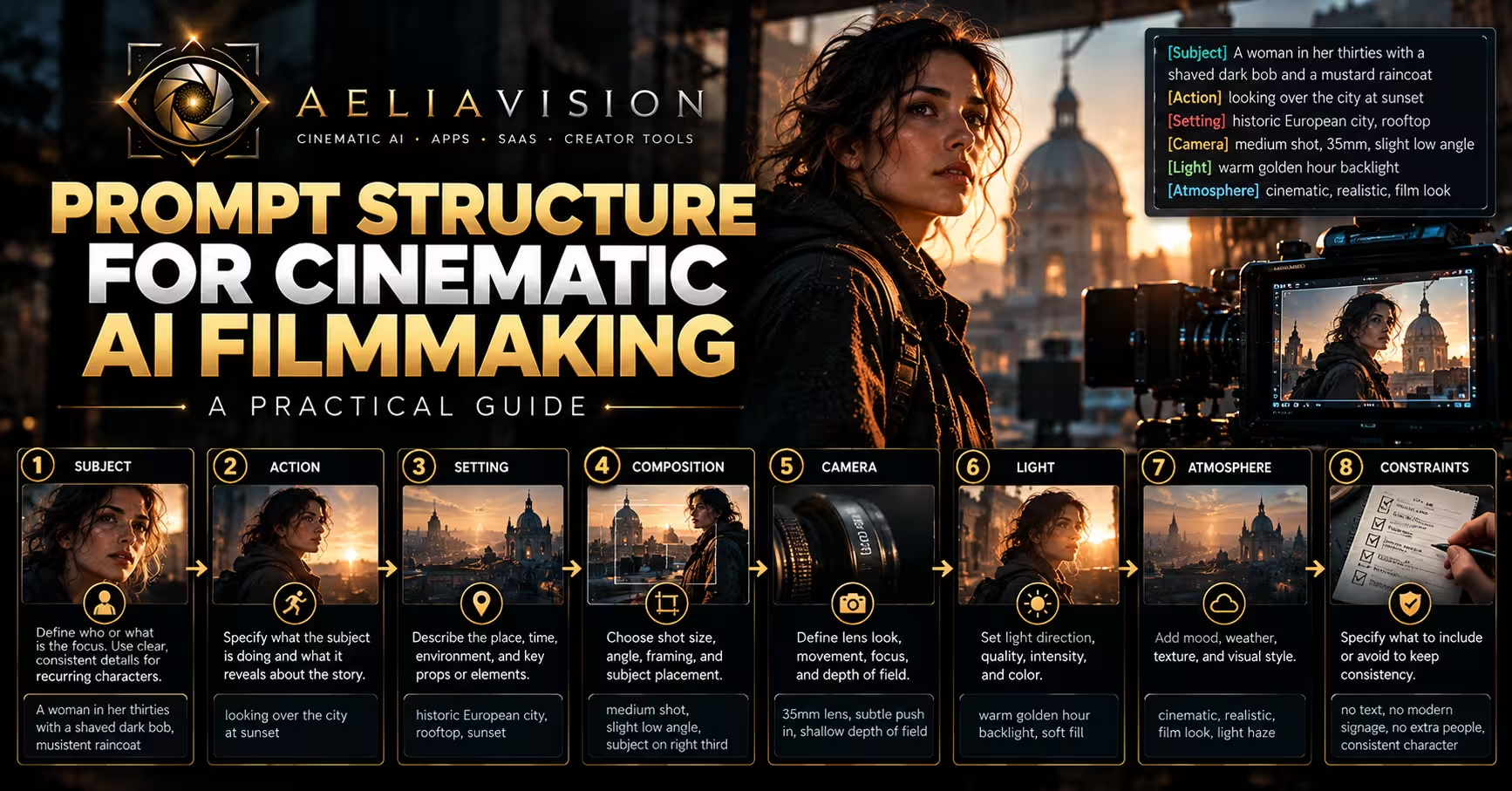
A useful prompt structure is:
> [period and location], [character and immediate goal], [specific physical action], [camera position and movement], [light and weather], [emotional tone], [what the image avoids].
For example:
> 1940s European rail yard at dawn, exhausted field medic in a mud-stained coat tries to pull a wounded stranger behind a stationary freight car, low camera from cover tracking sideways with them, cold fog and weak gray sunrise, urgent but restrained, no heroic pose, no visible gore, no modern objects, no text.
This prompt is specific enough to guide composition and behavior. It does not pretend that a single generated shot can solve the whole scene.
Direct AI war imagery with restraint
AI tools can produce uniforms, ruined architecture, vehicles, weather, and crowded frames quickly. They can also produce false historical details, unstable hands and weapons, duplicate people, invented insignia, and imagery that looks like real documentation. Your job is to control those risks.
Use reference images responsibly. Verify their source and license. Do not present generated scenes as historical photographs or current reporting. When publishing, label synthetic material where the context could confuse viewers. This is especially important for ongoing conflicts, victims, and public figures.
Prompt for cinematic distance rather than a demand for shocking detail. Replace “brutal battlefield carnage” with a story-based instruction: “aftermath of an artillery strike seen from a school corridor, dust falling through a broken window, survivors moving quietly in the far background, camera stays with a child’s abandoned backpack, no bodies in close view.” The latter asks for consequence, place, and point of view.
Build a continuity sheet before generating. Record character age range, hair, facial features, uniform layers, equipment, injuries, props, weather, time of day, lens family, color palette, and emotional state. Reuse the exact phrasing for recurring characters. Create a small set of approved reference frames and compare each new generation against them.
Check every generated image for anachronisms. Look at insignia, weapon era, vehicle silhouettes, road markings, electrical infrastructure, architecture, clothing fasteners, and visible writing. A single modern tactical vest in a period story can take viewers out of the scene. For a fictional setting, establish your own rules and check them with the same seriousness.
Do not use real suffering as a style board. Reference documentary photography and testimony to understand conditions, but do not strip people of context and turn their images into an aesthetic preset. If a project draws from a current war, consider consultation with historians, journalists, community members, or trauma-informed reviewers before release.
Use sound to make danger real
Sound often carries the reality that an image cannot. A distant blast may be frightening because it is heard through walls and followed by silence. Boots on wet stairs can tell us more about an approaching search party than a wide shot of armed people. A broken radio can make a large operation feel suddenly lonely.
Start with the sound perspective. Is the audience hearing the room as it exists, or through a character’s stressed perception? You can narrow the world after a blast, reduce high frequencies, make speech indistinct, or bring breathing forward. Use these devices sparingly. If every event causes ringing ears and muffled sound, the effect loses force.
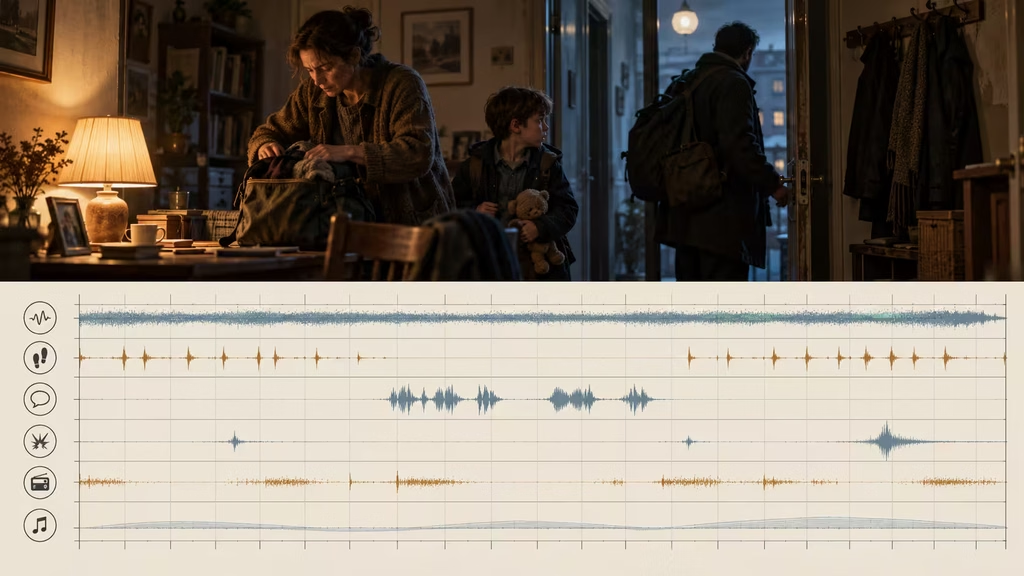
Create layers that have narrative jobs. Ambience establishes location: wind through broken windows, generators, insects, distant traffic, rain on sheet metal. Human texture establishes proximity: fabric, breath, footsteps, whispered directions, a cup set down too loudly. Threat sounds establish off-screen pressure: artillery, engines, aircraft, radio static, dogs, a gate opening. Music should enter only when it adds a viewpoint the other layers cannot carry.
Silence is not empty. A sudden absence of familiar ambient noise can signal that people are listening. A quiet room after bombardment can give the audience time to understand what changed. Leave space around major sounds instead of stacking every element on the same frame.
For combat, think in distance. A nearby rifle crack, a distant automatic burst, and an interior ricochet should not occupy the same acoustic space. Pan, filter, and reverberate them according to the environment. In a narrow street, echoes may confuse direction. In open terrain, a sound may arrive with unnerving clarity. The mix should help the audience feel the space, even when it withholds tactical certainty.
Dialogue needs protection. If a line contains a decision the viewer must understand, clear room in the track. Reduce music before the line rather than after it begins. Let a burst of sound interrupt a sentence only if the interruption changes the scene. A noisy mix can feel realistic and still fail as storytelling.
Edit for orientation, then feeling
Fast cutting can create urgency, but speed alone is not tension. The audience needs enough information to understand what a cut changes. Before tightening a sequence, make sure the viewer knows where the lead character is, what they are trying to do, where the danger comes from, and what options remain.
Use shot duration to reflect mental state. Longer shots can make waiting unbearable. A held close-up after a radio message gives a performer room to process it. Shorter cuts can express overload during a sudden attack. Moving between these rhythms creates shape. If every shot is brief, the film has nowhere to escalate.
Cut on decisions, not only impacts. A hand choosing not to pick up a weapon can be the important cut. A civilian hearing a lie can be the important cut. A character noticing a familiar object in a ruined room may redirect the entire sequence. These moments turn action into drama.
Preserve aftermath. After a loud event, resist the urge to immediately cut to the next threat. Give the scene a beat for people to react, count who is present, search for a voice, or fail to speak. The aftermath may be only two seconds, but it tells the audience that the event happened to someone.
Transitions can carry the passage of time without a montage of explosions. Cut from a full water container to the same container nearly empty. Match a child’s drawing to a military map. Let a train sound bridge from a peaceful departure scene to an evacuation platform. Repeated objects can measure attrition more elegantly than captions.
Test the sequence without music. If it is incomprehensible, score will not fix the edit. Test it with sound only. Then add music in a version where it enters later than you think it should. War films often become more affecting when the soundscape is allowed to do its work before a cue tells us how to feel.
Handle history and ethics in the final pass
Before locking the film, do an ethics review separate from the ordinary technical review. Ask whether the film has turned real suffering into atmosphere. Ask whether the people most affected have agency, names, and interior lives. Ask whether the opposing force has been made legible enough to understand the danger without becoming a caricature. Ask whether a scene has been included because it serves the story or because it looks intense in a trailer.
If the conflict is current or closely connected to living communities, seek feedback from people with relevant experience. They may identify language, gestures, locations, or assumptions that research alone missed. Pay them for their time when possible. Consultation is not a stamp of approval, but it can prevent avoidable harm.
Consider viewer care. Content notes may be appropriate for graphic injury, child endangerment, torture, sexual violence, or material based on recent events. A note should describe the relevant material plainly without using it as marketing. If your film uses synthetic recreations, state that clearly in credits or accompanying material.
Do not simplify history to make a cleaner ending. Some stories end with survival, not victory. Some characters make the least harmful choice available and still lose something essential. A final image can hold grief, uncertainty, relief, guilt, or ordinary life returning in fragments. You do not need a speech about what war means. Let the accumulated details make the point.
A practical production workflow
Start with a one-page story brief. Include the protagonist, objective, time limit, conflict context, location, visual palette, sound perspective, and one sentence on the consequence of violence. Make a research folder that separates verified facts, visual references, and ideas you have invented. This prevents a useful reference from becoming an accidental claim of history.
Next, make a sequence map. List each scene’s goal, obstacle, turn, visual anchor, and sound anchor. A visual anchor might be a stairwell, a red kettle, a checkpoint barrier, or a damaged bus. A sound anchor might be a generator, an emergency broadcast, bells, rain, or a particular radio phrase. Repeated anchors help a short film feel like one world.
For AI production, break the sequence into shots and generate only after you know what each shot needs to convey. Keep a prompt log with seed or version information where the tool allows it. Save accepted takes, rejected takes, and notes about why a result failed. This is faster than trying to repair continuity from memory after dozens of generations.
Create temporary sound early. Even a rough ambience bed and a few effects will reveal whether the imagery needs more breathing room. Edit a clear assembly before polishing visual effects, color, or music. Then review for historical and ethical accuracy again, because small visual additions often introduce mistakes.
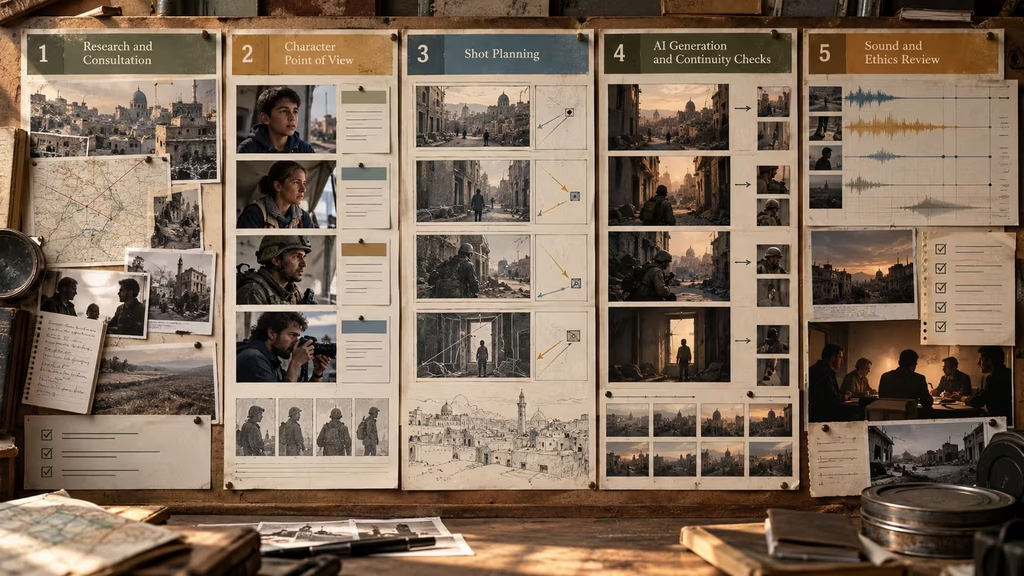
A final checklist before release
Read the film from the audience’s position. Can they name what the main character wants in each major sequence? Can they understand the space during action? Does the sound clarify the emotional point of view rather than merely making the mix louder? Does the camera observe people with dignity when they are vulnerable?
Check factual claims, dates, uniforms, locations, accents, and visible language. Check generated material for distorted weapons, duplicate extras, invented insignia, and accidental references to real contemporary events. Check that no synthetic frame could be mistaken for documentary evidence in the place where it will be posted.
Then check the film’s appetite for violence. If you removed one explosion, one impact shot, or one line of explanation, would the scene become stronger? Often it will. War filmmaking does not require restraint because war is quiet. It requires restraint because the subject already carries enough force. The filmmaker’s work is to direct attention toward the people living through it.
A good war film leaves the audience with more than a memory of scale. It leaves them with a face, a room, a choice, a sound that returns at night, or an ordinary object that has become impossible to see the same way. That is where the genre earns its place. Not in the machinery of conflict, but in the human lives pressed against it.
Continue reading
Further insights from the Journal
Have a story in mind?
Bring your next project into focus.
Tell us what you are creating and what you want the audience to feel.