The story in brief
Learn what makes an image cinematic and how story, composition, lenses, lighting, color, depth, and realism improve AI images and video prompts in practice.
A cinematic image uses story, composition, camera position, lighting, color, depth, texture, and believable detail to guide attention and create a specific feeling. For AI creators, those choices matter more than adding film grain, black bars, lens flares, or the word “cinematic” to a prompt.
What makes an image cinematic? A guide for AI creators
Table of contents
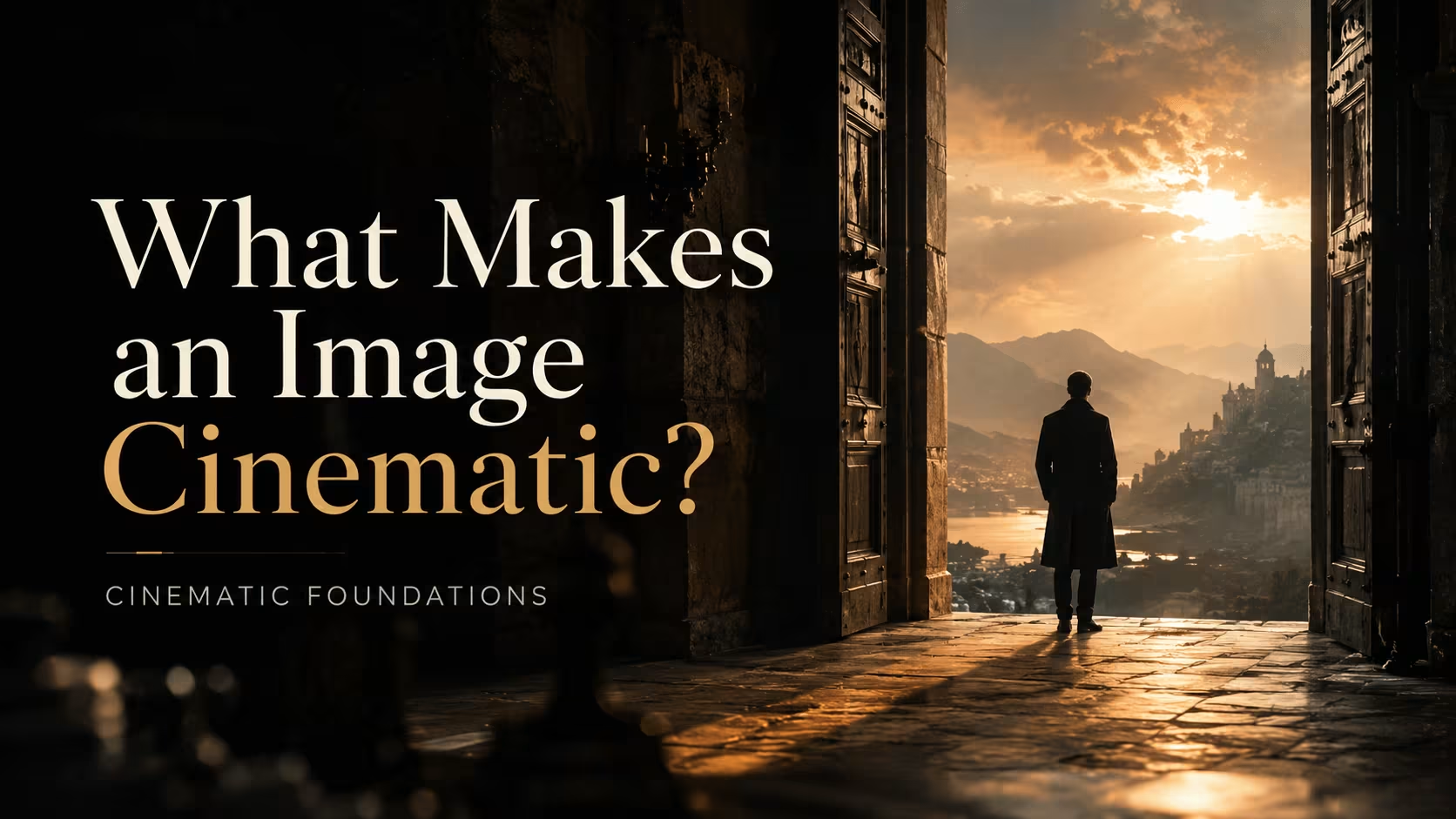
A cinematic image is more than a beautiful picture. While black bars, dramatic lighting, shallow depth of field, film grain, or expensive lens flares can enhance an image, those surface details do not make an image cinematic on their own. A cinematic image feels as if it belongs to a larger story. Composition, lighting, depth, color, texture, realism, and camera language guide the viewer toward a specific feeling. An ordinary image may show what something looks like. A cinematic image also communicates what the moment means.
For AI creators, this foundation matters. AI tools can generate polished images in seconds, but visual beauty alone is not cinema. Many AI images look polished at first glance but feel empty because the story, emotion, visual logic, or focal point is unclear. Before writing a prompt, decide what a director and cinematographer would need to know about the moment. Ask two questions: “What should the image show?” and “What should the audience feel when they see it?”
1. A simple definition of a cinematic image
A cinematic image is a deliberately designed composition where story, emotion, lighting, depth, color, texture, and realism work together to create meaning. The distinction separates directed visual storytelling from an image that is merely attractive. A cinematic shot doesn’t need to be massive, expensive, or complex. It can be as simple as a close-up of a face, a lonely chair, a product on a table, or a child peering through a window. What matters is the intention behind the frame.
When elements like a clear story moment, motivated lighting, visual depth, and a meaningful camera angle work together, the image feels cinematic. If they do not, the image will just feel generic, no matter how pretty it is.
2. Cinematic does not mean “expensive looking”
Many beginners mistakenly equate “cinematic” with expensive Hollywood tropes, such as anamorphic lens flares, orange and teal color grading, shallow depth of field, dramatic fog, or 8K ultra-realistic detail. While these are useful tools, they are not the foundation of visual storytelling. A bad image with black bars slapped on it is still a bad image. Cinematic quality comes from visual storytelling, not mere decoration.
| Concept | The Prompt | The Resulting AI Image |
| Weak Prompt | A cinematic man sitting in a room, dramatic lighting, ultra realistic, 8K. | Produces a polished but generic image that lacks meaning and emotional weight. |
| Strong Prompt | An exhausted father sits alone at a kitchen table after reading a final hospital bill, his face half-lit by the cold refrigerator glow, unpaid papers scattered in the foreground, an empty chair across from him, quiet domestic realism, muted colors, restrained composition, emotional stillness. | Produces an image grounded in story, human tension, motivated lighting, and meaningful props. |
3. Story comes first
Before you consider lighting, lenses, or color grading, you must establish the story. Every cinematic image represents a story beat: a meaningful moment inside a larger scene. For example, a hero realizing they have been betrayed requires a different visual language (shadows, distance, cold colors) than a mother saying goodbye to her child (soft light, close framing, emotional stillness). Let the story determine the visual choices. Every AI prompt should begin with a core story idea, rather than just a visual style.
| Approach | Prompt Example |
| Style-First (Weak) | A cinematic knight in a castle. |
| Story-First (Strong) | A wounded knight returns to the castle gate at dawn after losing the final battle, standing alone in the mud while the kingdom’s banners burn behind him, quiet defeat, low wide angle, cold morning fog, realistic armor scratches, muted gray and gold palette. |
4. Emotion gives the image direction
While story tells us what is happening, emotion tells us how it should feel. A woman standing in a doorway can evoke romance, loneliness, danger, power, or peace, entirely depending on the cinematic choices made. If the doorway is flooded with warm sunset light, it feels nostalgic; if she is just a silhouette in the darkness, it feels threatening. Choose one dominant emotion before writing the prompt. Asking for horror, beauty, comedy, and realism at the same time usually produces a confused image.
5. Composition: the frame must guide the eye
Composition is the intentional arrangement of visual elements inside the frame, creating a visual hierarchy that tells the viewer where to look first. In AI generation, composition is often a weakness because models prioritize placing things beautifully rather than giving them story priority.
- Subject Placement: A centered subject feels formal, powerful, or iconic, while an off-center subject feels more natural, lonely, or vulnerable.
- Negative Space: The empty or quiet area around a subject is one of the most powerful cinematic tools, used to create suspense, elegance, scale, or emotional distance.
- Leading Lines: Elements like roads, hallways, shadows, or light beams guide the viewer’s eye directly to the focal point.
- Balance: A balanced frame feels controlled and elegant, whereas an intentionally imbalanced frame creates psychological tension and unease.
6. Camera distance controls emotional distance
The physical distance between the camera and the subject completely alters the audience’s emotional relationship to the scene. AI creators must choose a shot size that supports the story beat.
- Extreme Wide Shot: Shows the subject as a tiny figure in a massive environment, perfect for epic scale, isolation, or world-building.
- Wide Shot: Shows the full body and the environment, useful for action, location clarity, and establishing power relationships.
- Medium Shot: Frames the character from the waist or chest up, grounding the scene in natural realism and dialogue.
- Close-up: Frames the face tightly, bringing the viewer closer to grief, fear, or realization.
- Extreme close-up: Isolates a detail, such as trembling hands or a cracked ring, and gives it emotional weight.
7. Camera angle creates power and psychology
Camera angles affect how the viewer reads power, vulnerability, and tension. An eye-level angle feels human, honest, and grounded, making it perfect for natural conversations. Conversely, a low angle looking upward makes the subject feel heroic, dangerous, or dominant. A high angle looking down creates a sense of vulnerability, making the subject feel small or trapped. A Dutch angle can suggest instability or unease. An over-the-shoulder shot places the viewer inside a conversation or conflict.
8. Lens choice changes the feeling of space
In real cinematography, lenses change perspective, compression, and emotional distance; in AI prompting, naming a lens can help guide the model toward that physical feeling. Wide lenses (18mm to 24mm) exaggerate space and are perfect for epic environments or claustrophobic distortion. Natural lenses (35mm and 50mm) mimic human observation and are ideal for grounded, street-level drama. Portrait and telephoto lenses (85mm, 100mm, 135mm) compress the background space, isolating the subject for emotional intimacy or surveillance. When using anamorphic prompts, always ask for “subtle” distortion, as AI tends to exaggerate lens flares heavily.
9. Lighting creates mood and depth
Lighting makes a subject visible, but it also establishes mood, depth, texture, and time of day. Motivated lighting appears to come from a believable source, such as a window, fire, or neon sign. That makes the scene easier to believe. Flat, front-facing light feels ordinary, whereas directional light (like side light or backlight) creates shape and mystery. Cinema often uses shadow to hide information, shape depth, and create tension.
10. Color creates mood
Before a viewer even processes a story, the color palette has already established a feeling. Warm colors suggest comfort, memory, or danger, while cool colors evoke isolation, technology, or sadness. Saturated colors feel magical and energetic, whereas muted colors feel serious, historical, and restrained. AI models often oversaturate images, so to achieve a cinematic look, you must prompt for a controlled palette using phrases like “muted cinematic palette,” “restrained color grade,” or “no oversaturation”.
11. Depth makes the image feel like a real scene
A cinematic image feels three-dimensional and layered, unlike a flat poster. To create spatial layers, define the foreground (objects close to the camera, like blurred door frames or rain on glass), the midground (where the main subject and action live), and the background (which provides context and scale). These layers help the viewer read the scene as a physical space.
12. Focus directs attention
Focus is a storytelling tool. While shallow depth of field (a blurred background) is great for isolating a single emotional detail, it is a mistake to think it is always the best choice. Deep focus where both the foreground and background are sharp works when the environment or a distant threat matters to the story. Use clear AI instructions like “background softly blurred” or “both foreground and background readable” to control this.
13. Realism makes the image believable
Even impossible fantasy or sci-fi worlds require visual logic and realism to feel believable. Realism means the image follows believable physical rules: shadows match the light source, scale makes sense, and environments look lived in. AI images frequently fail here by generating plastic skin, impossible reflections, or worlds that are far too clean. Counteract this by prompting for specific physical wear, such as “weathered steel armor with scratches and mud stains” instead of just “realistic armor”.
14. Texture gives the image physical presence
Texture gives a generated image physical presence and can reduce the smooth, synthetic look common in AI output. Rough stone, wet pavement, wrinkled fabric, and natural skin pores help the viewer believe in the world. Because AI often produces clean, polished surfaces, ask for specific imperfections. Use phrases like “natural skin texture,” “visible fabric weave,” “subtle scratches,” or “no beauty retouching” to ground the image in reality.
15. Atmosphere shapes emotional space
Fog, smoke, rain, dust, or heat shimmer can add mood and depth. However, atmosphere must always belong logically to the story. A battlefield naturally has smoke and ash, and a fantasy forest might have mist, but you should never add fog randomly to every prompt just to make it look moody.
16. Cinematic images use contrast
Contrast creates visual energy and keeps an image from feeling flat. This isn’t limited just to light versus dark; cinematic tension comes from many opposites. You can use color contrast (warm fire against cold moon), size contrast (a tiny person against a massive kingdom), texture contrast (soft skin against rough stone), or emotional contrast (a calm face inside a violent battle) to keep the frame from feeling flat.
17. Cinematic images feel intentional
A cinematic image feels directed. The lighting has a source, the depth supports the scene, the camera angle says something specific, and the viewer knows where to look. Many AI images fail because they cram in too many competing lights, colors, and details. A cinematic frame does not need to show everything; it only needs to show the right thing in the right way.
18. Common mistakes AI cinematic creators make
- 1. Using “Cinematic” as a Magic Word: Just writing “cinematic” isn’t enough; you must provide specific emotional and visual direction.
- 2. No Story Beat: Beautiful images without a defined story moment will always feel empty.
- 3. Random Camera Angles: Using a high, low, or Dutch angle without an emotional purpose feels gimmicky.
- 4. Overusing shallow depth of field: Blur is not cinema; sometimes the background is important to the story.
- 5. Fake Lighting: If the light source isn’t defined, the image feels artificial.
- 6. Too Much Detail Everywhere: AI tends to over-detail; you must establish a visual hierarchy of what is sharp and what is soft.
- 7. Plastic Realism: Avoid overly smooth skin and perfect surfaces by prompting for texture and imperfections.
- 8. Over-Grading: Heavy, random color saturation makes images look cheap; use controlled palettes instead.
- 9. No Depth Layers: A subject against a flat background is a poster, not a scene; always add foreground, midground, and background.
- 10. Prompting Style Before Meaning: Never start a prompt with “epic, ultra-detailed.” Always begin with story and emotion.
19. A cinematic prompt formula
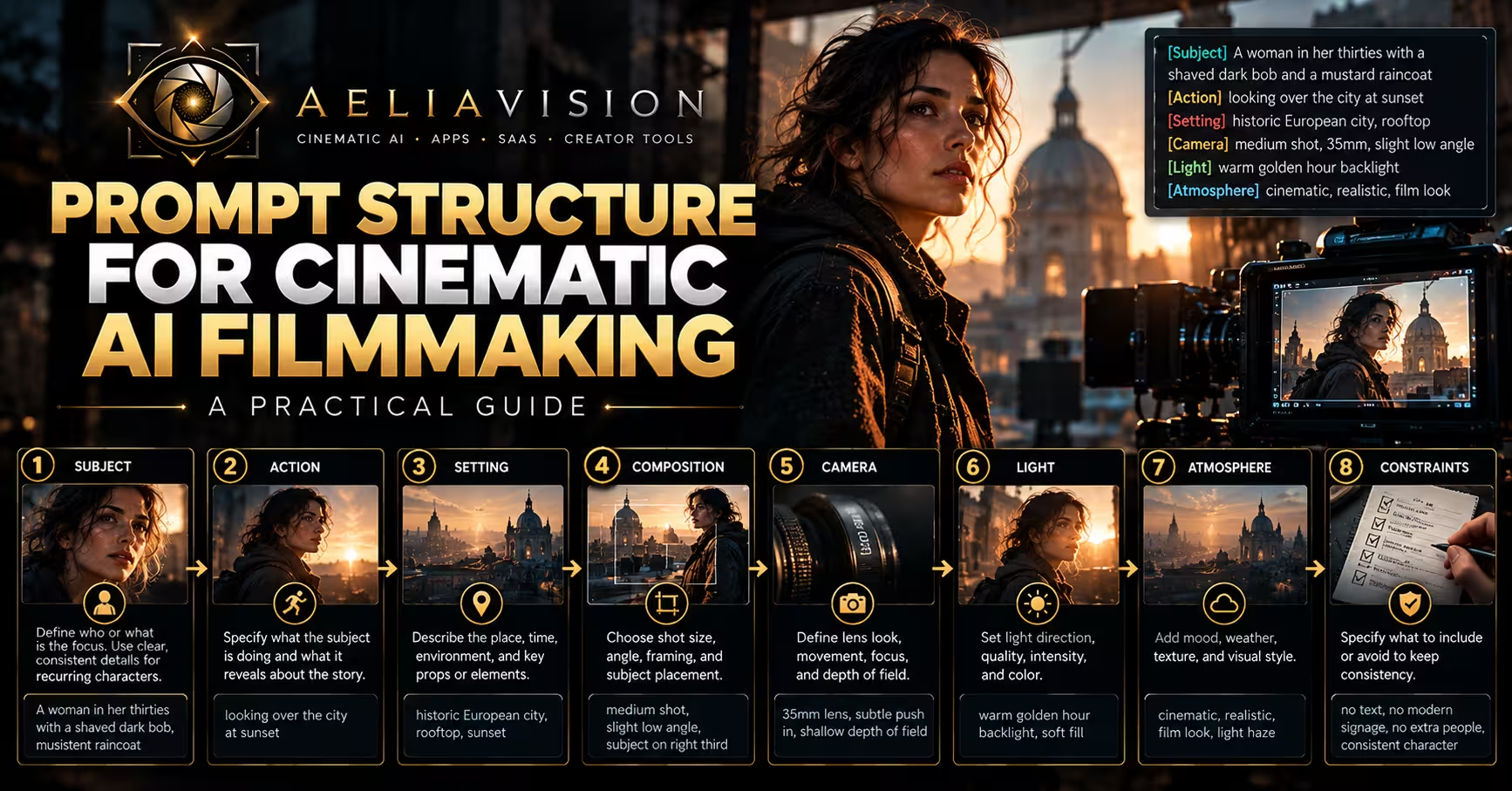
Build prompts around the decisions a director would make, not a pile of style words. Use this formula:
Story Beat + Emotion + Subject + Composition + Camera + Lens + Lighting + Color + Depth + Texture + Realism
Example of the formula:
A young queen stands alone on a palace balcony after hearing that her army has fallen, quiet shock and restrained grief, wide shot from behind, 35mm lens, slightly high angle to make her feel small against the burning city below, placed on the left third of the frame with large negative space to the right, cold moonlight from above mixed with distant orange firelight, muted blue and ember color palette, foreground stone railing, midground queen silhouette, background city smoke and flames, realistic fabric weight, natural hair movement, believable shadows, no fantasy glow, no plastic skin, no poster text.
20. Image to video: motion must serve the story
In AI video, the still frame is only the starting point. The motion must also serve the story. Random camera orbits, unmotivated zooms, warped backgrounds, and floating objects can break an AI video shot. Give every camera move a reason.
- Slow Push-In: Best used for realization, fear, or discovery.
- Pull-Back: Ideal for showing loneliness, scale, or a dramatic reveal.
- Tracking Shot: Perfect for journeys, urgency, and immersion.
- Locked-Off Frame: A static camera creates immense tension, realism, and discomfort.
- Handheld Drift: Simulates anxiety, panic, and documentary-style realism.
21. A practical cinematic checklist
Before accepting an AI-generated image, ask:
- Story: Can I describe the story moment in one sentence?
- Emotion: Do I know what the audience should feel?
- Subject & Composition: Is the main subject clear, and does the frame guide the eye?
- Camera & Lens: Do the shot size, angle, and perspective support the emotion?
- Lighting & Color: Does the light have a believable source, and does the palette support the mood?
- Depth & Texture: Does the image have distinct spatial layers, and do the materials feel real?
- Realism & Simplicity: Do shadows and scale make sense, and is the frame clear rather than overloaded?
22. Cinematic vs. beautiful vs. realistic
These concepts overlap, but they are not interchangeable.
| Term | Definition |
| Beautiful | Visually pleasing with nice colors, soft lighting, or symmetry, but potentially lacking depth or narrative. |
| Realistic | Believable in its physics, lighting, and anatomy (like a security camera feed), but not necessarily artistic or story-driven. |
| Cinematic | Combines beauty, realism, and intention. It may be ugly, fantastical, or beautiful, but it is always directed toward emotion and meaning. |
23. Start with the story
A cinematic image is not created by a single keyword, lens, or LUT. It comes from deliberate choices. Define the story moment and emotion, then use composition, camera position, lighting, color, depth, and texture to guide the viewer. For AI creators, the lesson is simple: do not prompt only what the image looks like; prompt what the image means. Start with the story, design the frame, and protect the realism until the result feels like a still frame from a coherent scene.
Continue reading
Further insights from the Journal
Have a story in mind?
Bring your next project into focus.
Tell us what you are creating and what you want the audience to feel.