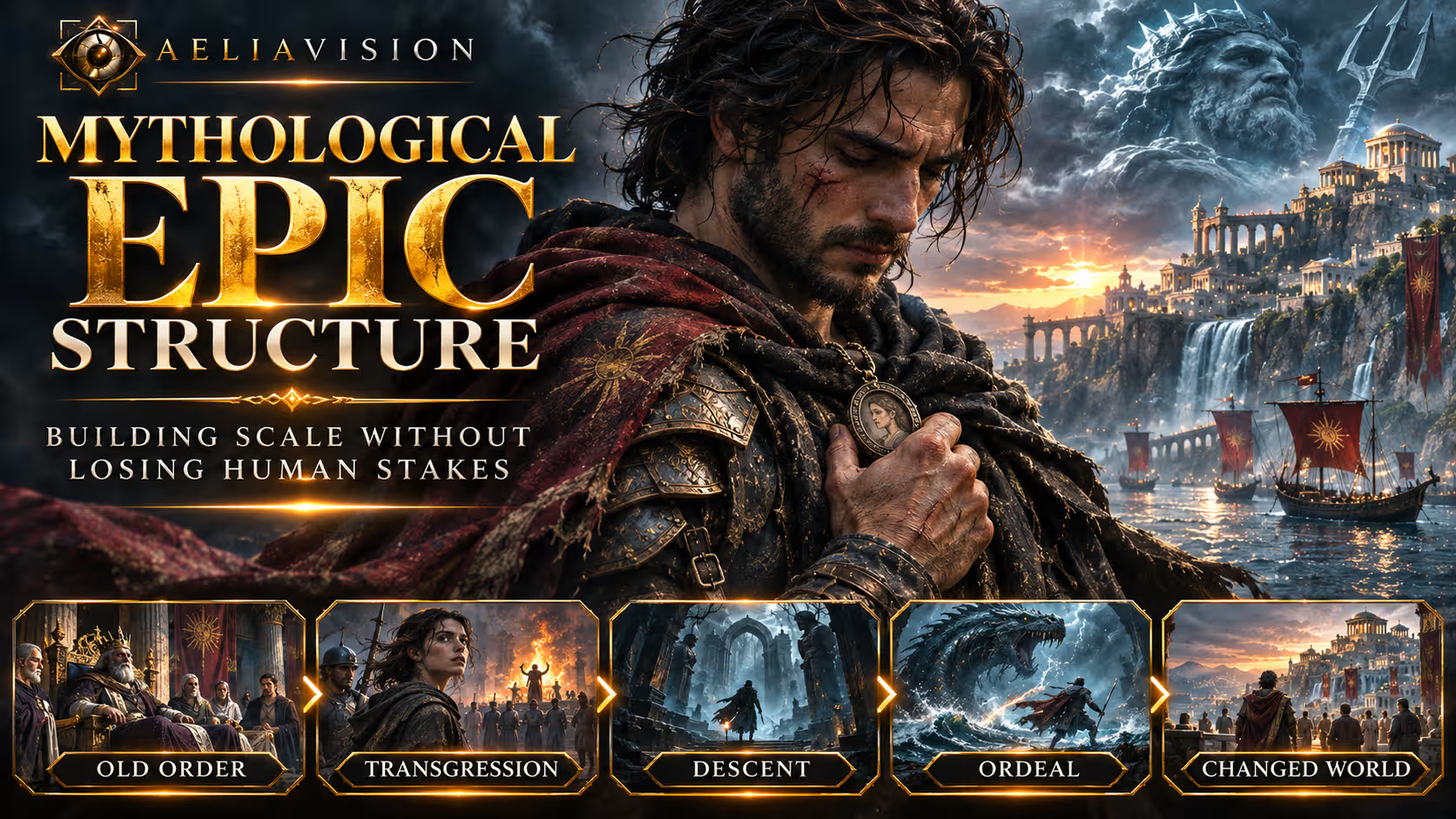
The story in brief
An epic is not simply a long story with gods in it. It is a story in which private choices carry public consequences. A prince refuses a duty, a hunter breaks a taboo, a queen hides a child, a soldier comes home…
Inside this story
An epic is not simply a long story with gods in it. It is a story in which private choices carry public consequences. A prince refuses a duty, a hunter breaks a taboo, a queen hides a child, a soldier comes home unable to accept peace. The immediate problem may be intimate. Its damage spreads through a household, a city, a kingdom, or the border between the human and divine worlds.
That scale is why mythological epics can feel so durable. *The Odyssey* is full of monsters, storms, disguises, and interventions from Olympus, but its pressure comes from a marriage and a homecoming. *The Mahabharata* contains armies and cosmic instruction, yet its catastrophe begins with kinship, inheritance, envy, and a rigged game. In *The Epic of Gilgamesh*, the great king’s terror of death becomes legible through grief for one friend. The spectacle gives the story reach. The human wound gives it a center.
For filmmakers, novelists, game writers, and designers using generative tools, the difficulty is not a shortage of epic-looking material. It is making that material obey cause and effect. A winged horse, a cursed blade, a drowned city, and a prophecy can produce handsome images without producing a story. The audience needs to understand what was broken, who benefited from the old order, what the protagonist risks by changing it, and why the final act cannot be solved by an easier conversation.
This guide treats mythology as a structural language rather than a crate of decorative symbols. It covers how to build an epic through obligation, transgression, ordeal, descent, revelation, and return. It also addresses the practical problems that tend to weaken the form: prophecies that erase choice, gods who can fix anything, villains who are only evil, and climaxes that confuse volume with consequence.
Begin with an order that can be violated
A mythological epic needs an existing arrangement of the world. It may be a royal line guarded by a river god, a treaty between mountain clans and the dead, a seasonal ritual that keeps the sun moving, or a household whose inheritance law has been accepted for centuries. The arrangement does not have to be fair. In fact, it is often more useful if it has a hidden cost. A stable order can be cruel, exhausted, dishonest, or built on a bargain nobody still remembers making.
Give the audience a lived-in version of that order before you destroy it. Show what a normal meal looks like. Show who speaks first at a council, who has to remain outside, what offerings go into the fire, and what people fear saying aloud. A single specific custom does more structural work than a paragraph explaining the history of an empire.
In a story about a coastal kingdom, for example, the king’s family may offer one child from every generation to the sea. The court calls it an honor. Fishermen say it keeps storms away. Mothers quietly count their daughters and know what the ceremony costs. That custom immediately creates more drama than the statement “the kingdom has a dark secret.” It gives the protagonist a duty, gives other characters a reason to defend the system, and makes rebellion expensive.
The old order should make sense to at least some people inside it. The queen who maintains the sacrifice may have seen a generation spared from famine. The captain who supports the king may believe civil war would kill more people than the ritual ever has. Their arguments should not be nonsense just because the protagonist has to oppose them. An epic gains force when preserving the world and changing it both carry a price.
Choose the wound before choosing the quest
The quest is what happens. The wound is why it matters.
Many weak epic outlines start with an external assignment: retrieve a relic, defeat a beast, reach a forbidden city. Those are workable plot engines, but they do not tell you what the protagonist cannot yet face. Start there instead. What private truth makes the public mission difficult?
A ruler may be ashamed of how they inherited power. A warrior may need admiration more than victory. A young priestess may resent the god she was raised to serve. A parent may believe love always requires control. The chosen wound should create bad decisions under pressure. If it could be cured by a single speech in the first act, it is not strong enough to carry an epic.
Gilgamesh begins as a king who treats other people as extensions of his own appetite. Enkidu changes him because the friendship gives him an equal. Enkidu’s death then exposes the limit of strength, status, and conquest. The journey for immortality is not a random second adventure. It grows from the wound that grief opens.
A useful test is to write two sentences:
– The world is in danger because __________. – The protagonist makes that danger worse because __________.
The second blank is where the story becomes personal. A hero who is merely reluctant can be pushed along by events. A hero whose flaw shapes the catastrophe has to change, pay, or fail.
Let the call arrive as a conflict of duties
The familiar “call to adventure” can sound thin if it only means an invitation to travel. In mythic stories, the call usually exposes competing obligations. The protagonist owes something to family, office, gods, community, memory, or the dead. The quest demands that one of those loyalties be broken.
Suppose a city is dying because its sacred flame has gone out. The obvious plot is to send a brave young person into the underworld for new fire. The stronger version asks why that person cannot simply leave. Perhaps they are the last heir of the house that keeps the city gates. Perhaps their sibling is due to marry the foreign ruler who controls the mountain pass. Perhaps the old god demands that anyone who returns from below cannot speak the name of the living person they love most.
Now departure is an argument, not a launch sequence. The council can object for reasons that matter. The protagonist can refuse for reasons that reveal character. When they finally leave, the decision changes relationships at home. The journey has begun before the first monster appears.
Do not treat refusal as a checkbox. It should teach the audience what the hero fears losing and what they misunderstand about the task. A soldier refusing a campaign because they are tired is one thing. A soldier refusing because they know the king’s war is based on a lie is another. The second version turns later obedience, betrayal, or revolt into a moral choice.
Make transgression specific
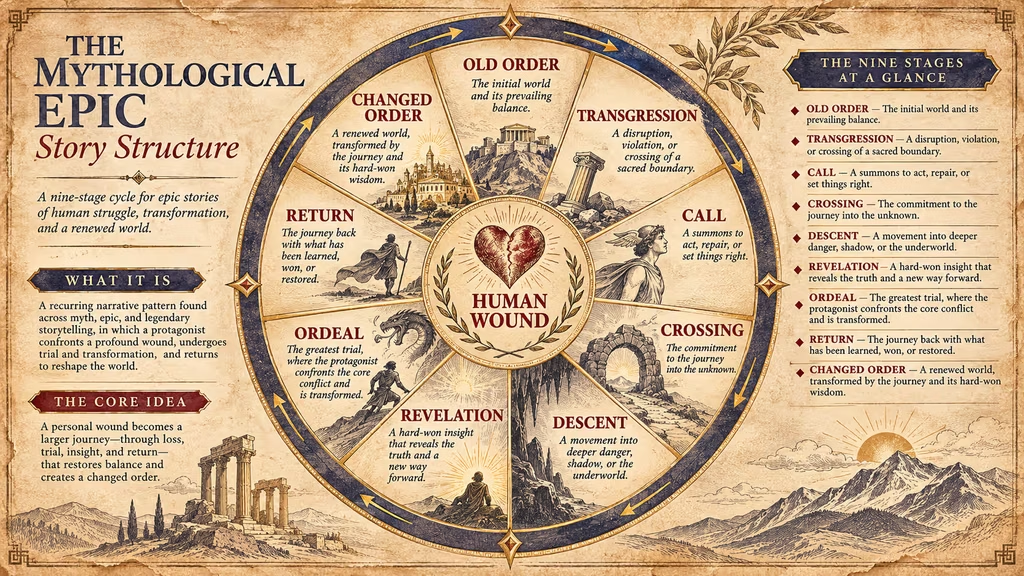
Epic stories often turn on a violation. Someone eats what is forbidden, crosses a boundary, kills under protection, breaks an oath, steals fire, opens a sealed room, or refuses burial. The transgression works best when it is concrete enough to be judged from more than one angle.
“The hero defies the gods” is too abstract. What did they do? Did they refuse to sacrifice a bull? Did they expose a god’s disguise? Did they save a child the oracle ordered abandoned? The details reveal the values of the world and make the punishment feel less arbitrary.
A transgression can belong to the protagonist, an ancestor, a ruler, or the society itself. If an earlier generation committed it, the protagonist should still be implicated in a meaningful way. They may have benefited from the stolen land, inherited a weapon made from a broken vow, or been trained to repeat the same injustice. A curse is more compelling when it is not merely bad luck arriving from the past.
The punishment should also have logic. Mythic justice is not always gentle, but it should reveal the rule that has been violated. If a king breaks hospitality, the consequence might be that no guest can safely enter his halls. If a healer tries to reverse death, the dead may begin returning without memory. The consequence should distort the very thing the character tried to control.
This is a useful place to separate fate from prediction. A prophecy becomes boring when it acts like a spoiler. It becomes interesting when it names a danger that characters struggle to interpret. “A son will destroy the house” can lead to murder, concealment, exile, adoption, and self-fulfilling fear. The prophecy does not remove agency. People trying to avoid it create the path toward it.
Build a threshold that changes the rules
The crossing into the larger world should feel like more than a location change. It tells the audience that the protagonist is no longer protected by the assumptions of home. A river crossing, a city gate, a desert boundary, a funeral mound, a storm at sea, and a ritual sleep can all work as thresholds. The important part is the rule change on the other side.
Before the crossing, a character may be able to rely on rank, language, family name, weapons, or ordinary time. After it, those advantages should become unreliable. A princess in a foreign court may be unable to invoke her title. A famous hunter may find that the animals know his name. A scholar entering a ruin may learn that written records alter when read aloud.
Give the crossing a cost. The hero may surrender a weapon, leave someone behind, accept a mark that makes them visible to spirits, or speak an oath that cannot be withdrawn. A cost keeps the threshold from being a pretty montage. It also plants material for the return. If the protagonist leaves their sword at the river, they may later have to face the final enemy without the identity the sword represented.
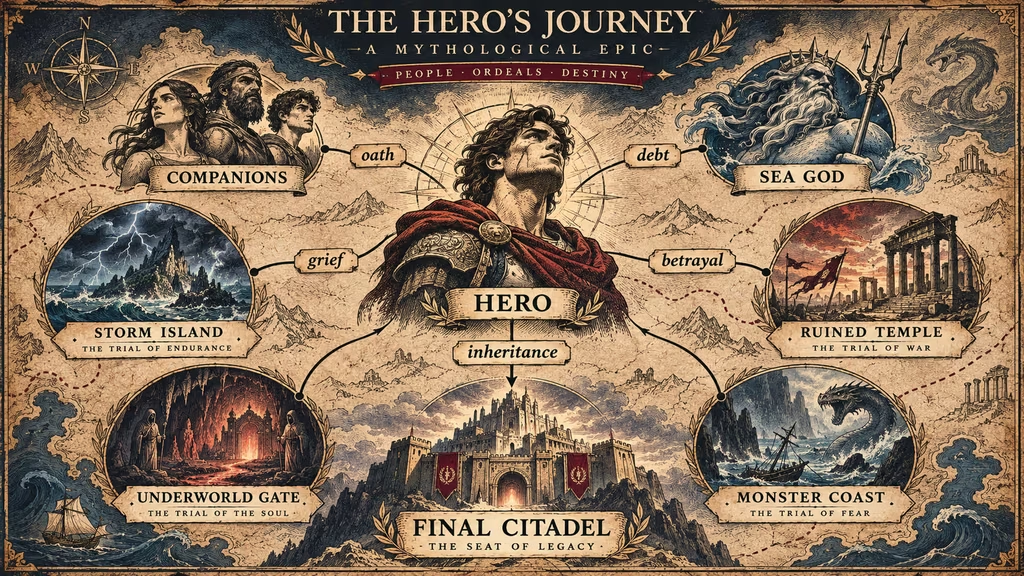
Epic travel is not filler between plot points. Each region should pressure a different part of the hero’s worldview. A desert can test endurance, but it can also test the belief that effort always produces reward. A court of immortals can test ambition. An island where the dead are fed names rather than food can test memory and guilt. Choose places because they can argue with the protagonist.
Design companions as competing answers
A companion should not exist only to admire the protagonist or explain lore. Good epic companions embody answers to the story’s central problem.
If the hero believes duty matters more than love, one companion might show the damage of that belief while another insists that duty is the only thing keeping the realm from collapse. If the protagonist wants revenge, a companion can have already taken revenge and found it empty. A comic character can work too, provided they have an actual view of the world and not just a supply of jokes.
Think of the group as a moving council. They can disagree about what the quest is for, who deserves saving, and how much blood the goal is worth. Their disagreements prevent the hero from becoming the only moral instrument in the story.
Each companion needs an independent stake. The thief helping the hero may be seeking pardon for a sibling. The priest may want proof their god has not abandoned them. The rival warrior may accept the mission because returning alive is the only way to reclaim an inheritance. Their choices should sometimes complicate the route. Cooperation without friction does not reveal much character.
The mentor deserves particular care. Mythological stories are full of guides, old queens, shamans, dead fathers, trickster gods, and impossible teachers. A mentor becomes useful when their advice has a limit. They may understand the old laws but not the new situation. They may demand obedience because they fear the protagonist’s freedom. They may have helped build the order that now needs to end.
When the mentor dies, disappears, betrays the group, or simply cannot go farther, the story should not merely remove an exposition source. It should force the hero to make a choice without borrowed authority.
Use episodes as tests of belief, not obstacles in a queue
Episodic structure is one of the great strengths of the epic. It lets a story visit strange societies, meet monsters, survive disasters, and gather stories within stories. The problem appears when every episode has the same shape: arrive, fight, win, leave.
Give each episode a distinct dramatic function. One may test mercy. Another may tempt the hero with a life that avoids the central duty. Another may reveal that the antagonist has a sympathetic claim. Another may force a companion to act against the group. The external challenge can be physical, social, spiritual, or intellectual, but it should change the terms of the journey.
A monster is most useful when it makes an inner problem visible. The gorgon can turn people to stone because the hero avoids seeing suffering. The river beast can demand a name because the hero has hidden behind titles. The giant may be unbeatable through strength because the hero treats strength as the only virtue. These connections do not need to be announced in dialogue. Let the action carry them.
Vary the endings of episodes. Sometimes the hero wins. Sometimes they bargain. Sometimes they escape with a cost. Sometimes they do the right thing and lose ground. Sometimes they discover they were wrong to accept the challenge at all. An epic needs setbacks that are not simply injuries or broken equipment.
Keep a ledger of consequences. If the hero insults a sea god in chapter four, do not forget it while they solve a mountain problem in chapter ten. If they save a village, give that village a chance to matter later. Epic scale comes partly from recurrence. The world remembers what the hero has done.
Give divine power limits, motives, and bills to collect
Gods become a structural problem when they are all-powerful and emotionally available. If a deity can solve the war, cure the curse, transport the hero, and explain the truth whenever the plot slows down, human decisions stop mattering.
Set the rules early. A god may be bound to a place, barred from direct action, dependent on worship, divided against other gods, or unable to understand human love and mortality. The limitation should be more than a writer’s excuse. It should emerge from the god’s nature.
A sea god might command storms but have no power inland. A goddess of memory may know every past event but be unable to predict a choice made freely. A war god may empower courage but cannot tell courage from stubbornness. These limits create scenes rather than merely closing loopholes.
Gods should want things. Worship, beauty, obedience, stories, revenge, change, an end to an old bargain, or proof that humans are worth saving are all more playable than generic cosmic balance. A divine ally can help the hero for a selfish reason and still become emotionally meaningful. A divine antagonist can have a legitimate grievance and still be terrifying.
Every intervention should create a bill. If a god saves the hero from drowning, perhaps the god claims a memory, a future favor, or a promise that endangers someone else. If a deity gives a weapon, the weapon may force its bearer to kill the first person they see with it. The bill does not need to be a surprise. It is often stronger when the audience sees it coming and watches the hero choose anyway.
Descend when the story needs knowledge that daylight cannot provide
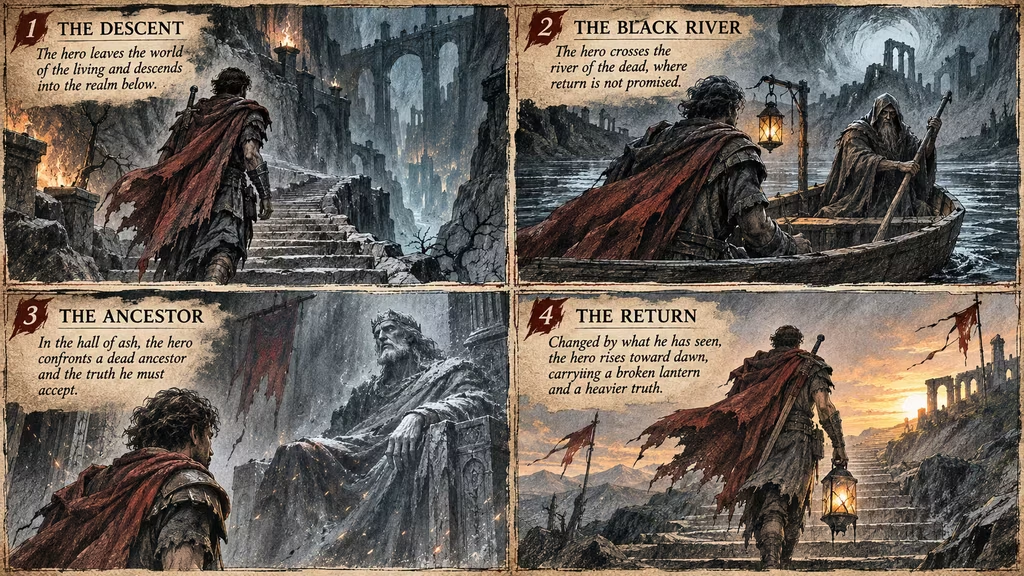
The descent is one of the most flexible parts of mythic structure. It may be a literal journey to the land of the dead, a prison beneath a city, a dream realm, a buried archive, a battlefield after everyone has gone, or a confrontation with the family history nobody names. It belongs near the center or late middle of the story because it changes what the protagonist knows.
A descent should not only make the world darker. It should expose a truth the hero has been avoiding. Perhaps the dead parent was not a victim. Perhaps the monster guards a crime the kingdom committed. Perhaps the hero’s promised victory would restore the same system that caused the disaster. Knowledge acquired below should make the old plan impossible to follow unchanged.
The rules of the underworld should be emotionally exact. In one story, the dead might forget faces. In another, they remember only the moments when they were betrayed. In another, the dead can speak only if the living give them something true. These rules turn exposition into action. The protagonist cannot just interview a ghost. They have to pay attention to what the ghost world requires.
Avoid making the descent a lore dump. Let one or two encounters do the work. A dead sibling who refuses forgiveness can reveal more than a gallery of famous shades. A ferryman who recognizes the hero’s lie can make the hero’s moral state clear without a narrator explaining it.
The return from the descent needs a visible alteration. The hero may come back with a new name, a wound, an impossible object, a changed relationship to time, or a truth they cannot safely share. The living world should react. If nobody notices that the hero has crossed the boundary of death, the descent may have been ornamental.
Turn revelation into a choice
A revelation does not automatically create drama. It matters when it makes every available choice worse in a different way.
A common epic reveal is that the chosen hero is related to the enemy, caused the curse, carries the dangerous bloodline, or has misunderstood the prophecy. Use these only if the reveal changes the decision at hand. If the hero discovers they are the lost heir and nothing else shifts, the fact is costume jewelry.
For example, a protagonist may learn that the relic they seek will not save the city. It will feed the god who has kept the city dependent for generations. Returning it means preserving thousands of lives for now and continuing the bargain. Destroying it means famine, revolt, and a chance for freedom later. That is a revelation with teeth.
The choice should expose the difference between the person who began the story and the person who can finish it. Early on, the hero might have chosen glory, obedience, vengeance, or safety. Late in the story, they need to choose responsibility with a clearer understanding of the cost. A changed hero does not suddenly become perfect. They make a better decision for a reason the audience has watched them earn.
Build the final ordeal around irreversible loss
The climax of an epic is often a battle, but combat is not its defining feature. The final ordeal is the moment when the protagonist cannot protect every value they have been trying to preserve.
The hero may have to kill a beloved companion who has become a vessel for a god. They may have to abandon the throne to stop a war. They may save the city but lose the person who taught them how to belong to it. They may refuse a weapon that would guarantee victory because using it would repeat the original crime.
Make the tactical problem clear. Audiences can follow a complex battle if they know what changes the outcome. The enemy needs a source of power, a defensive position, an objective, and a vulnerability that grows from the story’s earlier material. Do not introduce the one fatal rule in the final five minutes unless the point is that the hero has been withholding information from the audience.
The antagonist must make a credible offer. “Join me and rule” is rarely enough. The offer should answer the hero’s wound. To a hero ashamed of failing their family, the antagonist can offer a restored name. To a hero frightened of death, they can offer immortality. To a hero sick of sacrifice, they can offer a clean victory with someone else paying the price.
A final battle becomes memorable when the hero refuses the easy answer for a reason that has been tested throughout the story. The physical action then expresses a moral position. The sword blow is not the theme. It is the consequence of the theme.
Return to a world that has not waited politely
Homecoming is not an epilogue. It is the proof of the story’s meaning.
The hero returns with knowledge, power, trauma, or responsibility that does not fit easily into ordinary life. Meanwhile, the place they left has continued without them. Allies have made compromises. Children have grown. Rivals have filled the gap. The old order may have hardened because of the hero’s absence.
This is why return scenes can carry as much tension as the journey. The protagonist may know how to defeat a monster and still not know how to speak to a grieving parent. They may have changed enough that old friends no longer understand them. They may find that restoring the former world is neither possible nor desirable.
Show the consequences in institutions as well as feelings. If the hero broke a sacrificial system, who now manages famine relief? If they killed a tyrant, who prevents the army from becoming the next regime? If they returned with forbidden knowledge, who gets access to it? Mythological stories can end with mystery, but they should acknowledge the administrative and social wreckage left by divine events.
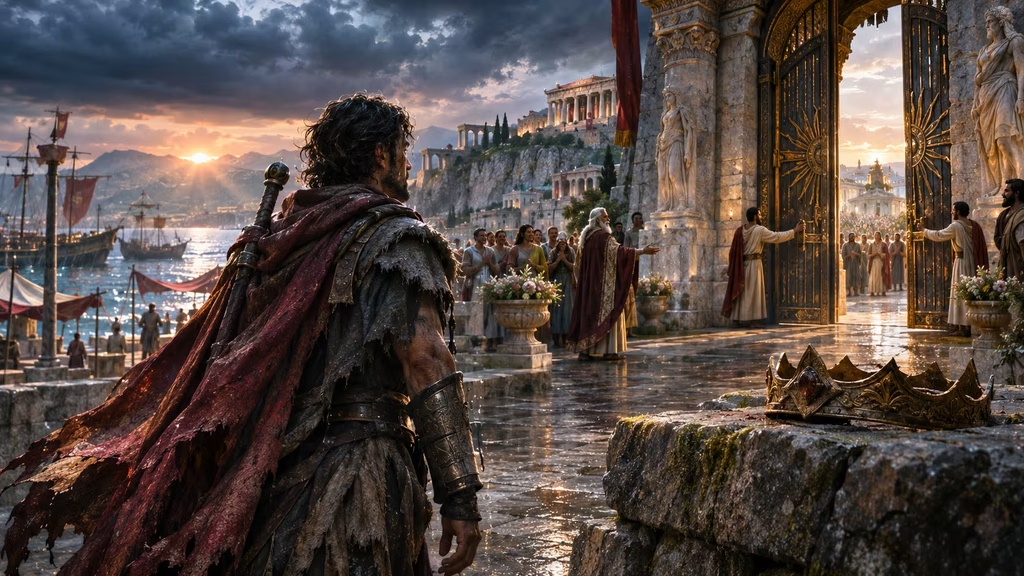
A good return does not need to be happy. It needs to be honest about what has changed. The hero may become ruler, exile, guardian, witness, or simply a person capable of living with a truth they once could not bear. The final image should relate to the opening order. A once-silent temple may be open. A crown may sit unclaimed. A family meal may include someone who was excluded before. Small changes can carry the scale of the whole journey.
Shape the epic across acts without making it mechanical
A three-act model can help, provided it does not erase the story’s particular rhythm. In an epic, the first act establishes the old order, the wound, and the decision to cross the threshold. The middle tests the hero through episodes and brings them to a descent or major reversal. The last movement converts new knowledge into a costly action and then shows its aftermath.
For a feature screenplay, the first major commitment often lands around the end of the first quarter. The central reversal belongs near the middle, when the old plan fails or changes meaning. The final ordeal should begin early enough that it can include difficult decisions, not only spectacle. A game or novel has more room for detours, but the same principle applies: each section needs to alter the hero’s understanding of the goal.
Use compression carefully. A journey across a continent can pass in a page if nothing changes except geography. Slow down when a relationship shifts, an oath is made, a rule is discovered, or a character makes a choice that will matter later. Time on the page is a statement of importance.
A sequence outline can be more useful than a beat sheet. Try naming twelve to sixteen sequences with verbs and consequences: “he accepts the funeral oath,” “the companions bargain with the river people,” “she learns the monster is protecting the stolen children,” “they escape but lose the map,” “the hero returns with proof that splits the council.” Those lines keep story movement visible.
Research widely, borrow narrowly
Mythology is not a free supply of generic ancient mood. Many traditions are living religious and cultural systems. If you work from a specific tradition, read translations, scholarship, historical context, and voices from the communities connected to it. Learn what terms mean before turning them into monster names or visual decoration.
Do not flatten different traditions into one imaginary “old world.” Greek, Yoruba, Norse, Hindu, Māori, Mesopotamian, Japanese, Celtic, and Indigenous American traditions have different cosmologies, histories, and relationships to contemporary practice. A story can be inspired by multiple sources, but the writer should know where the seams are and avoid presenting a collage as authentic representation.
The safest structural borrowing is often at the level of questions: What does this tradition say about obligation? What does it believe death owes the living? How does power create debt? Those questions can inform an original world without copying sacred figures or stripping a culture’s stories of context.
Common failures and practical repairs
- The prophecy solves the plot. Rewrite it as partial, symbolic, or contested information. Make characters’ interpretations create the disaster.
- The gods are emergency writers. Establish what they cannot do and what each intervention costs. Let mortals make the decisive choice.
- Every episode ends in victory. Give some episodes a moral compromise, a loss of time, an enemy gained, or a truth that makes success harder.
- The villain wants power because villains want power. Give them a diagnosis of the world that is partly correct, then show where their remedy becomes monstrous.
- The lore arrives in blocks. Put information inside rituals, arguments, bargains, objects, and consequences. Let the reader infer some of the world.
- The final battle has no decision. Place a value in conflict with another value. Winning should require the hero to give up something real.
- The ending resets the old status quo. Let the world bear marks from the journey. A return that changes nothing makes the ordeal feel optional.
A working blueprint
Before drafting scenes, fill in this compact blueprint:
1. What old order keeps life functioning, and who pays its hidden cost? 2. What does the protagonist want that makes them dangerous to themselves or others? 3. What transgression has occurred, and what rule does its consequence reveal? 4. Which duty does the call force the protagonist to betray or reinterpret? 5. What changes at the threshold besides geography? 6. What does each companion believe the quest is for? 7. What does the divine power want, and what will it charge for help? 8. What truth can only be learned through descent, loss, or contact with the dead? 9. What final choice cannot preserve every value at once? 10. What visible social change proves the world did not simply reset?
If you can answer those questions with scenes rather than slogans, you have the bones of an epic. You can add spectacle later. The sea can rise, the dead can speak, armies can gather beneath impossible skies. None of that substitutes for a protagonist who understands, too late and then just in time, what their world has asked them to become.
Continue reading
Further insights from the Journal

Have a story in mind?
Bring your next project into focus.
Tell us what you are creating and what you want the audience to feel.