The story in brief
Horror works when a story makes the audience live inside a threat before it explains or resolves that threat. The creature, killer, curse, contaminated house, and strange sound in the wall are only delivery systems. Structure is what turns them into pressure.…
Inside this story
Horror works when a story makes the audience live inside a threat before it explains or resolves that threat. The creature, killer, curse, contaminated house, and strange sound in the wall are only delivery systems. Structure is what turns them into pressure. It decides what the audience understands, what it suspects, and how long it has to wait with that suspicion.
A horror story needs more than a sequence of frightening images. A masked figure at the end of a corridor can be alarming for a moment; it becomes frightening when someone must cross that corridor to reach a child, a phone, an exit, or the truth. The audience needs to understand the ordinary life at risk, the rule that has been violated, and the cost of a wrong decision. Then the story can start taking options away.
This guide uses feature-film structure because it gives the ideas room to breathe, but the same mechanics apply to short films, episodes, trailers, and AI-generated sequences. The useful question is never “when should the scare happen?” It is “what has the viewer been taught to fear by this point?”
The engine: fear needs a story question
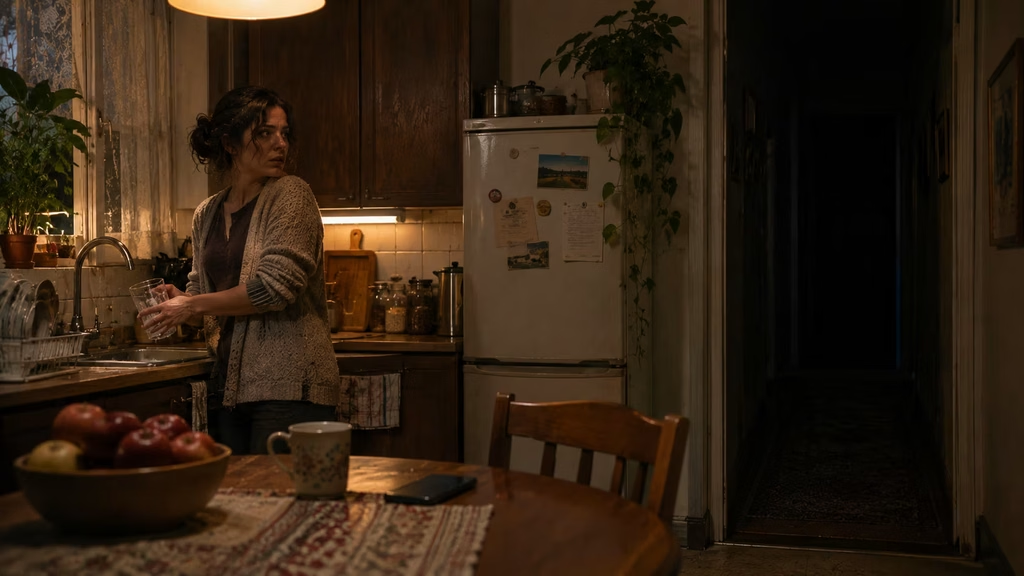
Most horror plots can be reduced to a question that becomes harder to avoid. Can a family leave the house before the thing inside claims one of them? Can a skeptical nurse prove a patient’s visions are real before another person dies? Can a teenager survive the consequences of a ritual she treated as a joke? The question gives every scare a job.
At the beginning, the protagonist usually has a practical goal that has nothing to do with surviving. They want a new apartment, a promotion, a reconciled relationship, a quiet weekend, an inheritance settled, or a missing person found. This goal grounds the character in ordinary concerns. It also creates a reason to stay after the first warning. If nobody has a reason to remain in the dangerous place, a sensible exit can end the film twenty minutes in.
The threat then changes the meaning of that ordinary goal. The apartment is cheap because someone died there. The missing person was not taken, but became part of a pattern. The family cannot leave because the curse traveled with them. A story becomes much stronger when the danger attacks a value the protagonist already had, rather than appearing as a random obstacle.
Horror benefits from a clear external question and a quieter internal one. The external question might be whether Mia can save her brother from an entity in their childhood home. The internal question might be whether Mia can accept that she abandoned him years ago. Do not treat the internal question as a separate lesson pasted between scares. Let it change choices. Her shame makes her dismiss his calls. Her need to be forgiven makes her return to the house. Her final choice should cost her something because she finally sees the truth clearly.
The best structural tool for this is a promise. Early scenes promise the kind of fear the film will deliver. A strange reflection promises uncertainty about perception. A dead bird on a doorstep promises invasion of the domestic world. A child who knows something impossible promises that adults are behind the danger. Promises create anticipation without requiring a full explanation.
A scare that has no relationship to the central promise can still make a viewer jump. It rarely makes the story more frightening. Every major beat should either sharpen the central question, alter the protagonist’s available choices, or reveal a new cost of failure.
Start with normality, but do not idle
“Ordinary world” does not mean a long stretch of harmless breakfast scenes. It means the audience gets a usable picture of what normal feels like for these people. A couple may already be tense. A mother may already be exhausted. A teenager may already be lying to friends. Those conditions make the coming horror specific.
Give the protagonist an active problem before the supernatural or human threat becomes undeniable. In a haunted-house story, the family might need the house sale to clear debt. In a folk-horror story, a documentarian might need access to a closed community. In a slasher, friends may be trying to keep a trip together after someone has broken trust. The pre-horror problem does not have to be huge. It needs enough weight that walking away has a consequence.
Then introduce a disturbance that can be explained away. A knock comes from a room nobody occupies. A security camera catches a figure whose face is obscured by glare. A dog refuses to enter a basement. The first disturbance works best when it is concrete and modest. It should make the viewer notice a change rather than demand that they immediately accept an elaborate mythology.
Characters need plausible reasons to doubt it. A grief-stricken protagonist may think they saw a dead relative because they want to. A landlord may blame bad wiring. A friend may assume a prank. Skepticism is useful because it delays certainty and gives the audience multiple interpretations. It becomes frustrating only when characters ignore evidence that any reasonable person would act on.
A common mistake is opening with a brutal prologue, then spending an hour pretending nothing is wrong. Prologues can work when they plant a question that matters later: why did this person vanish, what rule did they break, why was a room sealed? They fail when they merely announce that the movie has a monster. The audience already knows it is watching horror. Give it information it can use.
The first act: cross the line deliberately
The first act establishes the protagonist, their need, the world, and the first abnormal sign. Its most important job is to create a line the protagonist crosses. After that crossing, returning to ordinary life is no longer simple.
That line may be literal: moving into a house, entering a cave, accepting an invitation, opening a box, answering a call, or joining a ritual. It may be emotional: deciding to investigate, keeping a secret, refusing to believe a loved one, or agreeing to help someone who is dangerous. The point is not that the character has made a foolish choice. The point is that they have made a comprehensible choice with incomplete information.
The inciting incident introduces a problem that cannot remain background noise. A missing child is found speaking in an unknown voice. A tape contains the protagonist’s name and tomorrow’s date. Someone returns from a trip with a wound that will not heal. The incident needs a visible consequence. It should make a character do something, not just feel uneasy.
The first-act turn commits the story to horror. It is where a benign explanation becomes too weak, an attempted exit fails, or the protagonist chooses to proceed despite a warning. A woman sees the same stranger in two locations that cannot connect. A family leaves the house, only to find their son sleepwalking toward it from miles away. A detective learns that the killer knows details from a sealed case file.
This is a good place to state, imply, or test the story’s rules. Rules do not need to arrive as exposition from an old book. They can emerge through action. The mirror only shows the figure when the lights are off. The presence cannot cross running water. The caller knows what people have said in private. A rule gives the audience a way to anticipate danger. Once it exists, you can complicate it, but do not casually discard it. Arbitrary threats feel less frightening because viewers cannot imagine a meaningful choice.
Horror also needs a point of attachment. The protagonist can be flawed, selfish, or difficult, but the audience must understand what pain they are trying to avoid. Fear becomes more personal when survival would force a character to confront something they have spent years denying.
Escalation is a chain, not a volume knob
The middle of a horror story is where many drafts become repetitive. A character sees something frightening, tells someone, is not believed, sees something worse, and repeats. The images may grow more graphic, but the story remains in the same place.
Escalation means the situation changes. Each new event should take away a strategy that previously seemed available. First the protagonist can dismiss the disturbance. Then they can investigate privately. Then they can seek help. Then help becomes compromised, unavailable, or dangerous. Eventually they must act without the safety net they expected.
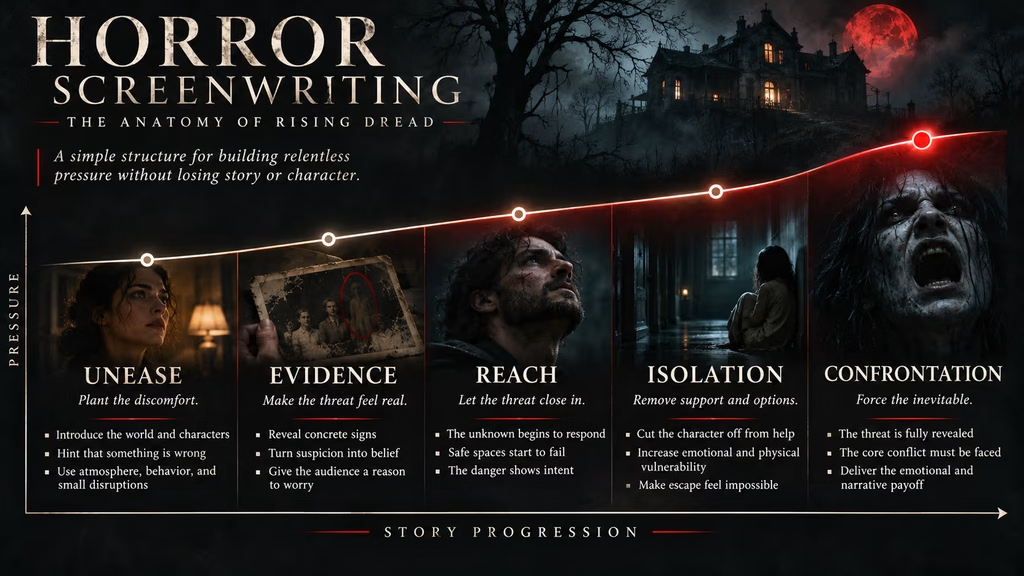
Think in phases rather than a stack of scares:
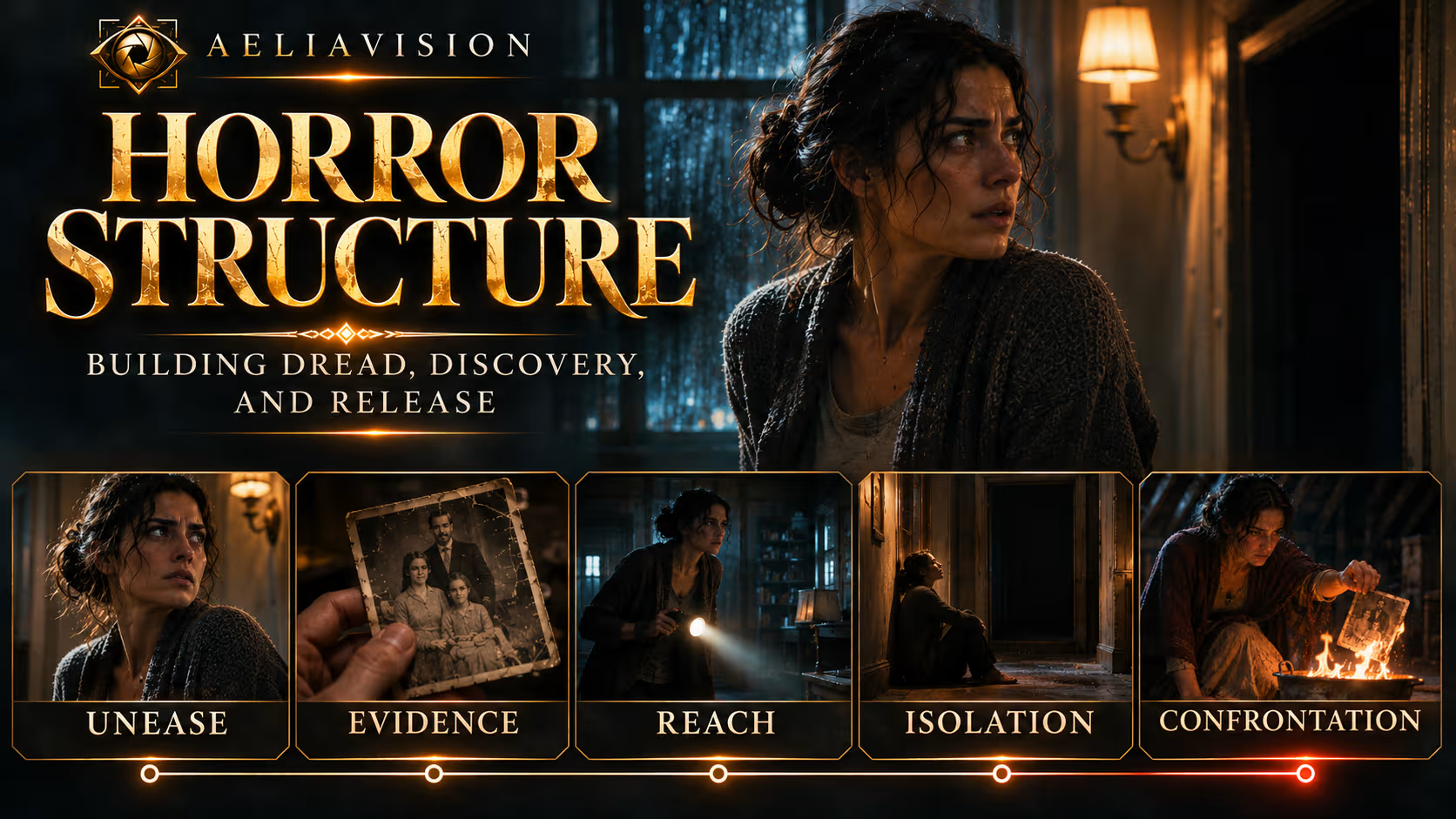
- Unease: Something is off, but normal explanations still survive.
- Evidence: The protagonist gains proof, though other characters may resist it.
- Contagion or reach: The threat enters a supposedly safe space, targets another person, or follows the protagonist.
- Isolation: Allies doubt, leave, die, or reveal divided loyalties. Communication and escape narrow.
- Confrontation: The protagonist can no longer observe. They must choose and act.
The exact order can vary, but the movement should be visible. A house story gets scarier when the haunting follows someone to work. A body-horror story tightens when medical help produces an answer that is worse than ignorance. A slasher develops when the group realizes the killer has access to their private plans.
Escalation also needs contrast. If every scene plays at maximum alarm, the audience adapts. Give it brief zones of false calm, practical work, intimacy, humor, or ordinary disagreement. These scenes should still carry residue from the threat. Someone hears a sound beneath an argument. A character lies about what happened because they fear ridicule. A quiet meal becomes unsettling because one person sees something no one else can see.
A release should change the question rather than erase it. The cat in the closet is not enough unless it exposes a window that is now open, or makes the protagonist realize the cat has been hiding from something. A false answer can be useful if it directs the character into a worse truth.
The midpoint: make the danger undeniable and personal
The midpoint often functions as the story’s first irreversible proof. It need not be the biggest scare, but it should change the protagonist’s understanding of what they are dealing with. Before this point, they may be asking whether the danger is real. After it, the question becomes what it wants and what can be done.
In *The Ring*, the cursed tape moves from urban legend to a countdown with personal consequences. In *Jaws*, the threat stops being a civic inconvenience once the danger is undeniable and the hunt becomes necessary. In a smaller film, the midpoint can be intimate: a protagonist realizes that the voice on a recording is their own, speaking words they have not said yet.
Make the midpoint costly. Someone should lose safety, trust, time, or a relationship. A vague vision is weaker than a vision that causes the protagonist to accuse the wrong person. A creature sighting is weaker than a sighting that proves an ally has already been changed. Cost prevents the midpoint from feeling like a lore reveal delivered between scenes.
The midpoint can also revise the story’s apparent genre engine. Perhaps the ghost is real, but it is not the villain. Perhaps the murderer is dead, while the survivors are being manipulated by someone living. Perhaps the protagonist has been trying to escape a place when the real problem is what they brought there. A reversal earns its place when earlier details can be read differently afterward.
Avoid a twist that replaces the story question with a completely unrelated one. The audience should feel a floor drop out beneath an existing path, not discover that it has been watching the wrong film. Plant evidence early. Let the first viewing feel tense and the second feel inevitable.
The second half: expose the cost of staying alive
After the midpoint, horror needs to become more intimate. The threat should understand the protagonist’s vulnerability, or at least appear to. This does not require a villain who delivers psychoanalytic speeches. It can happen through selection: the entity speaks in the dead mother’s voice, the killer arranges a scene around a buried crime, the infected body starts rejecting the role that once gave the protagonist pride.
This is where subplots either pay off or should be cut. The estranged sibling, doubtful partner, unreliable friend, or compromised authority figure should force a decision. Horror is often about trust under pressure. Who believes whom? Who gets sacrificed for the group? Who refuses to see what is happening because acknowledging it would destroy their self-image?
An effective second-half sequence places the character in a series of bad choices. They can call the police, but doing so exposes an earlier lie. They can destroy the object, but it will harm someone attached to it. They can leave, but the threat will reach the person they promised to protect. The choices do not need equal moral weight; they need consequences that the audience understands.
Do not confuse isolation with simply killing off supporting characters. Isolation is loss of reliable support. A friend can remain alive and still become unavailable because they are possessed, terrified, trapped elsewhere, or convinced the protagonist is dangerous. Sometimes keeping an ally alive but uncertain creates more pressure than removing them.
The low point arrives when the protagonist’s preferred strategy fails. They perform the ritual and it does not work. They reach the road and find it loops back. They expose the killer, only to learn that exposure makes the killer accelerate. The low point should challenge the character’s central misconception. If they have spent the film trying to control every variable, they may need to risk trust. If they have refused responsibility, survival may require them to take responsibility without knowing the result.
Designing scares that move the plot
A scare is a scene event, not a decoration. It works structurally when it does one of four things: introduces a new rule, confirms a suspicion, changes a relationship, or forces a choice.
A first scare can establish the threat’s signature. A whisper heard only through a baby monitor tells the audience where attention belongs. A later scare can show that the signature has changed, such as when the whisper appears outside the house or through a device that was unplugged. This progression makes the threat feel active.
Use the scare’s aftermath. A character’s response often matters more than the image itself. Does she hide evidence? Does he wake someone else? Does a couple split because one person refuses to believe the other? If nothing changes after a scare, it risks becoming a disconnected amusement-park beat.
Anticipation, surprise, and disgust use different structures. Anticipation gives the audience information before the character has it, then lets them wait for contact. Surprise withholds the event until it interrupts a moment of lowered guard. Disgust makes the audience stay with an unwanted detail long enough to understand it. A film can use all three, but the rhythm changes. Repeating only surprise trains viewers to watch for edits and sound stings instead of living in the scene.
When staging a jump, leave the frame enough room to become dangerous. A close-up can hide an intrusion, but an empty wide doorway invites the viewer to scan. Sound can point attention one way while the image reveals another. The strongest jumps often arrive after a scene has already generated tension without music demanding it.
Rules, mystery, and fair withholding
Horror thrives on partial knowledge. The audience should not understand every mechanism by minute thirty. It does need enough consistency to predict what might go wrong.
A useful rule has three parts: a condition, a consequence, and a limitation. If someone watches the tape, they receive a call and have seven days. If they pass the curse to another person, they may survive, but someone else inherits it. If the monster hears a sound, it attacks, but the characters can move through a specific environment quietly. Conditions create behavior. Consequences create stakes. Limitations create tactics.
Mystery becomes frustrating when information is delayed only because the writer wants to preserve a reveal. Ask why the protagonist cannot know something yet. Is the evidence missing? Is a witness lying? Would discovering it require a dangerous action? If the answer is merely that the story is not ready, the scene may need a stronger obstacle.
Exposition can arrive through failed action. Instead of having an expert explain that a symbol traps the entity, let a character draw the symbol, watch it work briefly, then realize the line has been broken somewhere outside the frame. The audience learns the rule and watches its failure at the same time.
The climax: make the final action a choice
Horror climaxes are strongest when the protagonist does more than run from a final attack. They should make a choice that uses what the story has taught them and exposes who they have become.
If the protagonist has treated the haunting as a puzzle to solve without caring about its victim, the climax may require compassion rather than cleverness. If they have believed they can save everyone, the climax may force a painful limit. If they have hidden from a past wrong, the final confrontation may demand confession in front of people they wanted to impress.
The physical objective must remain clear. Rescue the child before the room floods. Burn the object before sunrise. Get the recording to the only person who can verify it. Keep the rules visible in the climax so it does not become abstract shouting in dark rooms. The audience should be able to track why each action helps or hurts.

A climax usually benefits from compression. The protagonist has fewer places to go, less time, and less certainty. But it also needs one or two beats of recognition. Give the character a moment to understand what the final choice costs before they take it. That breath is where the ending becomes more than a mechanism.
The threat does not always need to be defeated. In tragic horror, survival may require surrendering to the truth too late. In cosmic horror, the protagonist may understand the scale of the danger and still fail to stop it. Even then, the climax needs resolution at the level of choice. The character has acted according to the truth they now possess.
Endings: relief, damage, and the last image
The ending should answer the main dramatic question while leaving the appropriate emotional residue. “Does the protagonist survive?” is not always the main question. Sometimes it is whether they break a cycle, protect someone, accept guilt, or become the thing they feared.
A clean victory can work when the film has earned it through tactics and sacrifice. The audience sees how the rule was used, what it cost, and why the threat is gone. A bitter victory adds damage: the curse ends, but a relationship cannot recover; the child survives, but the parent has become someone else.
Ambiguity works when the plot is resolved but the feeling remains unsettled. The house may be destroyed, yet a survivor notices the same mark on their hand. The killer may be dead, yet a final detail suggests the protagonist misunderstood the source of the violence. The audience should be able to say what happened, even if it cannot be certain what it means.
Avoid sequel bait disguised as an ending. A final eye opening, hand twitching, or unexplained noise means little if it only says “perhaps there will be another installment.” A final image needs a relationship to the story’s central fear. If a character escaped a house that exploited their need to deny family history, a photo in the new home might show that denial has followed them. That says something. A random claw from a grave does not.
Leave space after the climax. One brief aftermath scene can show what survival costs. Do not explain every surviving mystery, but do not cut so fast that the viewer cannot register the change. Horror often lands hardest in the return to an ordinary object: a toothbrush left by a missing person, an empty child’s bedroom, a grocery list with a name crossed out.
Structure for short horror films
A short has less room for backstory and more need for a clean turn. Start close to the disturbance. Establish the protagonist’s immediate task in a few images, introduce the abnormal element, let them make one wrong or necessary choice, then make the consequence irreversible.
For a five-minute short, one useful pattern is:
- Opening minute: Set location, character task, and one odd detail.
- Minutes two and three: The odd detail repeats or changes. The protagonist tests it.
- Minute four: The test exposes the true danger or traps the protagonist.
- Final minute: A choice produces the ending image.
Do not attempt a feature’s mythology in five minutes. A short can imply a much larger world, but it needs only one rule the audience can feel. A woman hears crying through an apartment wall, learns the apartment is empty, then chooses whether to break in. That is enough material for a complete horror movement.
Horror structure for AeliaVision productions
AI image and video generation make it easy to gather atmospheric frames. They also make it easy to build a story out of beautiful fragments with no continuity. Start with beats and coverage, not mood boards.
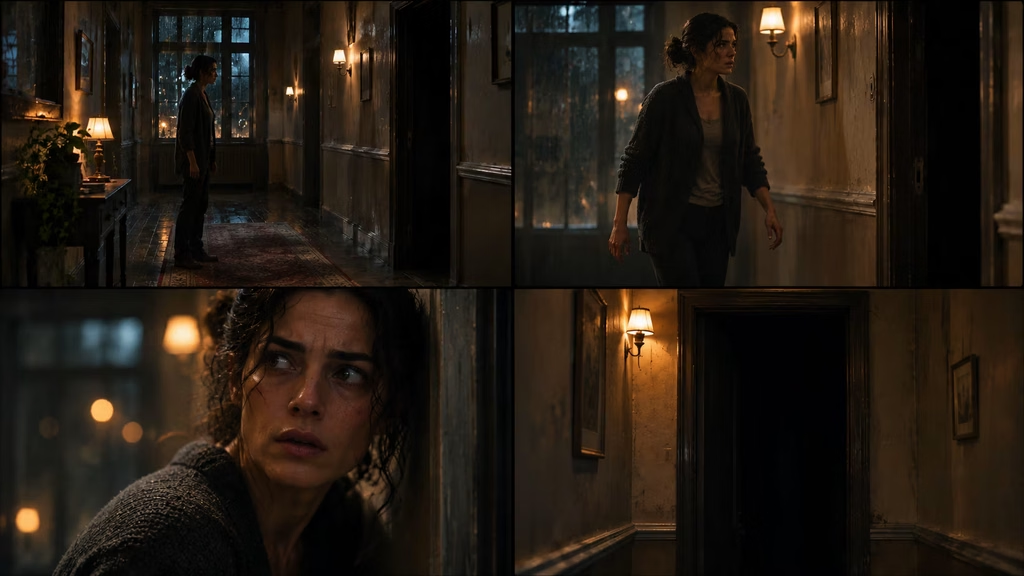
Write each sequence as a small unit: the character’s goal, the environmental fact, the disturbance, the choice, and the changed state at the end. Then generate the shots needed to cut that unit. A hallway scene may need an orienting wide shot, a medium shot of the character advancing, an insert of the changed lock, a reaction looking screen left, an empty hallway plate, and the eventual reveal. Repeating wardrobe, weather, time of day, lens feel, and screen direction makes the shots useful.
Prompt actions with a readable beginning and end. “A man enters the laundry room, hears a wet scrape, stops, and turns toward screen right” gives an editor a usable beat. “Terrifying supernatural terror in a haunted laundry room” may generate an arresting still, but it does not tell the system who is doing what or leave room for a cut.
Generate several reaction variations. Horror depends on small changes in recognition, disbelief, and decision. Ask for neutral listening, a delayed look, a contained attempt not to panic, and a look toward the correct side of frame. Hero images are rarely enough to build suspense.
Treat sound as part of the plan even if you generate visuals first. Decide where a sound begins offscreen, where it becomes identifiable, and where it stops. Build silence into the beat sheet. A sequence with clear visual geography and a specific sound cue will feel more coherent than a chain of close-ups labeled “scary.”
A practical revision pass
When revising a horror outline or cut, label every scene by function. Is it establishing normality, planting a rule, increasing reach, separating allies, revealing a cost, or forcing the final choice? A scene can do more than one job. If it does none, its atmosphere may not justify its place.
Check the information flow. What does the audience know at the start of each sequence? What does the protagonist know? What changes by the end? Tension lives in differences between those answers. If no knowledge changes and no choice narrows, the sequence may be repeating an earlier beat.
Then check escalation in concrete terms. Has the threat moved closer? Has the protagonist lost an option? Has the danger affected another relationship or location? If the only answer is that the images got darker or louder, find a story consequence.
Finally, read the ending against the beginning. The last choice should feel impossible for the person we met in the opening, yet believable for the person the story has forced them to become. That is the structure beneath the scares. Horror gives viewers a shape for dread, then asks them to wait inside it.
Related AeliaVision guides
– [Tension editing: how cuts create pressure, dread, and release](tension-editing-guide)
– [Silence guide: using absence of sound to create fear](silence-guide)
– [Scene rhythm guide: controlling attention across a sequence](scene-rhythm-guide)
– [Shot size guide: choosing wide shots, mediums, and close-ups](shot-size-guide)
– [Visual storytelling guide: building meaning through image and action](visual-storytelling-guide)
Continue reading
Further insights from the Journal


Have a story in mind?
Bring your next project into focus.
Tell us what you are creating and what you want the audience to feel.