The story in brief
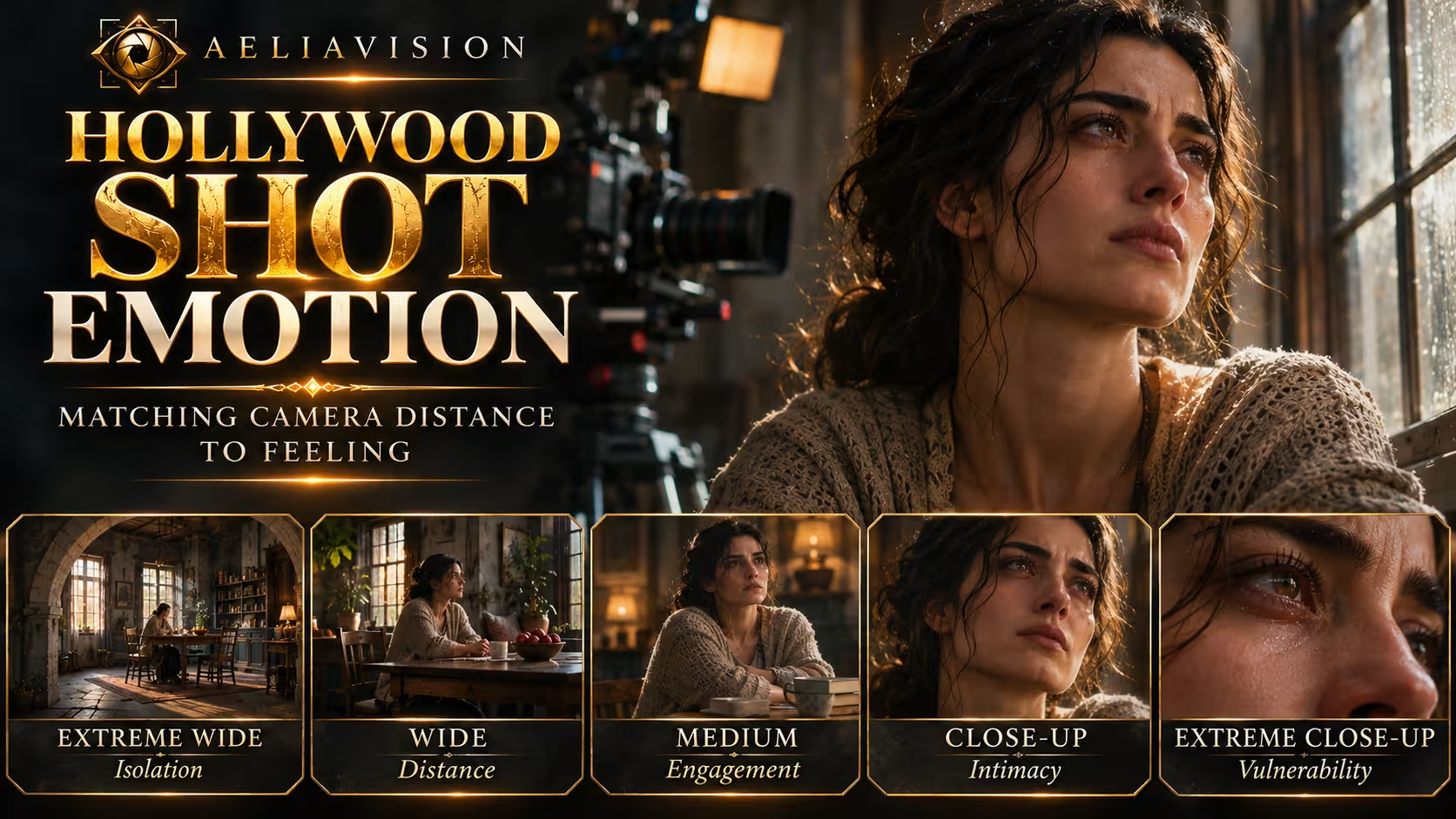
A shot does not contain emotion by itself. A close-up is not automatically intimate; a wide shot is not automatically lonely; a low angle is not automatically powerful. Actors, sound, editing, production design, and the scene around the image all matter. Still,…
Inside this story
A shot does not contain emotion by itself. A close-up is not automatically intimate; a wide shot is not automatically lonely; a low angle is not automatically powerful. Actors, sound, editing, production design, and the scene around the image all matter. Still, framing changes the terms of the encounter. It tells the audience where to stand, what distance to keep, how much of the world to notice, and whether a character appears in control of the frame or overwhelmed by it.
That is why Hollywood grammar survives changes in cameras, aspect ratios, and fashion. The labels are practical shorthand: extreme wide, wide, full, medium, close-up, extreme close-up, over-the-shoulder, two-shot, insert. None are rules. They are choices that put pressure on performance in different ways. A director can shoot the same line six times at six distances and create six different scenes in the edit.
This guide treats shot size and placement as emotional tools rather than a catalog of camera terms. The aim is to help you decide what the audience should feel before you reach for a lens, a move, or a reference still.
Start with distance, not with a shot name
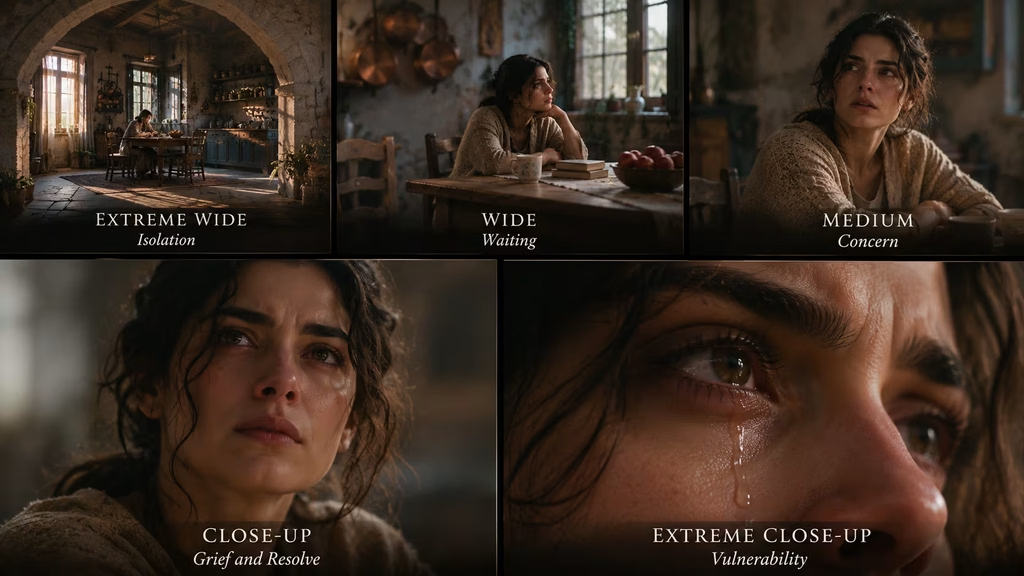
People read distance instinctively. When someone tells a painful story from across a room, we take in their posture, the empty chair beside them, the door they keep looking at. When we are inches from their face, the same story becomes harder to avoid. The audience has lost the option of looking elsewhere.
That physical logic gives shot size its emotional force.
– A distant frame lets the viewer observe a person in relation to a place. – A nearer frame makes facial behavior and breath part of the scene. – A very tight frame restricts context. The audience must search for meaning in a glance, a twitch, a held jaw, or the space around an eye.
There is no fixed map where medium equals neutral and close-up equals sad. A close-up can feel comic when it arrives at the wrong moment, threatening when it denies us context, romantic when it waits with a face, or suffocating when it traps a character after bad news. The useful question is more specific: how close should the viewer be allowed to get right now?
A second question matters just as much: who controls that distance? A camera that moves toward a character can feel like attention, desire, suspicion, or danger. A character stepping into a close-up may feel decisive. If the camera retreats while they stay still, the scene can suddenly admit that their victory is small against the world around them.
Hollywood coverage often gets criticized as mechanical because it cycles through a master shot, singles, and over-the-shoulders. The better version of that method is not mechanical at all. It gives the editor emotional options. The master protects geography. The medium shot keeps behavior readable. The close single catches the private cost of what was said. The trick is to make each setup earn its distance instead of treating every shot as insurance.
The extreme wide shot: a person against conditions
An extreme wide shot makes the environment active. The person may be tiny in a desert, swallowed by office towers, caught at the edge of a packed stadium, or barely visible in a cold suburban parking lot. The frame says that circumstances exist beyond the character’s reach.
This can produce loneliness, but loneliness is only one version of the effect. An extreme wide can also give relief. After a run of tight coverage, opening out to a shoreline or a city block lets the viewer breathe. It can make a reunion feel public and expansive, or make an action beat legible by showing the route, the danger, and the scale of a stunt.
The emotional variable is not simply the amount of background. It is the relationship between the subject and that background.
A lone figure placed low in an enormous frame often reads as vulnerable because the frame leaves so much unused territory above and around them. Put that same figure on a ridge, centered against the horizon, and the feeling can turn defiant. Make the background orderly, such as a grid of windows or a ceremonial hall, and the person may look judged by a system. Let them move through a messy crowd while the camera holds back, and the shot can make them seem lost or unnoticed.
Directors frequently use the extreme wide after an intimate scene, not before it. That order is important. We first understand what a character has lost, chosen, or realized. Then the cut reveals the large indifferent setting that remains. The emotional hit comes from the contrast. A wide image of a man standing by a car is merely descriptive until it follows the call where he learns he cannot go home.
For an AeliaVision prompt, name the geography and the imbalance. “A solitary detective seen from far across a rain-darkened transit terminal, small beneath departure boards and long fluorescent rows” gives the frame a reason to be wide. “Wide shot of a detective” does not.
What can go wrong with a very wide frame
The common mistake is using a distant shot to manufacture importance. Big locations do not automatically make a moment feel large. If the character’s body language cannot be read and the location does not tell us anything, the audience may simply wait for the movie to get closer.
Be careful with empty space too. Negative space needs direction. Is it a vacant half of the frame where someone should be? A stretch of corridor that might reveal a threat? A sky that makes a character look exposed? If the empty space has no narrative pressure, it looks accidental.
Wide shots also need enough time. A two-second establishing frame often functions as information only. To let a viewer feel isolation, awe, or dread, hold long enough for the eye to travel through the image. The exact duration depends on pace, but the point remains: an emotional wide has to be experienced, not flashed past.
The wide and full shot: the body tells the story
A standard wide or full shot keeps most or all of the body visible while preserving a strong sense of place. It is where movement becomes readable. A character can hesitate at a doorway, refuse to sit down, pace around a confession, cross a room without touching anyone, or take a swing. The audience sees choices expressed through distance and posture.
The full shot is especially useful for embarrassment. A close-up can show that someone is embarrassed, but a full shot lets us see the bad joke land in their entire body: shoulders fold, hands search for something to do, weight shifts backward, eyes find the exit. Comedy often needs this extra room. A pratfall requires geography; even a tiny social failure benefits from seeing who is watching and how exposed the person feels.
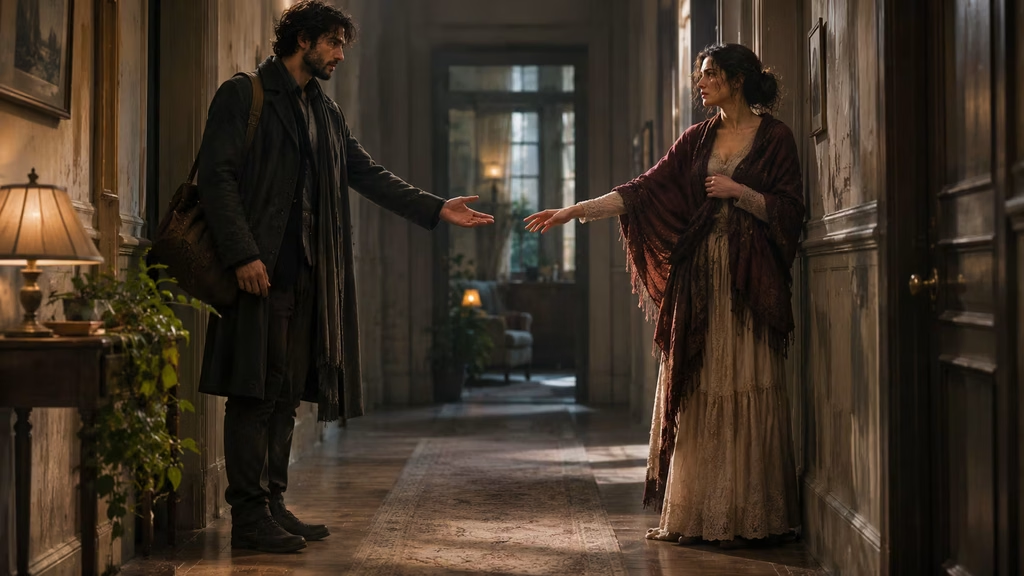
It also carries romance in a less obvious way. The first time two people occupy the same frame without touching, a full two-shot can show the charge in the gap between them. The distance is not an abstract emotional metaphor. It is measurable. One person leans in; the other remains still. A hand begins to move and stops. If you cut too close too soon, you lose the little negotiations that make the eventual touch matter.
Action directors lean on wider framings when they want the audience to respect physical cause and effect. A blow is clearer if we see the attacker, the target, and enough ground for a reaction. A chase gains urgency when we can track where the runner is headed. Close, shaky action can make impact feel chaotic, but it often sacrifices spatial clarity. The best choice depends on whether the scene wants us to feel the move or understand it.
Blocking inside a full frame
Treat the frame like a small stage, even if the camera moves. Horizontal separation usually feels conversational because people share a plane. Depth separation can feel more unstable. Put one character close to the lens and another deep in the room, and you give the foreground figure visual dominance while making the other seem remote, watched, or hard to reach.
Doorways, windows, and table edges can divide people without calling attention to themselves. A character standing behind a kitchen island may look defended. Two people on either side of a car can seem stuck in an argument they cannot leave. A person at the far end of a hallway can be both physically distant and emotionally withheld.
Do not make every composition symmetrical. Symmetry can make a relationship seem formal, mutually locked, or uneasy in a controlled way. A lopsided frame gives one person more visual weight. That may be useful when power has shifted, but it will distract if the scene is supposed to feel equal.
The medium shot: the pressure of conversation
The medium shot, often framed around the waist or chest, is Hollywood’s workhorse because it balances face, hands, and setting. It does not force a feeling as aggressively as a close-up. That flexibility is its strength. It can stay with a character through a difficult exchange without announcing that every word is a major emotional event.
Medium shots let people behave. They can pour a drink while avoiding an answer, handle a phone they are afraid to check, clean something that is already clean, or sit forward when they decide to lie. Hands matter in scenes of restraint. A clenched fist, fingers picking at a label, a palm held flat on a table: these details are often too small in a wide shot and too absent in a close-up.
A medium can feel safe, but it can also become oppressive if the scene stays there while information turns ugly. That mild pressure is useful. The audience remains near enough to read the consequences, yet the character still has nowhere to hide behind a face-filling image. We see the room, the other person, and the attempt to maintain ordinary behavior.
In a dialogue scene, medium singles usually create a more measured rhythm than close singles. They let pauses live. The speaker can look away. The listener can turn their body. A cut to a close-up should therefore mean something: a lie has reached its limit, an old wound has reopened, attraction has broken through, or the audience needs access to a thought the other character cannot see.
The medium two-shot and shared emotional space
A medium two-shot is one of the cleanest ways to show a relationship changing in real time. Early in a scene, two people may face each other evenly. As tension rises, one may turn away while remaining in frame. The other speaks toward their back. We do not need a cut to understand the imbalance.
For warmth, leave room for shared behavior. Let both characters react to the same object, talk over a meal, or lean into the same pool of light. For conflict, use a table, a counter, a windshield, or an unoccupied chair to break the middle of the image. The separation should arise from the room and action, not from decorative staging.
AeliaVision responds better when you describe the interpersonal geometry. Try: “Medium two-shot at a diner booth, sister facing brother but angled toward the exit, coffee between them untouched, late-afternoon light on the window.” That supplies the model with behavior, distance, objects, and tone without forcing it to imitate a specific film.
The close-up: access, pressure, and selective truth
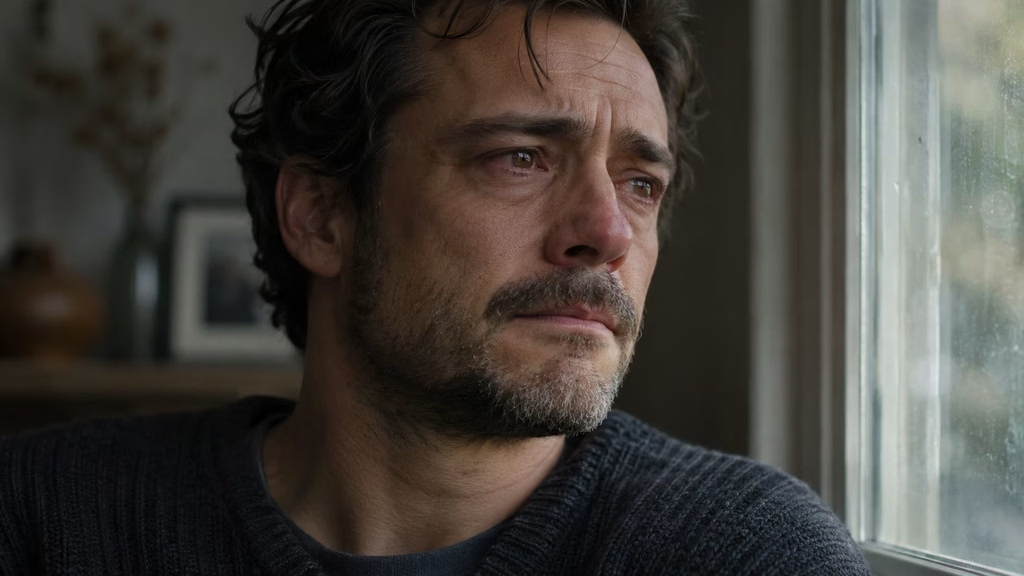
A close-up narrows attention to the face. It can feel intimate because the audience sees details people normally reserve for those standing nearby. It can feel invasive for the same reason. The frame has crossed a social boundary.
A useful close-up does not merely record an actor speaking. It arrives when the face contains information that dialogue cannot carry. Someone says “I’m fine,” then the close shot lets us notice that their eyes have stopped moving. Someone laughs, and the laugh fades before the camera cuts away. Someone hears a name and tries to recover before the person across from them notices.
The power of the close-up comes partly from what it excludes. By removing the room, it removes excuses. The character cannot hide in production design, activity, or a group. The viewer studies the smallest decision: whether to meet a gaze, whether to swallow a reaction, whether to cry. This is why close-ups often feel heavy after a wide or medium scene. The cut declares that the private moment is now the scene.
There are several emotional flavors of close-up:
- A centered, still close-up can feel direct and exposed. It asks the audience to sit with someone.
- A close-up with a character pushed to the edge of frame can feel precarious or distracted by an offscreen presence.
- A profile close-up preserves some privacy. We see emotion, but not as an open confession.
- A moving close-up that creeps nearer can create dread, desire, recognition, or the sense that a decision is closing in.
- A handheld close-up can make a moment unstable. Used sparingly, it puts the viewer inside a character’s loss of balance.
Close-ups can also withhold. If you stay on the listener instead of the person delivering a speech, the reaction may become more important than the words. This is a classic Hollywood choice because it lets the audience infer the unseen speaker’s power from the face receiving it. It is often more moving than coverage of the line itself.
Why close-ups lose force
When every line is shot tight, the frame stops feeling intimate. The audience adjusts to the distance, and the story loses a simple way to increase pressure. Constant close coverage can also flatten a scene because it cuts away hands, rooms, and the physical logic of who is dominating whom.
The answer is not to avoid close-ups. It is to stage a range of distances. Let a scene begin in a medium two-shot, separate the speakers into mediums when their objectives diverge, then move to a close-up when the audience must read a private reaction. Return to the two-shot only if the scene has genuinely changed the relationship.
Watch eyeline height as well. A close-up shot from slightly above can make someone look diminished, tired, or exposed. A slight low angle can give a person authority or make their grief feel stubborn rather than fragile. Do not overstate it. A few inches can be enough. Obvious high and low angles quickly turn into visual commentary, which may be right for a stylized scene but wrong for quiet drama.
The extreme close-up: when context becomes unbearable
An extreme close-up isolates a piece of a face or body: an eye, lips, a hand, a finger at a trigger, skin gathering around a mouth that is trying not to react. It has a strong effect because it denies normal perspective. We no longer see a whole person. We see evidence.
Use it when the story truly needs that concentration. In a thriller, an eye tracking movement offscreen may place the audience inside alertness. In a romance, a mouth almost touching another can make a pause feel electric. In grief, an extreme close-up of a hand gripping fabric may be less sentimental than a full face in tears. The shot asks us to notice a physical fact that has become emotionally loaded.
It can also create comedy through excess. A sudden extreme close-up of a character realizing an absurd mistake gives the reaction more weight than the event deserves. The joke lies in the disproportion.
Because the shot is so intense, sound becomes especially important. A loud breath, cloth rubbing under a tightening hand, a refrigerator hum, a silence after a sentence, all grow larger when the image has removed the rest of the room. This is an opportunity, but it can become mannered fast. If every emotional beat gets an eye close-up and a bass hit, the audience will see the machinery.
Think of an extreme close-up as punctuation, not a default sentence. It should interrupt the scene’s normal visual grammar. If the film has been patient and observational, one extreme close-up can feel startling. If the film already lives at that proximity, it will need another contrast to regain its force.
Angles change the social meaning of a shot
Shot size tells us distance. Camera angle tells us where the viewer stands in relation to a character. The distinction matters.
A high angle looks down. In a wide shot, it can show a character pinned within an environment. In a close-up, it may make them look younger, smaller, exhausted, or scrutinized. A high angle should not automatically signal weakness. A person may be physically below camera level while still controlling a room through their performance and the reactions around them.
A low angle can lend authority, but it can also create menace or false bravado. In a close shot, a low angle may make a person look as if they are holding back rage. In a wide shot, it can turn architecture into an ally or a threat. The difference lies in the setting: a low angle under a loved one’s face feels different from a low angle under a corporate tower.
An eye-level camera tends to feel least editorial. It can be intimate, matter-of-fact, or deliberately plain. That plainness is valuable. It lets performance do the work without making the camera announce judgment.
A canted frame, where the horizon tilts, makes instability visible. It has become so familiar in crime, horror, and comic-book language that it needs a reason beyond “the character is upset.” A slight tilt may work when the character’s sense of order has been disturbed. A steep angle needs a world with enough stylization to support it.
Point of view shots are a different kind of angle because they borrow a character’s eyes. They can produce closeness, but they also create responsibility. If we literally see what a character sees, the edit invites us to share attention with them. That is useful for attraction, pursuit, suspicion, and discovery. It can be uncomfortable when the character’s gaze is intrusive. The film should know which feeling it wants.
Over-the-shoulders: power in the foreground
The over-the-shoulder shot appears simple: one character’s shoulder or head holds the foreground while we look at the other person. Yet its emotional effect depends on how much foreground you keep and how you place it.
A generous shoulder, clearly present but not blocking the face, keeps both characters connected. It tells us they are sharing a real space. This can make a conversation feel intimate even when coverage alternates between singles.
A large, dark shoulder filling a third of frame can turn the foreground character into pressure. The speaker may look trapped, challenged, seduced, or watched. A barely visible shoulder creates a looser feeling and can make the reverse shot read more like a single. Directors can adjust this by inches.
Height matters too. If one person’s shoulder line looms higher in the frame than the other, the composition may imply an advantage. That advantage could be physical, emotional, or temporary. A seated character shot over the shoulder of someone standing may look cornered. Reverse the setup after a verbal shift, and the scene quietly changes sides.
Avoid cutting over-the-shoulders by habit. They are most useful when the relationship itself matters more than a private reaction. If a character finally tells the truth, a clean close single may let us see their risk. If the other person does not believe them, returning to an over-the-shoulder can make the shared space feel colder, because the listener now occupies the frame as an obstacle.
Two-shots: the emotional unit is the pair
A two-shot says the scene belongs to the relationship, not to either individual. It can show affection, rivalry, codependency, resentment, professional partnership, or the uncomfortable fact that two people have to inhabit the same moment.
The key is not merely having two faces onscreen. It is letting the frame record how they manage space. Sit characters close together with no barrier and they may look allied, unless their bodies angle away. Put them far apart in the same wide room and the shot may make their failure to connect visible. Place them on opposite sides of a table and the table becomes a negotiated border.
A locked two-shot is often stronger than fast reaction cutting when neither person can escape what the other has said. The audience watches silence pass between them. In a more volatile exchange, a moving two-shot can follow characters as they circle, pursue, or retreat. The movement needs to come from the scene’s behavior. A drifting camera that adds nothing can make emotional uncertainty look like a music video.
There is a reason romantic films return to two-shots near turning points. Love is not only a face reacting; it is the new possibility of shared space. The same is true of rupture. A couple can be in one frame but no longer connected by it. Sometimes the cruelest image is not a close-up of someone crying. It is a full two-shot after the fight, with both people visible and no one willing to cross the room.
Lens choice and emotional distance
Camera position determines perspective more than focal length does, but lens choice still changes how a shot feels because it influences where the camera can sit, how much background appears, and how space is rendered.
A wider lens used close to a face exaggerates the near features and keeps more environment in view. It can feel immediate, youthful, comic, raw, or aggressive. In a crowded room, it lets the camera stay physically close while the background remains alive. Push it too near without intent and it can distort a face in a way that distracts from performance.
A longer lens often requires the camera to move back. It compresses apparent depth and can separate a subject from the background with shallow focus. That distance can feel observational, romantic, secretive, or isolating. A character filmed through a long lens across a street may look watched. The same lens used in a quiet close-up can soften the world behind them and make the frame feel private.
Do not use lens language as a bag of automatic emotions. “Wide lens equals anxiety” and “long lens equals intimacy” are not reliable laws. Consider the entire setup: camera distance, blocking, focal length, depth of field, movement, and cut before and after. A 24mm lens from a foot away has different energy from a 24mm lens across a room. A 100mm close-up can feel tender or surveillant depending on whether the character knows the camera is there.
For image prompting, it is useful to specify a lens only when it supports the visual intent. “Handheld 28mm close to her face in a cramped elevator” tells AeliaVision why the shot should feel crowded. “85mm profile from across a restaurant, busy lights falling soft behind him” gives a sense of private observation. If lens numbers do not help your concept, use plain language about camera distance and perspective instead.
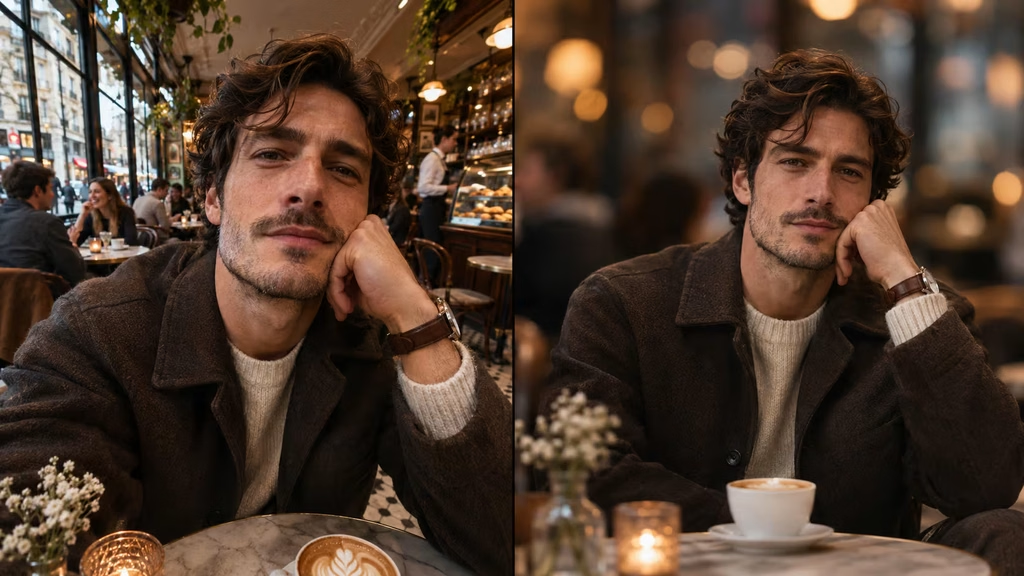
Movement can change the emotion inside the same shot size
A static close-up and a slow push-in are not emotionally interchangeable. The first can invite us to observe. The second tells us that attention is tightening. It may signal a realization, a threat, a confession, or a thought becoming impossible to ignore.
A push-in works best when something changes within the take. If the character begins the shot guarded and ends it exposed, the move follows the emotional arc
A push-in with no internal change becomes decorative. The audience notices the camera approaching and asks why.
A pull-back can have the opposite effect. It can reveal that a person is alone, restore the environment after an intimate moment, or make a victory look fragile.
A simple example: begin close on someone receiving good news, then pull back to show they are standing in a hospital corridor. The achievement remains, but the context complicates it.
Lateral movement often reads as companionship or pursuit. A camera tracking beside two friends can make their shared rhythm feel easy. Track beside an argument and it can trap them in motion, unable to stop long enough to resolve anything. A character walking while the camera stays locked off will feel different: they cross the frame and leave it, while the world remains indifferent.
Handheld work can bring useful instability, particularly when a scene is too immediate for polished composition. But handheld is not shorthand for realism.
A carefully controlled handheld camera can be more stylized than a tripod. Decide what kind of instability you need: a light human sway, a nervous searching frame, a frantic loss of orientation, or none at all.
Editing distance: emotional cuts need contrast
A shot receives part of its meaning from the previous shot. Cut from a wide of a family dinner to a close-up of one person and the viewer begins looking for what separates them from the group. Cut from an extreme close-up to a wide exterior and the viewer feels a release, a shock of scale, or a cruel reminder that the world has not paused.
This is why coverage plans should include deliberate contrasts. If every shot is medium, the edit has few levers. If you only shoot grand wides and intense close-ups, you may have no graceful way to move between them. Mediums and two-shots supply the connective tissue. They are where action continues and emotional pressure can build without declaring itself too early.
Reaction shots deserve special care. A reaction is not a blank insert after dialogue. It is a small scene. Decide what the person understands, what they hide, and how long they need before they answer. A close reaction may be right if the character cannot conceal their response. A wider reaction can be more painful if it lets us see them physically continue a routine while their face goes absent.
Hold shots past the obvious endpoint. The first beat after a line is often performative: a smile, a shrug, an answer prepared in advance. The real response may come two seconds later, once the character believes no one is watching. Editing that extra beat into a scene can make the work feel observant rather than explained.
A practical emotional shot plan
Before you list setups, write one sentence for each beat: what changes for the character, and when should the audience be allowed to notice it? Then choose coverage around that answer.
Imagine a daughter telling her father she is moving away.
Begin in a medium two-shot at the kitchen table. Both are present, and the room contains their shared history. Let the first part of the conversation play without cutting. When she says she has accepted the job, stay wide enough to see that he reaches for the salt instead of looking at her. The behavior is the reaction.
Move to a medium on him when he asks practical questions. He is trying to turn feeling into logistics. Give her a close-up only when she realizes he will not offer the blessing she expected. The close frame lets the audience see the hurt before she decides whether to show it.
When he finally says he is proud of her, do not rush to his close-up. An over-the-shoulder from behind her may keep the relationship in the image and let us see that he cannot quite meet her eyes. Then return to the two-shot. If they remain separated by the table, the scene has not tied itself into a neat bow. If one stands and crosses the space, the frame records the decision.
That plan uses familiar shot types, but each has a job. The feeling comes from the progression, not from any single label.
Prompts that preserve emotional intent
When you build a Hollywood-style still in AeliaVision, avoid stuffing the prompt with generic mood words such as “cinematic, emotional, dramatic, beautiful.” They do not explain what the camera sees. Give the model concrete evidence.
Useful prompt ingredients include:
- subject and immediate action
- shot size and camera position
- relationship to another person or environment
- lighting source and time of day
- emotional behavior rather than a label alone
- a few material details that support the world
For example, instead of writing “sad cinematic close-up of a woman,” write: “Close-up at eye level of a woman in a parked car at dusk, rain streaking the side window, one hand still on the ignition, listening to a voicemail she cannot bring herself to delete.” The sadness is built from behavior and context.
Instead of “epic lonely wide shot,” write: “Extreme wide from a high ridge, a teenage boy in a red jacket standing alone beside a stalled school bus on a snow-covered road, pale morning light, mountains swallowing the horizon.” The scale and the visible problem do the work.
If the image needs to support a scene sequence, keep continuity anchors stable. Repeat wardrobe, location, time of day, and a defining prop. Then change only what the emotional beat requires: shot distance, posture, eye line, or the space between characters. This is more reliable than asking for five unrelated “emotional movie shots” and trying to edit meaning into them afterward.
A final check before you shoot or generate
Ask four plain questions.
1. What information should the audience have at this moment, and what should remain offscreen? 2. How close should the audience feel to the character: across the room, beside them, or uncomfortably near? 3. Does the frame show the relationship, the environment, or the private reaction that matters most? 4. What changes in the next shot that this shot cannot express on its own?
If you can answer those questions, you probably know the right direction even if you do not know the textbook name for the setup. Shot vocabulary helps crews communicate. Emotional intention is what keeps the vocabulary from becoming a checklist.
Hollywood shots work when the audience forgets they are being guided. A wide frame lets us sense a person under pressure from the world. A medium gives us the negotiations of the body. A close-up allows us to see what the character cannot say. Put those distances in the right order and a familiar scene can gain tension, tenderness, dread, or release without anyone explaining the feeling out loud.
Continue reading
Further insights from the Journal

Have a story in mind?
Bring your next project into focus.
Tell us what you are creating and what you want the audience to feel.